|
What to see in Atri
|
Atri, an
Abruzzo town, is very much loved by visitors who
have rediscovered it in recent years, so to speak.
Atri is a small medieval pearl, a town of art of
very ancient origin, looking out over the sea from
above, protected behind Gran Sasso. Its
location is ideal as it is only 10 km from clean
beaches and 30 km from the mountains. There are
several things to visit if you have the opportunity
to come here. Among these are: the historic center,
the Cathedral of Santa Maria Assunta, the Palazzo
Acquaviva, the Palazzo Mambelli, the Bishop's Palace
and the Seminary, the Municipal Theatre and on a
naturalistic level, the Calanchi di Atri, small
canyons really suggestive. |
|
Historical center
It is in the centre of the town that the charm of its long
history continues to exert its evocative force: monuments and
historical palaces, fortifications, churches, museums,
suggestive views, these are the many pieces of a splendid
historical and architectural mosaic. Take a stroll through the
medieval alleys and churches, then relax with a good red wine
from the area in an outdoor bar.
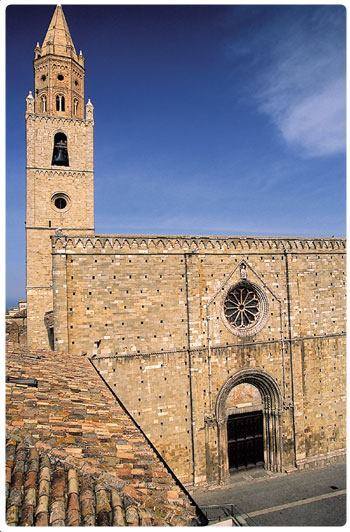
Cathedral of Santa Maria Assunta
In the heart of the city, in Piazza Duomo, the Cathedral of
Santa Maria Assunta, dating back to 1285 and recently restored,
has been standing out for centuries. Its four 13th century
portals are of remarkable craftsmanship, while the inside with
three naves has a square apse with a wonderful cycle of frescoes
by the 15th century Abruzzo artist Andrea Delitio. The
annexed Cathedral Museum preserves precious relics: painted
majolica, crosses and pastoral works of ivory and silver,
illuminated codices, statues and hundreds of fragments and
mosaics from the most ancient buildings. The two orders cloister
and the bell tower, which was completed in the fifteenth century
by Antonio da Lodi, are also splendid.
Palazzo Acquaviva
Palace
The Acquaviva Palace, also known as the ducal palace, was
built by Count Antonio Acquaviva in 1395 on the basis of
pre-existing Roman buildings and until 1760 was the residence of
the Acquaviva d' Aragona family, dukes of Atri. Since 1917, the
Town Hall has been housed there. Known for its characteristic
medieval tower, it gives its name to the square in front of it
(Piazza Acquaviva). Giulio Antonio Acquaviva distinguished
himself in the battle of Otranto in 1480 against the Turks,
earning the Acquaviva family the prestigious name of "d'
Aragona".
The facade of the palace is made of massive travertine stones,
from which the tower rises. In 1707 it was sacked by the
Austrians of Charles III, who destroyed the frescoes and stole
the precious paintings of Titian and Veronese. In
the inner courtyard, theatre of numerous summer events, the well
stands out, which communicates with a pre-existing Roman cistern,
the former stables and the bust of Beato Rodolfo D'Acquaviva
d' Aragona (Atri, 1550? Coculin, 1583), Jesuit and martyr in
India, who used to pray in the nearby chapel of San Liberatore.
On the back of the palace there is a beautiful garden. Today,
the Palazzo dei Duchi D' Acquaviva houses the Town Hall of Atri,
the Faculty of Sport and Sports Management (headquarters of the
University of Teramo) and the headquarters of the
Calanchi di Atri
Nature Reserve.
Mambelli Palace
Also in Piazza Duomo you will find Palazzo Mambelli. This
palace dates back to the mid-eighteenth century, although it has
undergone alterations over time. The beautiful portico is still
the old building. Palazzo Mambelli houses works by the sculptor
Francesco Paolo Evangelista.
Episcopal Palace and
Seminary
The Bishop's Palace, in front of the southern flank of
the Cathedral, was erected in the second half of the sixteenth
century by Bishop Paolo Odescalchi, coming from a wealthy
family of Como and it is for this reason that its coat of arms
is located above the entrance door. On the right is the former
seminary, built to observe the decree of the Council of Trent.
Atri was one of the first dioceses to establish the seminary,
even if it was not before ever. In the past, the palace was
joined to the monumental complex of the Duomo by an arch that
reinforced the statics between the two buildings and offered a
barrier to the cold winds and then demolished. It was used by
the Bishop to arrive in the Cathedral from the inside when there
were weather conditions or the possibility of attacks.
Municipal Theatre
Also in Piazza del Duomo, perfectly preserved is the
nineteenth-century Municipal Theatre (opened on January
25,1881), also known as the "wedding favors" for its size (300
seats) and the enviable acoustics. The outside is the Teatro
della Scala in Milan, while the inside seems to be
reminiscent of the "San Carlo" in Naples, with its three tiers
of stages and the gallery. The stages feature hand-carved wooden
inlays carved by Raffaele Del Bello and Gerardo Gerardini,
painted by Pietro Giovanetti and then decorated by Giuseppe
Manaresi. The initial project included a large atrium with
coffee to testify to the desire to make the theatre an element
of the urban fabric. The theatre has been fundamental in local
social life, hosting several exceptional events such as Verdi's
Rigoletto performance in 1886, Bizet's Carmen premiere in 1887
and Atri's Great Musical Band debut in 1948. Throughout his
life, the theatre has seen everything: prose, lyrics, concerts,
school essays, Carnival banners, end-of-year celebrations,
elections, farewell parties, commemorations of the warfalls that
almost always took place in the foyer, a large hall located
above the atrium for cultural purposes and illuminated by three
large windows. In 1944, the theatre was a dormitory for English
troops. From 1939 to 1948 it was transformed into a cinematic
theatre, experiencing a period of degradation.
The
Calanques of Atri
Between art and nature, the landscape of the hills of Atri is
fascinating for the spectacular presence of the Calanchi,
real "natural sculptures" born from the millenary erosion of
clay soil. It's a sort of canyon really impressive. The panorama
takes on the tones and colours of Dante's "bolgia", the scenery
seems almost "lunar" shaped by these extraordinary geological
formations. The gullies originated as a result of the erosion of
clay soil caused by past deforestation and favoured by the
continuous desiccation and runoff, which make many marine
fossils visible. Although it is a rather recurrent phenomenon in
the Adriatic landscape only here the gullies are spectacular and
reach considerable dimensions. The area is Regional Nature
Reserve and WWF Oasis. The interior of the protected area is
characterized by a very varied environment: cliffs, ponds, small
woods, cultivated fields alternate continuously, forming a
palette of changing colors. Finally, the mystery surrounding the
so-called "Stone of St. Paul", the taumaturgic monolith
preserved in a small chapel that legend has it that is the stone
on which Paolo di Tarso was beheaded in 67 A. D., also
contributes to the charm of the places.
For a restorative stopover, see the page dedicated to
restaurants in Atri.
To understand how to reach the city, read
How to get to Atri.
Copyright © Informagiovani-italia. com. Reproduction in whole
or in part, in any form, on any medium and by any means is prohibited
without written permission.
If you liked this guide and would like to help Informagiovani-italia. com
help us spread it.
Back Up
Ostelli Italia
Auberges de Jeunesse Italie
Carte Atri
Karte von Atri
Mapa Atri
Map of Atri
Carte Abruzzes Karte von Abruzzen Mapa Abruzos Map of Abruzzi
Carte d'Italie
Karte von Italien Mapa Italia Map of Italy
イタリア の地図 |