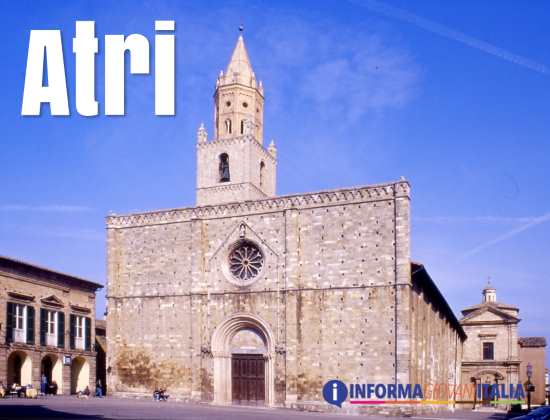
|
VISITING
ATRI: INFORMATION AND SMALL GUIDE
|
Atri, with
its maze of narrow streets with an ancient medieval
appearance, which follow the model of the Roman
city, lying on a hill at an altitude of about 450 m,
the ancient Hatria was an important pre-Roman
city of Piceno, a historical-geographical region of
central Italy overlooking the Adriatic Sea and
roughly corresponding to the current provinces of
Ascoli Piceno and Teramo.
|
|
 There
is a hypothesis that Emperor Hadrian was born here in
Hatria and not in Italy (near
Seville). Certainly the family of the future emperor
was originally from this city. Developed in Roman times as a
shopping centre where the ancient streets Cecilia and Valeria
were headed, Atri was erected as a bishop's seat by Innocent IV
in 1252, about thirty years after the consecration of its
grandiose cathedral, one of the major religious monuments of
Abruzzo. Atri is one of the oldest cities of art in the region,
and is located in the tourist area of Terre del Cerrano,
the so-called "Costa Giardino". We are in the province of Teramo
(which is about 25 km away) and a little less than 200 km from
Rome and the sea is only a few minutes away. There
is a hypothesis that Emperor Hadrian was born here in
Hatria and not in Italy (near
Seville). Certainly the family of the future emperor
was originally from this city. Developed in Roman times as a
shopping centre where the ancient streets Cecilia and Valeria
were headed, Atri was erected as a bishop's seat by Innocent IV
in 1252, about thirty years after the consecration of its
grandiose cathedral, one of the major religious monuments of
Abruzzo. Atri is one of the oldest cities of art in the region,
and is located in the tourist area of Terre del Cerrano,
the so-called "Costa Giardino". We are in the province of Teramo
(which is about 25 km away) and a little less than 200 km from
Rome and the sea is only a few minutes away.
If art is one of the reasons why you have visited this city, you
won't be disappointed as Atri is one of the places with the most
museums in the region.
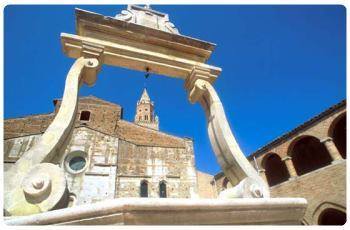 The
majestic building of the Church of Santa Maria Assunta was completed
at the beginning of the fourteenth century. It rises on the remains of a
church dating back to the 9th century, in turn founded on the ruins of a
Roman spa complex, still partly visible in the square in front of it, which
also included the mosaics that appear in the floor of the presbytery.
Entirely built in Bisenti stone (pietra di Bisenti), a material
responsible for its particular golden veining, the church is announced by a
severe Romanesque facade. The façade opens up a beautiful portal, designed
by the founder of the local school, Rainaldo d'Atri, surmounted by a
large rose window and a niche in which there is a madonna with the child. The
majestic building of the Church of Santa Maria Assunta was completed
at the beginning of the fourteenth century. It rises on the remains of a
church dating back to the 9th century, in turn founded on the ruins of a
Roman spa complex, still partly visible in the square in front of it, which
also included the mosaics that appear in the floor of the presbytery.
Entirely built in Bisenti stone (pietra di Bisenti), a material
responsible for its particular golden veining, the church is announced by a
severe Romanesque facade. The façade opens up a beautiful portal, designed
by the founder of the local school, Rainaldo d'Atri, surmounted by a
large rose window and a niche in which there is a madonna with the child.
 The
portals, whose refined workmanship will be imposed as models for the whole
of the 300 Abruzzo region, are the leitmotiv also of the right side, to
which Rainaldo and Raimondo of Poggio worked between 1288 and 1305.
The interior, of unexpected Gothic style, houses in the choir the most
important Renaissance pictorial document of the region, a precious cycle of
frescoes by Andrea De Litio (in the photo) about 1481, whose
imaginative and naturalistic language, of late Gothic inspiration (he
collaborated with Beato Angelico,
Piero della Francesca and
Domenico Veneziano in
Florence, among
others), reveals clear references to the flower lesson. The
portals, whose refined workmanship will be imposed as models for the whole
of the 300 Abruzzo region, are the leitmotiv also of the right side, to
which Rainaldo and Raimondo of Poggio worked between 1288 and 1305.
The interior, of unexpected Gothic style, houses in the choir the most
important Renaissance pictorial document of the region, a precious cycle of
frescoes by Andrea De Litio (in the photo) about 1481, whose
imaginative and naturalistic language, of late Gothic inspiration (he
collaborated with Beato Angelico,
Piero della Francesca and
Domenico Veneziano in
Florence, among
others), reveals clear references to the flower lesson.
 Interesting
example of civil building, the fourteenth-century Palazzo
Acquaviva, a short distance from the cathedral, reachable
from Piazza del Duomo following the main street of the
city. The church of Sant' Agostino is beautiful, with the portal
of Matteo da Napoli from 1420, which merges motifs of the
flowering Gothic style under the influence of the early
Neapolitan Renaissance. The palace shows an eighteenth-century
façade in Renaissance style, while the memory of the original
features is entrusted to the porch of the inner courtyard. The
visit of Atri is completed by the Church of San Domenico,
of fourteenth-century origin but reworked several times, with a
portal dating back to around 1330 that echoes those of Rainaldo. Interesting
example of civil building, the fourteenth-century Palazzo
Acquaviva, a short distance from the cathedral, reachable
from Piazza del Duomo following the main street of the
city. The church of Sant' Agostino is beautiful, with the portal
of Matteo da Napoli from 1420, which merges motifs of the
flowering Gothic style under the influence of the early
Neapolitan Renaissance. The palace shows an eighteenth-century
façade in Renaissance style, while the memory of the original
features is entrusted to the porch of the inner courtyard. The
visit of Atri is completed by the Church of San Domenico,
of fourteenth-century origin but reworked several times, with a
portal dating back to around 1330 that echoes those of Rainaldo.
There are several things to visit if you have the opportunity to
come here, we point out the page
What to see in
Atri where you will find details about the
attractions of the town. We also recommend a stop for lunch or
dinner in these areas, on this page you will find tips on local
dishes and restaurants
where to eat well in
Atri. Try the cuisine of local holiday
farms!
 Local festivals and traditions have ancient origins and are very much felt.
In addition to religious festivals, we remember the Feast of Santa Reparata
on the first Sunday after Easter. In August there is the Pesto Casolano
festival, the Atri a Tavola (12/13 August), the Festival of flavours of
Abruzzo (12/15) the Festival of Pecorino and Arrosticini. During the days of
August, the ancient Atrian traditions are celebrated. The festival
lasts for a few days and culminates on August 15 with the opening of the
cathedral's Holy Door and the parade of floats drawn by white oxen. The
floats are decorated with festive decorations and carry storytellers and
musicians who evoke the country festivals. Renowned the "Fire of the
Faugni", high bundles of reeds that at dawn on December 8th are carried
in procession through the streets of the center, with the accompaniment of
the band. The city comes alive at a party, all the clubs remain open and so
many people on the streets enjoy this special atmosphere. Local festivals and traditions have ancient origins and are very much felt.
In addition to religious festivals, we remember the Feast of Santa Reparata
on the first Sunday after Easter. In August there is the Pesto Casolano
festival, the Atri a Tavola (12/13 August), the Festival of flavours of
Abruzzo (12/15) the Festival of Pecorino and Arrosticini. During the days of
August, the ancient Atrian traditions are celebrated. The festival
lasts for a few days and culminates on August 15 with the opening of the
cathedral's Holy Door and the parade of floats drawn by white oxen. The
floats are decorated with festive decorations and carry storytellers and
musicians who evoke the country festivals. Renowned the "Fire of the
Faugni", high bundles of reeds that at dawn on December 8th are carried
in procession through the streets of the center, with the accompaniment of
the band. The city comes alive at a party, all the clubs remain open and so
many people on the streets enjoy this special atmosphere.
Atri can be reached by car, train and bus; the nearest airport is Pescara,
see
how to get to Atri.
Copyright © Informagiovani-italia. com. Reproduction in whole
or in part, in any form, on any medium and by any means is prohibited
without written permission.
If you liked this guide and would like to help Informagiovani-italia. com
help us spread it.
Where is
it located?
Back Up
Ostelli Italia
Hotel a Atri
Ostelli a Atri
Carte Atri
Karte von Atri
Mapa Atri
Map of Atri
Carte
Abruzzes Karte
von Abruzzen
Mapa Abruzos Map of Abruzzi
Carte d'Italie
Karte von Italien
Mapa Italia Map of Italy
イタリア ??地図 |