|
VISITARE LIVORNO INFORMAZIONI E GUIDA
|
L ooking at
Livorno from Montenero is as if you
knew the whole city. First the green hills full of
vineyards, then gradually the houses, palaces,
churches, boats and the sea, calm and intense, the
Tyrrhenian Sea ... and then again the
mountains, the Apuan Alps, which look at them
from afar seem blue and blend with the sea and the
sky, if not for their summit that always seems
snowy. |
|
 The
gaze wanders for miles and miles, goes up to
Versilia,
or down to Piombino and Maremma. In the middle are the smells
of the sea, the colours of the boats and the thoughts that would like to go
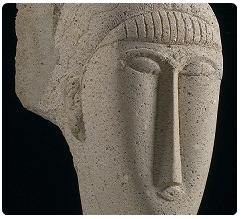
far, towards the more open Mediterranean. Livorno is a bit like those heads
sculpted and drawn by the famous artist
Modigliani
(Leghornese doc), elegant and simple as the earth, linear like the model who
lent herself to his art (the French Jeanne Hébuterne) and free to let
imagine what they think and want. A bit like the people of Livorno, who have
been open to the rest of the world since ancient history, offering
themselves to trade, culture and commercial development. The
gaze wanders for miles and miles, goes up to
Versilia,
or down to Piombino and Maremma. In the middle are the smells
of the sea, the colours of the boats and the thoughts that would like to go
far, towards the more open Mediterranean. Livorno is a bit like those heads
sculpted and drawn by the famous artist
Modigliani
(Leghornese doc), elegant and simple as the earth, linear like the model who
lent herself to his art (the French Jeanne Hébuterne) and free to let
imagine what they think and want. A bit like the people of Livorno, who have
been open to the rest of the world since ancient history, offering
themselves to trade, culture and commercial development.
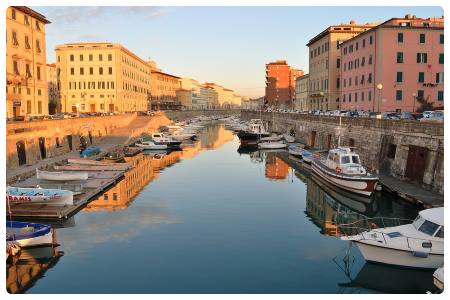 Between
canals, squares and lively spirit Livorno is also known as a 'little
Venice', or better since it was never so small, a New
Venice. From the bridges of the canals and from the terraces
on the sea you can see one of the major events of the city,
called 'Effetto Venezia', a summer festival that every
year floods the oldest districts, those around the 'Fossi
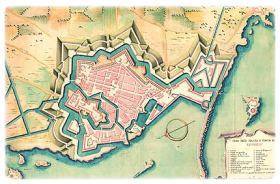
Medicei', namely the royal ditch that once marked the
perimeter of Renaissance Livorno, fortified by walls and
ramparts. Knowing the history of Livorno is in fact like taking
a trip into the history of the de' Medici family, who
wanted to create a sort of 'ideal city' here, strongly desired
by Francesco I de' Medici and later also realized by his
successor, Ferdinando I de' Medici, behind the project of
Bernardo Buontalenti, one of the most influential
architects and artists of the Italian Renaissance. Between
canals, squares and lively spirit Livorno is also known as a 'little
Venice', or better since it was never so small, a New
Venice. From the bridges of the canals and from the terraces
on the sea you can see one of the major events of the city,
called 'Effetto Venezia', a summer festival that every
year floods the oldest districts, those around the 'Fossi
Medicei', namely the royal ditch that once marked the
perimeter of Renaissance Livorno, fortified by walls and
ramparts. Knowing the history of Livorno is in fact like taking
a trip into the history of the de' Medici family, who
wanted to create a sort of 'ideal city' here, strongly desired
by Francesco I de' Medici and later also realized by his
successor, Ferdinando I de' Medici, behind the project of
Bernardo Buontalenti, one of the most influential
architects and artists of the Italian Renaissance.
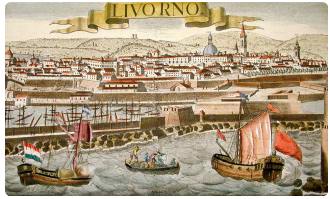
 After
the nearby Republic of Pisa and after the city passed from the
Milanese and Genoese to the lords of
Florence,
Livorno began to move towards a surprising development, first with its port
and then through the establishment of a civil society at the forefront. On
the basis of all this there were the so-called Livornine Laws, issued
by Ferdinand I, in order to establish a free port for Livorno,
increase the number of inhabitants for the cities of Livorno and Pisa,
ensure freedom of worship, religious practice, political and civil: After
the nearby Republic of Pisa and after the city passed from the
Milanese and Genoese to the lords of
Florence,
Livorno began to move towards a surprising development, first with its port
and then through the establishment of a civil society at the forefront. On
the basis of all this there were the so-called Livornine Laws, issued
by Ferdinand I, in order to establish a free port for Livorno,
increase the number of inhabitants for the cities of Livorno and Pisa,
ensure freedom of worship, religious practice, political and civil:
 "the
Serene Grand Duke ... to all of you merchants of any nation, Levantines,
Polnentini, Spagnuoli, Portughesi, Greeks, Germans, Italians, Jews, Turks,
Moors, Armenians, Persians, telling each of them health ... for his desire
to increase the spirit of strangers to come and attend their traffic,
merchantie in his beloved city of Pisa and Porto and Livorno port of call
with habitués, hoping habbia to be useful to the whole of Italy, our
subjects and maxims to the poor ... ". June 10, 1593 Constitution
Livornina. "the
Serene Grand Duke ... to all of you merchants of any nation, Levantines,
Polnentini, Spagnuoli, Portughesi, Greeks, Germans, Italians, Jews, Turks,
Moors, Armenians, Persians, telling each of them health ... for his desire
to increase the spirit of strangers to come and attend their traffic,
merchantie in his beloved city of Pisa and Porto and Livorno port of call
with habitués, hoping habbia to be useful to the whole of Italy, our
subjects and maxims to the poor ... ". June 10, 1593 Constitution
Livornina.
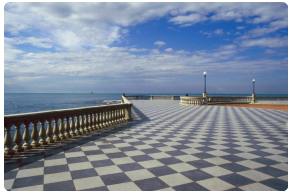 And
it is perhaps in these lines that you can read the whole character of
Livorno. We are even more convinced to look at the sea from the Terrazza
Mascagni, from where we seem to see boats full of laborious traders,
such as those who came from Spain and Portugal, driven away as
Jews. The numerous Jewish Community of Livorno was never
locked up in a ghetto, but free to build a new future for itself and for the
city. And
it is perhaps in these lines that you can read the whole character of
Livorno. We are even more convinced to look at the sea from the Terrazza
Mascagni, from where we seem to see boats full of laborious traders,
such as those who came from Spain and Portugal, driven away as
Jews. The numerous Jewish Community of Livorno was never
locked up in a ghetto, but free to build a new future for itself and for the
city.
 The
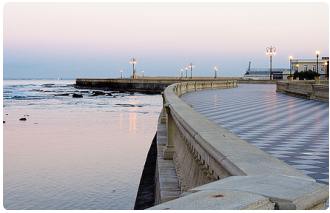
promenade of Livorno winds along a picturesque route of several
kilometers and as its most beautiful and elegant terrace, the Terrace
Mascagni is precisely the meeting place of Leghorn, tourists and cadets of
the historic Naval Academy of Livorno. It starts from the coastal
stretch of Romito and arrives up to Antignano and then down to
the port area. The
promenade of Livorno winds along a picturesque route of several
kilometers and as its most beautiful and elegant terrace, the Terrace
Mascagni is precisely the meeting place of Leghorn, tourists and cadets of
the historic Naval Academy of Livorno. It starts from the coastal
stretch of Romito and arrives up to Antignano and then down to
the port area.
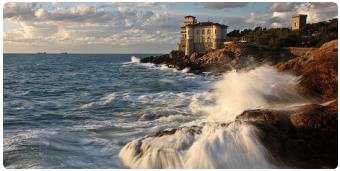
 The
walk takes you back to some of the most interesting places in the city, as
well as the historic bathing establishments of Livorno: from the
Castle of Sonnino, along the coast overlooking the sea (so called
because it was once inhabited by Baron Sidney Sonnino, Italian Prime
Minister since 1909 for a year) and the beautiful Church of San Jacopo di
Acquaviva, which overlooks the water and seems to have its origin in the
fourth century AD, we reach the walk between the Rotonda d'Ardenza
and the nineteenth-century Hotel Palazzo (1884), which already in
1904 was defined by some travel guides (Album Livorno and Surroundings) as
"one of the most beautiful in the world. The building is located behind the
characteristic gazebo of the terrace, in front of the bathing establishments
of the Bagni Palmieri (today Acquaviva), so delicately
immortalized by Giovanni Fattori in his 'La rotonda dei bagni
Palmieri' (Oil on board, 1866, Galleria d'Arte Moderna, Florence). The
walk takes you back to some of the most interesting places in the city, as
well as the historic bathing establishments of Livorno: from the
Castle of Sonnino, along the coast overlooking the sea (so called
because it was once inhabited by Baron Sidney Sonnino, Italian Prime
Minister since 1909 for a year) and the beautiful Church of San Jacopo di
Acquaviva, which overlooks the water and seems to have its origin in the
fourth century AD, we reach the walk between the Rotonda d'Ardenza
and the nineteenth-century Hotel Palazzo (1884), which already in
1904 was defined by some travel guides (Album Livorno and Surroundings) as
"one of the most beautiful in the world. The building is located behind the
characteristic gazebo of the terrace, in front of the bathing establishments
of the Bagni Palmieri (today Acquaviva), so delicately
immortalized by Giovanni Fattori in his 'La rotonda dei bagni
Palmieri' (Oil on board, 1866, Galleria d'Arte Moderna, Florence).
 The
promenade of the seafront is also enriched by the historic
Aquarium of Livorno Diacinto Cestoni, located on the
square Razzauti, on the edge of the terrace, and dedicated
to the famous Italian naturalist who lived between the
seventeenth and eighteenth centuries. The structure, originally
founded in 1937, has been extensively renovated over time since
the war, and reopened in July 2010. Together with the
Acquario di Genova and the Acquario di Cattolica, it
is the largest aquarium in Italy in terms of size. The
promenade of the seafront is also enriched by the historic
Aquarium of Livorno Diacinto Cestoni, located on the
square Razzauti, on the edge of the terrace, and dedicated
to the famous Italian naturalist who lived between the
seventeenth and eighteenth centuries. The structure, originally
founded in 1937, has been extensively renovated over time since
the war, and reopened in July 2010. Together with the
Acquario di Genova and the Acquario di Cattolica, it
is the largest aquarium in Italy in terms of size.
From the seafront to the centre of the Medicean city, the step is short. The
canal is filled to the east by a large area called Voltone and better
known today as Piazza della Repubblica, which covers well over 19,000
square meters. We recognize it for the beautiful neoclassical monument
dedicated to Ferdinand III, Grand Duke of Hapsburg-Lorraine and
elector of the
Holy Roman Empire, who ruled the city as Grand Duke of Tuscany
during the Restoration. To the north we arrive at the so-called
New Fortress, which today is home to a beautiful public park and was
born in the Renaissance period designed by Buontalenti (it was in fact the
ancient bulwark of St. Francis and is so named to distinguish it from
the Old Fortress of Livorno (Fortezza Vecchia), now known as Old
Dockyard and located on the edge of the Medici Port).
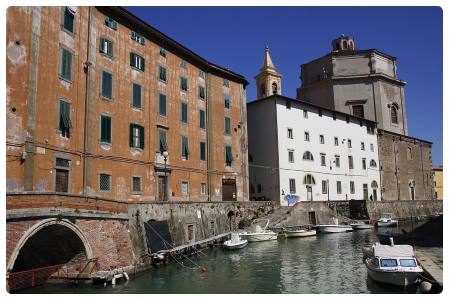
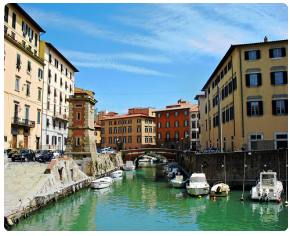
 At
its side there is one of the most beautiful districts of the city, what we
initially called New Venice: we like it for its ancient character,
the waters of the moat, the small boats on the piers, the old buildings and
churches. Among these you can visit the ancient warehouses of oil, called
Bottini, now part of the exhibition circuit of the Labronica Library
(the latter is housed in a beautiful nineteenth-century building, Villa
Fabbricotti, in Viale della Libertà). The most important element of the
entire district is also the Church of Santa Caterina (1720-1753),
characterized by a unique dome and frescoes by Cesare Maffei,
Giuseppe Maria Terreni and several others. Inside there are also the
relics of Santa Vigilia (Chapel of the Madonna di Montenero) brought
here from Cagliari in the seventeenth century. At
its side there is one of the most beautiful districts of the city, what we
initially called New Venice: we like it for its ancient character,
the waters of the moat, the small boats on the piers, the old buildings and
churches. Among these you can visit the ancient warehouses of oil, called
Bottini, now part of the exhibition circuit of the Labronica Library
(the latter is housed in a beautiful nineteenth-century building, Villa
Fabbricotti, in Viale della Libertà). The most important element of the
entire district is also the Church of Santa Caterina (1720-1753),
characterized by a unique dome and frescoes by Cesare Maffei,
Giuseppe Maria Terreni and several others. Inside there are also the
relics of Santa Vigilia (Chapel of the Madonna di Montenero) brought
here from Cagliari in the seventeenth century.
 To
the west of Piazza Repubblica, Via Grande leads to Via Madonna,
which in turn is characterized by the three Baroque facades of the
buildings. We are on Piazza Grande, in our opinion one of the most
beautiful squares in Italy (if it had remained completely pedestrian as in
the early twentieth century) and taken as an example by the English urbanist
Inigo Jones in the construction of one of the most famous squares in
London, Covent Garden. Since 1587, the central side of the
square has been home to the Cathedral of Livorno, which was almost
entirely rebuilt after the bombing of the Second World War. You can also
visit the Palazzo del Municipio (Town Hall, 1720), recognizable by
the beautiful double staircase outside, and the Grand Duke's Palace
of the seventeenth century. To
the west of Piazza Repubblica, Via Grande leads to Via Madonna,
which in turn is characterized by the three Baroque facades of the
buildings. We are on Piazza Grande, in our opinion one of the most
beautiful squares in Italy (if it had remained completely pedestrian as in
the early twentieth century) and taken as an example by the English urbanist
Inigo Jones in the construction of one of the most famous squares in
London, Covent Garden. Since 1587, the central side of the
square has been home to the Cathedral of Livorno, which was almost
entirely rebuilt after the bombing of the Second World War. You can also
visit the Palazzo del Municipio (Town Hall, 1720), recognizable by
the beautiful double staircase outside, and the Grand Duke's Palace
of the seventeenth century.
 The
monuments and tourist attractions in Livorno are numerous and all
very interesting. Livorno is in fact a city not only to visit but also to
live. Among the museums of Livorno, libraries, ancient historical
sites, cinemas and theaters, the many films shot in the city, you will have
the opportunity to enjoy the city. Once upon a time there were also the
Baths of Livorno, let them decay for a long time and hopefully in the
process of reconstruction. Finally, experience the traditional cuisine of
Livorno ... based mainly on fresh fish. Read also
where to eat in Livorno. We like to conclude with the moving
colors of another painting by Giovanni Fattori 'La Libecciata', which
'speaks' of the wind that from the sea seems to bring to the city the sounds
of a distant world. The
monuments and tourist attractions in Livorno are numerous and all
very interesting. Livorno is in fact a city not only to visit but also to
live. Among the museums of Livorno, libraries, ancient historical
sites, cinemas and theaters, the many films shot in the city, you will have
the opportunity to enjoy the city. Once upon a time there were also the
Baths of Livorno, let them decay for a long time and hopefully in the
process of reconstruction. Finally, experience the traditional cuisine of
Livorno ... based mainly on fresh fish. Read also
where to eat in Livorno. We like to conclude with the moving
colors of another painting by Giovanni Fattori 'La Libecciata', which
'speaks' of the wind that from the sea seems to bring to the city the sounds
of a distant world.
Getting to Livorno is easy, the nearest airport is Pisa, the city is located
on the Rome-Genoa line and is served by many trains. Both the motorway and
the freeway arrive there.
Copyright © Informagiovani-italia.com
If you liked this guide and want to help
Informagiovani-italia.com help us to spread it.
Where are we?
Top
Ostelli Livorno
Ostelli Italia
Auberges de Jeunesse Italie
Hotel Livorno
Carte de Livourne Karte von Livorno Mapa Livorno Map of Livorno
Carte de la Toscane Karte von Toskana Mapa Toscana Map of Tuscany
Carte d'Italie
Karte von Italien Mapa Italia Map of Italy |