|
|
You are here:
Siena > What
to see in Siena >
Sala del
Mappamondo (Globe Hall) in Siena
|
On the first
floor of the
Palazzo
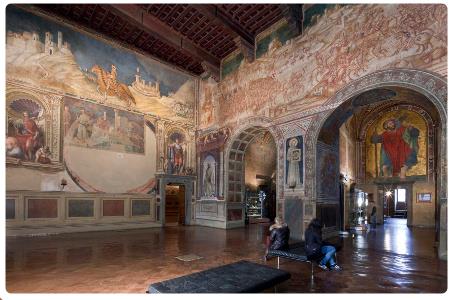
Pubblico there is the large hall
where the Council of the Republic of Siena,
known as Sala delle Balestre or more commonly
known as Sala del Mappamondo (Globe Hall).
The name derives from the ancient presence in the
hall of a rotating disc, the globe, probably
in parchment wood and depicting possessions of the
Sienese State, painted in 1344 by Ambrogio
Lorenzetti and dispersed in the eighteenth
century.
|
|
On the wall in front of Simone Martini's
Majesty, in the upper part, there is a famous civil theme fresco,
also linked to the name of the great Sienese artist, who represents
Guidoriccio da Fogliano, captain of the Sienese army, to the siege of
Montemassi, a Maremma castle conquered by the city in 1328.
 The
commander is depicted on horseback, decorated with a caparison bearing the
family's coat of arm da Fogliano, while he solemnly sets out on a
bare landscape, characterized on the left by a fortified village and, on the
right, by a fortification and encampments. A recent restoration has
highlighted the total renovation, probably fifteenth-century, of the left
side with the hill and castle of Montemassi. The theme is very different
with respect to Majesty (we will discuss it below): in the latter, a
sacred figuration, the Guidoriccio, a profane scene, or rather
military. However, the poetic intensity of the two compositions is equal. The
commander is depicted on horseback, decorated with a caparison bearing the
family's coat of arm da Fogliano, while he solemnly sets out on a
bare landscape, characterized on the left by a fortified village and, on the
right, by a fortification and encampments. A recent restoration has
highlighted the total renovation, probably fifteenth-century, of the left
side with the hill and castle of Montemassi. The theme is very different
with respect to Majesty (we will discuss it below): in the latter, a
sacred figuration, the Guidoriccio, a profane scene, or rather
military. However, the poetic intensity of the two compositions is equal.
 The
majesty's imaginative crowd is replaced here by only one group, the horse
and the knight who giant against the background of the horizon, the horse's
eye looks like a monster's eye from the long yellow and black caparison. A
heraldic group, of such representational effectiveness, to become a symbol
of the medieval militia or, better, of the leader who abandoned every
flattery of life, solitary urges him to explore the paths of death. Simone
Martini, with a superb synthesis, has also given life to an unforgettable
landscape: two cucuzzoli defended by trenches surmounted by two castles to
conquer (Montemassi and Sassoforte, in Maremma) and, at the end of the
fresco, another taller and more impervious hill where the militias that are
preparing to siege emerge. The
majesty's imaginative crowd is replaced here by only one group, the horse
and the knight who giant against the background of the horizon, the horse's
eye looks like a monster's eye from the long yellow and black caparison. A
heraldic group, of such representational effectiveness, to become a symbol
of the medieval militia or, better, of the leader who abandoned every
flattery of life, solitary urges him to explore the paths of death. Simone
Martini, with a superb synthesis, has also given life to an unforgettable
landscape: two cucuzzoli defended by trenches surmounted by two castles to
conquer (Montemassi and Sassoforte, in Maremma) and, at the end of the
fresco, another taller and more impervious hill where the militias that are
preparing to siege emerge.
Sotto questo affresco, si trova una grande
tavola di Guido da Siena raffigurante la Madonna col bambino in
trono, datata 1221 e provenienti da San Domenico dove, per molti secoli
rimase come oggetto di curiosità culturale in quanto ritenuta la prova
inconfutabile della priorità della scuola senese rispetto a quella
fiorentina. Oggi il problema è superato (anche prescindendo da quest'opera)
in quanto la data viene concordemente giudicata inesatta o, meglio, forse
alterata durante i restauri del primo trecento da parte di uno scolaro di
Duccio da Buninsegna. Secondo l'opinione prevalente, infatti, la datazione
dell'opera dovrebbe essere spostata avanti di circa mezzo secolo, e ciò
soprattutto per considerazioni stilistiche. Ai lati della Madonna, di Guido
da Siena, due splendide grandiose figure di santi, del Sodoma, del
1529, San Vittore e San Ansano Battezante.
Under this fresco, there is a large painting by
Guido da Siena depicting the Madonna and child on the throne, dated
1221 and coming from San Domenico where, for many centuries it remained as
an object of cultural curiosity because it was considered the irrefutable
proof of the priority of the Sienese school over the Florentine one. Today
the problem is overcome (also regardless of this work) as the date is
consistently judged incorrect or, better still, perhaps altered during the
restoration of the early fourteenth century by a pupil of Duccio da
Buninsegna. According to the prevailing opinion, in fact, the dating of the
work should be moved forward by about half a century, especially for
stylistic considerations. On the sides of the Madonna, by Guido da Siena,
two splendid grandiose figures of saints, of Sodoma, of 1529, San
Vittore and San Ansano Battezante.
During the restoration of the Sala del
Mappamondo, which took place in 1981, in the part of the wall underneath the
Guidoriccio da Fogliano, the oldest fresco of the hall came to light,
which took the title of Presa di un Castello. The left side is unfortunately
missing following the execution, dated 1529 of Sant' Ansano by
Sodoma. The theme of the representation, of a civil type as well as the
Guidoriccio, is a castle protected by a palisade and now conquered,
since it has the doors open, and two characters, probably a representative
of the Sienese government is a noteworthy of the place. It is hypothesized
that it is a representation of the submission of the castle of Giuncarico,
given the presence of a document of 1314 in which there was the execution,
in this room, a fresco that represented the Maremma village. The work is of
great importance both on a thematic level, constituting one of the oldest
scenes of autonomous landscape, untied by the narration of other episodes,
and on a stylistic level, given the very high quality level of execution,
and has opened new avenues for the study of Sienese art of the fourteenth
century. As for its attribution, in fact, the names of the greatest Sienese
painters active in that century were given, from Duccio da Buoninsegna
(which is the most accredited hypothesis), to Pietro and Ambrogio
Lorenzetti, to Simone Martini.
 The
left wall of the room is occupied by Simone Martini's famous fresco
of the majesty (i. e. the Madonna and child seated on the throne and
adored as sovereign of the world). The fresco is Martini's first works,
dated 1315, and restored in the central part, already by Martini himself in
1321. Back to the majesty of Duccio da Buoninsegna (who is now in the
Museo dell' Opera del Duomo) of only four years old, Martini's work
is partially separated by a freer conception of composition and a more
differentiated humanity of characters, by the atmosphere in which the scene
is represented, which is no longer the divinized gold of the Byzantines but
the blue sky. The
left wall of the room is occupied by Simone Martini's famous fresco
of the majesty (i. e. the Madonna and child seated on the throne and
adored as sovereign of the world). The fresco is Martini's first works,
dated 1315, and restored in the central part, already by Martini himself in
1321. Back to the majesty of Duccio da Buoninsegna (who is now in the
Museo dell' Opera del Duomo) of only four years old, Martini's work
is partially separated by a freer conception of composition and a more
differentiated humanity of characters, by the atmosphere in which the scene
is represented, which is no longer the divinized gold of the Byzantines but
the blue sky.
Again, Our Lady does not appear to you, as in Duccio da Buoninsegna,
only as a symbol of transcendence but also as a mother of humanity, as the
sweetest consolation of the afflicted. The Virgin sits on a very ordained
Gothic throne, with the child blessing in her womb, under a silk canopy
caressed by the breeze, whose slender flagpoles are supported by the
apostles. These together with the saints (including the four protectors of
Siena: Ansano, Vittore, Savino and Crescenzio) and two angels bearing cups
of flowers, they crown them in act of choral homage. The fresco has suffered
over the centuries is still suffering the threat of humidity that has
affected its chromatic substance.
Sopra le arcate, si trovano due affreschi in
terra gialla: a destra La vittoria dei senesi sui fiorentini a poggio
imperiale (presso Poggibonsi), di Giovanni di Cristoforo e
Francesco d'Andrea del 1480; a sinistra, La vittoria dei senesi
sulla compagnia inglese del Cappello a Sinalunga, Lippo Vanni del
1370. Altri affreschi decorano i pilastri: da destra i beati senesi
Andrea Gallerani e Ambrogio Sansedoni, opera di maestro secentesco, poi
una Santa Caterina, di Lorenzo Di Pietro detto il
Vecchietta del 1461, tra le prime se non la prima raffigurazione di
Caterina dopo la sua proclamazione a Santa: si noti l'evidenza plastica
dell'immagine lampeggiante entro una decorata piccola abside rinascimentale.
Seguono le figure di San Bernardino, di Sano di Pietro nel 1460 e del
Beato Bernardo Tolomei, del Sodoma nel 1553.
Above the arches, there are two frescoes in
yellow earth: on the right, The victory of the Sienese over the
Florentines in Poggio Imperiale (near Poggibonsi), by Giovanni di
Cristoforo and Francesco d'Andrea from 1480; on the left, The
victory of the Sienese over the English company of the hat in Sinalunga,
Lippo Vanni from 1370. Other frescoes decorate the pillars: from the
right the blessed Sienese Andrea Gallerani and Ambrogio Sansedoni,
the work of a seventeenth-century master, then a Saint Catherine, by
Lorenzo Di Pietro called the Vecchiatta of 1461, among the first
if not the first representation of Caterina after his proclamation in Santa:
we notice the plastic evidence of the flashing image within a decorated
small Renaissance apse. The following are the figures of St. Bernardino,
Sano di Pietro in 1460 and Blessed Bernardo Tolomei, by
Sodoma in 1553.
Copyright © Informagiovani-italia.com
Where is it located?
Top
Ostelli Siena
Ostelli Italia
Auberges de Jeunesse Italie
Hotel Siena
Carte de Sienne
Karte von Siena
Mapa Siena
Map of Siena
Carte de
la Toscane Karte
von Toskana Mapa
Toscana Map of
Tuscany
Carte d'Italie
Karte von Italien
Mapa Italia
Map of Italy |