|
|
You are here:
Siena > What
to see in Siena >
Siena Cathedral
|
If the
Palazzo
Pubblico is the masterpiece of Siena's civil architecture,
the Duomo is the masterpiece of religious
architecture. Both of them are admired with
astonishing admiration by the most illustrious
visitors to the city: for the Duomo, it is enough to
remember, among the many prestigious names, those of
Taine, Ruskin (the most extraordinary
church he had ever seen in Italy), of Wagner.
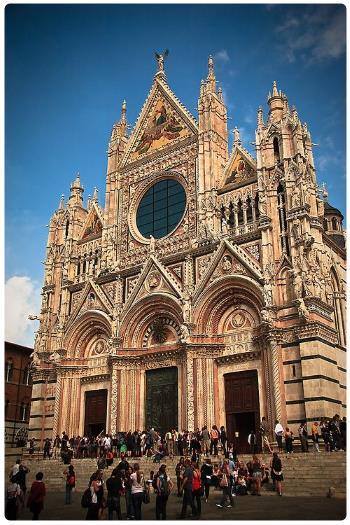
The Duomo or Cathedral of Siena is
dedicated to Santa Maria Assunta and was
built in Roman-Gothic style.
|
|
We do not know exactly when this church was
built, but what is certain is that in 1226 there was a record of the
expenses for its construction.
History of the
construction of the Siena Cathedral
 It
is very likely that, in the place where the Duomo stands today, there was
previously a pagan temple, dedicated to the goddess Minerva. Tradition has
it that the consecration of the cathedral took place on 18 November
1179 and was consecrated by Pope Alexander III himself. Even today,
on 18 November, the papal banner is still displayed. What is certain is that
here, since the 11th century, there has already been a small church that
serves as a cathedral. Towards the middle of the following century, at the
dawn of the communal age, the construction of a larger temple began, and
whose essential structures were already built in the second decade of 1200.
Great impulse to the continuation of the work gave, from 1238 to 1285, the
Cistercian monks of the
Abbey of San Galgano
(it will make the first Italian Gothic churches of which still remain, near
Siena, imposing ruins) with which the dome was planted between 1259 and 1264
and the apse and the peribolo (sacred enclosure) were built in 1267 both
then demolished. It was always the Cistercian monks who commissioned
Nicola Pisano to carry out the pulpit, and his son Giovanni Pisano,
to sculpt the lower part of the facade. In the second decade of 1300, during
the Government of the Nine, Siena wanted to announce its prosperity with the
enlargement of a cathedral in honor of Maria Assunta: for this reason
the apse and the head of the cross were demolished and the temple was
extended, under the direction of Camaino di Crescentino 1317. Then
not even this seemed enough and one imagined a Church that, for vastness and
magnificence, won the confrontation with the Duomo of Florence Cathedral,
eternal rival city. It
is very likely that, in the place where the Duomo stands today, there was
previously a pagan temple, dedicated to the goddess Minerva. Tradition has
it that the consecration of the cathedral took place on 18 November
1179 and was consecrated by Pope Alexander III himself. Even today,
on 18 November, the papal banner is still displayed. What is certain is that
here, since the 11th century, there has already been a small church that
serves as a cathedral. Towards the middle of the following century, at the
dawn of the communal age, the construction of a larger temple began, and
whose essential structures were already built in the second decade of 1200.
Great impulse to the continuation of the work gave, from 1238 to 1285, the
Cistercian monks of the
Abbey of San Galgano
(it will make the first Italian Gothic churches of which still remain, near
Siena, imposing ruins) with which the dome was planted between 1259 and 1264
and the apse and the peribolo (sacred enclosure) were built in 1267 both
then demolished. It was always the Cistercian monks who commissioned
Nicola Pisano to carry out the pulpit, and his son Giovanni Pisano,
to sculpt the lower part of the facade. In the second decade of 1300, during
the Government of the Nine, Siena wanted to announce its prosperity with the
enlargement of a cathedral in honor of Maria Assunta: for this reason
the apse and the head of the cross were demolished and the temple was
extended, under the direction of Camaino di Crescentino 1317. Then
not even this seemed enough and one imagined a Church that, for vastness and
magnificence, won the confrontation with the Duomo of Florence Cathedral,
eternal rival city.
 This
project of "Duomo Nuovo", substantially modified the plan of the previous
church: the whole part built, in fact, had to be only the transept to which
the longitudinal naves with the facade had to be added ("the Facciatone").
The cyclopean enterprise was begun in 1339, by Lando Di Pietro,
followed by Giovanni di Agostino and Domenico di Agostino.
Work proceeded exceptionally quickly and at a very high cost. The plague of
1348 imposed an interruption during which serious deficiencies emerged in
the statics of the building, too hastily carried out on the ground not
prepared and firmed properly. The economic crisis following the plague, the
futility of attempts to remedy the errors made, led to the decision to stop
the ambitious project. This
project of "Duomo Nuovo", substantially modified the plan of the previous
church: the whole part built, in fact, had to be only the transept to which
the longitudinal naves with the facade had to be added ("the Facciatone").
The cyclopean enterprise was begun in 1339, by Lando Di Pietro,
followed by Giovanni di Agostino and Domenico di Agostino.
Work proceeded exceptionally quickly and at a very high cost. The plague of
1348 imposed an interruption during which serious deficiencies emerged in
the statics of the building, too hastily carried out on the ground not
prepared and firmed properly. The economic crisis following the plague, the
futility of attempts to remedy the errors made, led to the decision to stop
the ambitious project.
In the following decades the dangerous structures were arranged while those
left standing were destined to offices of the Opera del Duomo (where
Jacopo della Quercia sculpted the Fonte Gaia). The only thing that remained,
therefore, was to complete the old Duomo: the new apse was completed in
1382, then the vaults of the central nave were rebuilt higher and, from
1376, Giovanni di Cecco completed the upper part of the facade.
In the following decades the dangerous
structures were arranged while those left standing were destined to offices
of the Opera del Duomo (where Jacopo della Quercia sculpted the
Fonte Gaia). The only thing that remained, therefore, was to complete
the old Duomo: the new apse was completed in 1382, then the vaults of the
central nave were rebuilt higher and, from 1376, Giovanni di Cecco
completed the upper part of the facade.
Top
External part of the Siena
Cathedral
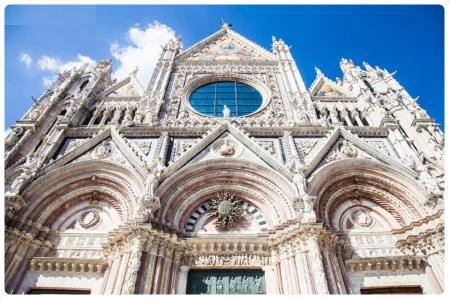 Stylistically,
the façade of the Cathedral of Siena has Romanesque structural motifs in the
lower part and Gothic in the upper part, but the soul of the monument, so to
speak, is typically Gothic. Only the arches of the centre are, in fact,
still a Romanesque motif but they fit into one with the complex and peculiar
complexity of Gothic architecture. The lower part is a wonderful creation of
Giovanni Pisano and his helpers carried out between 1284 and 1296,
but it was finished only in 1333. It is divided into three parts by the
portals surmounted by round arches (the lateral ones slightly pointed arches),
the latter included within triangular cusps. Corner pillars (on a marble
base) join not only the lower part but the entire elevation. Bundles of
small columns finely decorated with plant motifs precede the portal: the
middle one bears, in the architrave, a bas-relief of Tino di Camaino
evoking a story of Anna and Joachim (the parents of the Madonna). Stylistically,
the façade of the Cathedral of Siena has Romanesque structural motifs in the
lower part and Gothic in the upper part, but the soul of the monument, so to
speak, is typically Gothic. Only the arches of the centre are, in fact,
still a Romanesque motif but they fit into one with the complex and peculiar
complexity of Gothic architecture. The lower part is a wonderful creation of
Giovanni Pisano and his helpers carried out between 1284 and 1296,
but it was finished only in 1333. It is divided into three parts by the
portals surmounted by round arches (the lateral ones slightly pointed arches),
the latter included within triangular cusps. Corner pillars (on a marble
base) join not only the lower part but the entire elevation. Bundles of
small columns finely decorated with plant motifs precede the portal: the
middle one bears, in the architrave, a bas-relief of Tino di Camaino
evoking a story of Anna and Joachim (the parents of the Madonna).
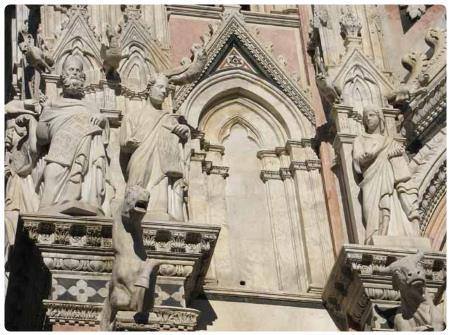 The
statues and busts, by Giovanni Pisano and his collaborators, refer to
figures of the Old Testament: here they are in copy (the originals can be
seen in the Museum of the Opera del Duomo) the sculptural decoration
followed a criterion not only decorative but also didactic: the lower part
of the facade is in fact dedicated to the preparation of the Advent of Mary,
the one above her presence on earth until the assumption in heaven. But the
modification in the order of the statues makes this thematic succession less
readable today. The central door in bronze and modern work of Enrico
Manfrini of 1958, glorifying the Madonna through the memory of his life
as well as biblical characters, popes, saints and artists who promoted
devotion to the Virgin. The
statues and busts, by Giovanni Pisano and his collaborators, refer to
figures of the Old Testament: here they are in copy (the originals can be
seen in the Museum of the Opera del Duomo) the sculptural decoration
followed a criterion not only decorative but also didactic: the lower part
of the facade is in fact dedicated to the preparation of the Advent of Mary,
the one above her presence on earth until the assumption in heaven. But the
modification in the order of the statues makes this thematic succession less
readable today. The central door in bronze and modern work of Enrico
Manfrini of 1958, glorifying the Madonna through the memory of his life
as well as biblical characters, popes, saints and artists who promoted
devotion to the Virgin.
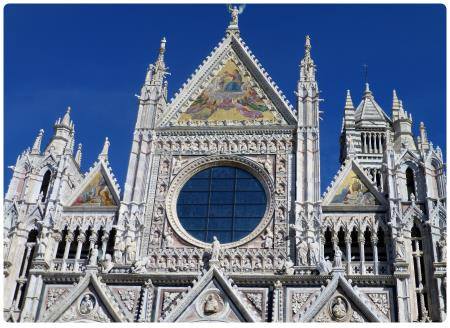 The
upper part of the façade, an expression of the extreme evolution of the
Gothic style, is a flourishing of decorative motifs: late fourteenth-century
statues (the originals are also in the museum of the Opera del Duomo),
friezes, inlay, etc., around the fundamental structures. The large central
rose window is located inside a very neat square frame (adorned with
patriarchs, prophets, evangelists and, above, of the Madonna). The two side
tunnels are separated by two pillars from the frame, as well as the three
end cusps, with the central much higher than the others, on which stands an
angel, Tomaso Redi of 1639. The surface of these cusps is animated by
mosaics made by The
upper part of the façade, an expression of the extreme evolution of the
Gothic style, is a flourishing of decorative motifs: late fourteenth-century
statues (the originals are also in the museum of the Opera del Duomo),
friezes, inlay, etc., around the fundamental structures. The large central
rose window is located inside a very neat square frame (adorned with
patriarchs, prophets, evangelists and, above, of the Madonna). The two side
tunnels are separated by two pillars from the frame, as well as the three
end cusps, with the central much higher than the others, on which stands an
angel, Tomaso Redi of 1639. The surface of these cusps is animated by
mosaics made by
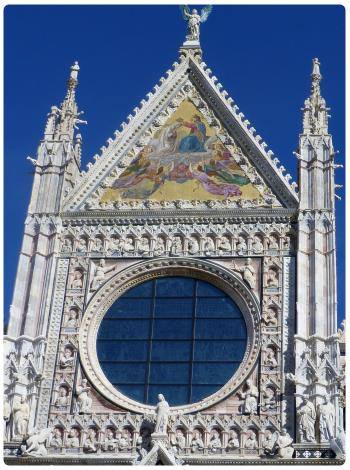 the
Murano school on cartoons by Luigi Mussini and Alessandro
Franchi in the late nineteenth century, illustrating, on the left, the
Presentation of the Virgin at the temple, in the center the Coronation of
Mary, on the right, the Nativity of Jesus. the
Murano school on cartoons by Luigi Mussini and Alessandro
Franchi in the late nineteenth century, illustrating, on the left, the
Presentation of the Virgin at the temple, in the center the Coronation of
Mary, on the right, the Nativity of Jesus.
The designer of the upper part of the facade, the Sienese Giovanni di
Cecco in 1376 was inspired, with all evidence, the almost contemporary
facade of the Cathedral of Orvieto, a masterpiece of another Sienese,
Lorenzo Maitani. The implementation of this design gave rise to the
symmetry of the side pillars to the frame of the rose window with respect to
the underlying pillars of the median portal: a symmetry that does not,
however, affect the aesthetic validity of the entire architectural organism.
Top
Right side and Bell Tower
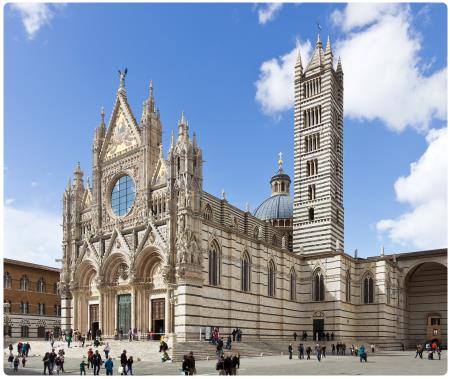 On
the right side of the Duomo (the left side, with a closed single-light, and
joined with the archiepiscopal palace), divided by pillars crowned by copies
of fourteenth-century statues (the originals are in an underground part of
the Duomo) is out of the way by redoing cuspided ogival. The facing is
horizontally crossed by strips of dark marble alternating with wide bands of
white marble: this decoration continues in the right transept, opened by the
end of the Gothic layer, in the head of the cross that forms a single body
with a baptistery, as well as in the Bell Tower, erected in 1313
above the pre-existing structure of the Tower of Bisdomini, designed
by Agostino di Giovanni and Agnolo di Ventura. On
the right side of the Duomo (the left side, with a closed single-light, and
joined with the archiepiscopal palace), divided by pillars crowned by copies
of fourteenth-century statues (the originals are in an underground part of
the Duomo) is out of the way by redoing cuspided ogival. The facing is
horizontally crossed by strips of dark marble alternating with wide bands of
white marble: this decoration continues in the right transept, opened by the
end of the Gothic layer, in the head of the cross that forms a single body
with a baptistery, as well as in the Bell Tower, erected in 1313
above the pre-existing structure of the Tower of Bisdomini, designed
by Agostino di Giovanni and Agnolo di Ventura.
 According
to Lombard prototypes, the openings in the roof are wider, proceeding from
the bottom (single-hatted) upwards (it evaporates) and the roof in the form
of a cusp surrounded by four pinnacles. The bell tower of the Cathedral of
Siena in Romanesque style, almost 77 meters high, was built in 1313.
Together with the 88-metre high
Torre del Mangia, it
is one of the city's landmarks. The walls visible in the internal cell of
the previous bell tower remain. The bell tower has six bells, which almost
form a correct diatonic scale, of different epochs and fusions. Their sound
from the acoustic point of view is certainly not the best but they are very
interesting from the historical point of view. According
to Lombard prototypes, the openings in the roof are wider, proceeding from
the bottom (single-hatted) upwards (it evaporates) and the roof in the form
of a cusp surrounded by four pinnacles. The bell tower of the Cathedral of
Siena in Romanesque style, almost 77 meters high, was built in 1313.
Together with the 88-metre high
Torre del Mangia, it
is one of the city's landmarks. The walls visible in the internal cell of
the previous bell tower remain. The bell tower has six bells, which almost
form a correct diatonic scale, of different epochs and fusions. Their sound
from the acoustic point of view is certainly not the best but they are very
interesting from the historical point of view.
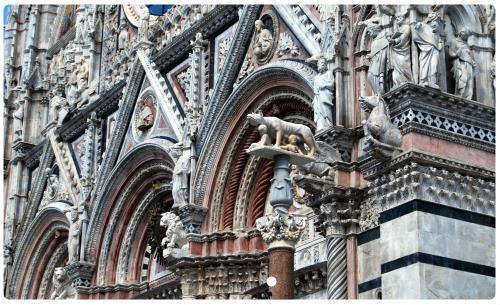 Moving
now on to the platform that precedes the front entrance of the Duomo, on the
floor we find three restored graffiti (copies of originals by Nastagio di
Gaspare, 1450) include the Ceremony of the restrictions of the
ecclesiastical hierarchies. On the sides of the staircase two columns bear
the symbolic Lupa che breastfeeding i twin, copies of Giovanni Pisano
and Urbano da Cortona (the originals can be found in the museum of
the Opera del Duomo). Walking along the left side of the Duomo of Siena, you
will reach the superb structures of the "New Cathedral" built between 1339
and 1355. They include part of the main facade, the so-called Facciatone;
the right nave, attached to the Duomo is marked by five huge arches (and
open into the wall); part of the left side with three arches and Czech
monolights are embedded in the walls of the prefecture building. What we see
lets us imagine the incomparable grandeur of the work if it had been
completed and gives us some essays of its high quality of art: look at the
decorations of Giovanni D'Agostino who also designed the beautiful side door
in 1345. In the first three closed arcades of the right nave is located the
Museum of the Opera del Duomo. Moving
now on to the platform that precedes the front entrance of the Duomo, on the
floor we find three restored graffiti (copies of originals by Nastagio di
Gaspare, 1450) include the Ceremony of the restrictions of the
ecclesiastical hierarchies. On the sides of the staircase two columns bear
the symbolic Lupa che breastfeeding i twin, copies of Giovanni Pisano
and Urbano da Cortona (the originals can be found in the museum of
the Opera del Duomo). Walking along the left side of the Duomo of Siena, you
will reach the superb structures of the "New Cathedral" built between 1339
and 1355. They include part of the main facade, the so-called Facciatone;
the right nave, attached to the Duomo is marked by five huge arches (and
open into the wall); part of the left side with three arches and Czech
monolights are embedded in the walls of the prefecture building. What we see
lets us imagine the incomparable grandeur of the work if it had been
completed and gives us some essays of its high quality of art: look at the
decorations of Giovanni D'Agostino who also designed the beautiful side door
in 1345. In the first three closed arcades of the right nave is located the
Museum of the Opera del Duomo.
Top
Internal
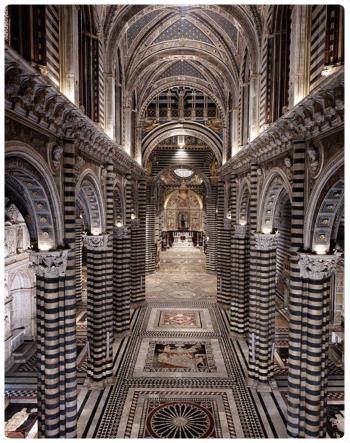 The
plan of the church is Romanesque plant to Latin cross, divided into three
naves wide transept, apse and choir, cross vault with arches in the center
and the dome above. The eye is immediately attracted by the forest of
powerful polystyrene pillars that divide the naves and continue in the two
arms of the transept (the pillars are 26 in all): in them returns to that of
the marble color we have already seen outside. A variation of colours that,
if they slow down the vertical momentum a little, at the same time give
warmth and pictorial sensations to the whole church, to which the polychromy
of the walls contribute, the blue painted stars of the vaults is, more than
anything, the wonderful flooring. Entering the cathedral, what is most
striking is its wonderful central nave, from which you can admire 171
busts depicting as many Popes, among whom there is also St. Peter. Under
the Popes there are thirty-six busts of emperors, but since there are no
captions, it is not known exactly who they are. The
plan of the church is Romanesque plant to Latin cross, divided into three
naves wide transept, apse and choir, cross vault with arches in the center
and the dome above. The eye is immediately attracted by the forest of
powerful polystyrene pillars that divide the naves and continue in the two
arms of the transept (the pillars are 26 in all): in them returns to that of
the marble color we have already seen outside. A variation of colours that,
if they slow down the vertical momentum a little, at the same time give
warmth and pictorial sensations to the whole church, to which the polychromy
of the walls contribute, the blue painted stars of the vaults is, more than
anything, the wonderful flooring. Entering the cathedral, what is most
striking is its wonderful central nave, from which you can admire 171
busts depicting as many Popes, among whom there is also St. Peter. Under
the Popes there are thirty-six busts of emperors, but since there are no
captions, it is not known exactly who they are.
Top
Floor
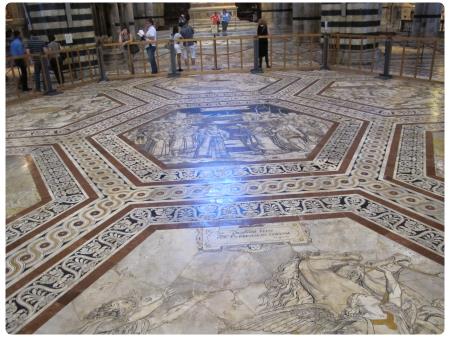 The
floor is one of the boasts of the Cathedral of Siena, divided as it
is into 56 panels, the oldest of which from 1369 onwards, graffito, the most
recent, those until 1547, committed with marble (a type of mosaic with
marble). The historied floor is part of a transalpine Gothic conception of
the temple, according to which each element must contribute organically to
the ultimate goal of exalting the divinity, preparing for the road to heaven.
The subjects of the panels are dedicated, for the most part, to facts of the
Old Testament (Stories of Moses, Joshua, Abraham, Elijah) but,
with them, are mixed mythical figures (the Sibyls, considered,
however, anticipatory of Christ) and allegorical (Virtue) and, the
only episode of the new will, the representation of the Slaughter of the
Innocents. About forty artists, mostly Sienese, dedicated themselves to this
artistic effort that lasted two centuries. Some panels, which have been
damaged by time, have been partially reworked or replaced by copies. Others,
the oldest of these, are protected by tables and are visible every year from
August 15 to September 15. Here we remember some of the most famous authors
of cartons for the execution of the floor: Domenico di Nicolò,
Matteo di Giovanni, Domenico di Bartolo, Benvenuto di Giovanni,
Urbano da Cortona, Antonio Federighi, Neroccio di
Bartolomeo, il Pinturicchio, and the greatest of all for his new
inventions and industriousness, Domenico Beccafumi, who, in 1547,
made the drawings of 35 panels. The
floor is one of the boasts of the Cathedral of Siena, divided as it
is into 56 panels, the oldest of which from 1369 onwards, graffito, the most
recent, those until 1547, committed with marble (a type of mosaic with
marble). The historied floor is part of a transalpine Gothic conception of
the temple, according to which each element must contribute organically to
the ultimate goal of exalting the divinity, preparing for the road to heaven.
The subjects of the panels are dedicated, for the most part, to facts of the
Old Testament (Stories of Moses, Joshua, Abraham, Elijah) but,
with them, are mixed mythical figures (the Sibyls, considered,
however, anticipatory of Christ) and allegorical (Virtue) and, the
only episode of the new will, the representation of the Slaughter of the
Innocents. About forty artists, mostly Sienese, dedicated themselves to this
artistic effort that lasted two centuries. Some panels, which have been
damaged by time, have been partially reworked or replaced by copies. Others,
the oldest of these, are protected by tables and are visible every year from
August 15 to September 15. Here we remember some of the most famous authors
of cartons for the execution of the floor: Domenico di Nicolò,
Matteo di Giovanni, Domenico di Bartolo, Benvenuto di Giovanni,
Urbano da Cortona, Antonio Federighi, Neroccio di
Bartolomeo, il Pinturicchio, and the greatest of all for his new
inventions and industriousness, Domenico Beccafumi, who, in 1547,
made the drawings of 35 panels.
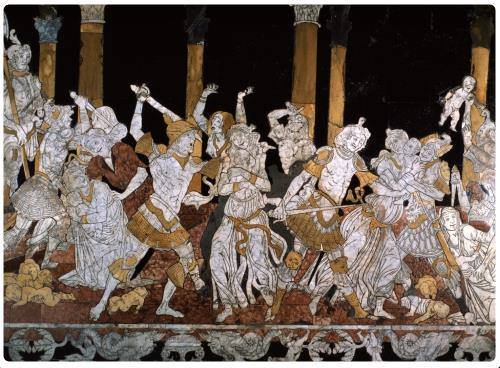 To
him we owe the most beautiful biblical stories among which are excellent
Moses springs from the waters from the cliff Horeb, the Sacrifice of Abraham,
both in the presbytery, the Sacrifice of Ahab, under the dome. Particular
attention should be paid to the Allegory of Fortune by Paolo Mannucci
on cartoons by Pinturicchio in the nave, the Sibilla Eritrea, Antonio
Federighi in the right nave; The Emperor Sigismund on the throne,
Domenico di Bartolo in the right transept, the Allegory of Justice,
Marchese d'Adamo from Como in the left apse, the Slaughter of the
Innocents, Matteo di Giovanni and Herod driven from the throne,
Benvenuto di Giovanni. Both in the left transept. To
him we owe the most beautiful biblical stories among which are excellent
Moses springs from the waters from the cliff Horeb, the Sacrifice of Abraham,
both in the presbytery, the Sacrifice of Ahab, under the dome. Particular
attention should be paid to the Allegory of Fortune by Paolo Mannucci
on cartoons by Pinturicchio in the nave, the Sibilla Eritrea, Antonio
Federighi in the right nave; The Emperor Sigismund on the throne,
Domenico di Bartolo in the right transept, the Allegory of Justice,
Marchese d'Adamo from Como in the left apse, the Slaughter of the
Innocents, Matteo di Giovanni and Herod driven from the throne,
Benvenuto di Giovanni. Both in the left transept.
In addition to the floor, another artistic
peculiarity of the Cathedral of Siena, are the series of 172 imaginary
busts of popes (including the bust of Christ, at the end of the apse)
that serve as shelves to the conrbicione that runs on the top of the nave
and the presbytery. Under these busts are placed, at intervals, another
36 imaginary busts of emperors, from Constantine to Theodosius: they are
all sculptures of the four and the sixteenth. At the entrance there are two
stoves finely worked by Antonio Federighi in 1463.
Top
Back facade
 The
middle portal is adorned with columns decorated by Giovanni Di Stefano,
with pedestals of bas-reliefs (Stories of Mary) of Urbano of Cortona;
above the portal, the architrave contains other reliefs dedicated to the
Life of St. Ansano of the fifteenth century. The stained-glass window of the
Rosone shows an Last Supper) by Pastorino de' Pastorini
who made it in 1549, perhaps on cardboard by Perin del Vaga (from the
workshop of Ghirlandaio and collaborator of
Raffaello).
On the sides, always in counter-fronted, In a niche, there is the statue of
Paul V (bourgeois Camillo of Siena), Fulvio Signorini in 1605 and Marcello
II Domenico Cafaggi at the behest of the rector of the Opera del Duono
Giugurta Tommasi to represent the first two Sienese popes Alexander
III (1591) and Pius II (1592). Later they were converted into
other popes by adding beards, by the workshop of the Mazzuoli family (eighties
of the seventeenth century). It is presumable that this was done so as not
to obscure the program of representation of all the Sienese popes with new
memorials that was being made in those years. The
middle portal is adorned with columns decorated by Giovanni Di Stefano,
with pedestals of bas-reliefs (Stories of Mary) of Urbano of Cortona;
above the portal, the architrave contains other reliefs dedicated to the
Life of St. Ansano of the fifteenth century. The stained-glass window of the
Rosone shows an Last Supper) by Pastorino de' Pastorini
who made it in 1549, perhaps on cardboard by Perin del Vaga (from the
workshop of Ghirlandaio and collaborator of
Raffaello).
On the sides, always in counter-fronted, In a niche, there is the statue of
Paul V (bourgeois Camillo of Siena), Fulvio Signorini in 1605 and Marcello
II Domenico Cafaggi at the behest of the rector of the Opera del Duono
Giugurta Tommasi to represent the first two Sienese popes Alexander
III (1591) and Pius II (1592). Later they were converted into
other popes by adding beards, by the workshop of the Mazzuoli family (eighties
of the seventeenth century). It is presumable that this was done so as not
to obscure the program of representation of all the Sienese popes with new
memorials that was being made in those years.
Top
Right nave
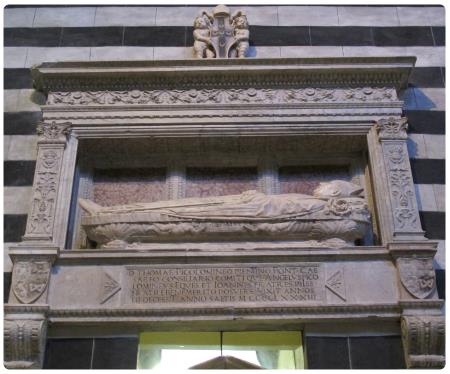 Four
altars follow, decorated with seventeenth-century paintings; the side door
opens, the one that gives access to the bell tower. Above this door stands
the tomb of Bishop Tommaso Piccolomini del Testa, Neroccio di
Bartolo performed between 1484 to 1485, the sides of the tomb, reliefs
of Urbano of Cortona with six episodes of the life of the Madonna of
which is remarkable the Annunciation. From here there is a beautiful view of
the dome that rises in the middle of the cruise. Set on six pylons (on both
sides of the middle nave are placed the antennas hoisted on the Carroccio
di Siena during the Battle of Montaperti). Four
altars follow, decorated with seventeenth-century paintings; the side door
opens, the one that gives access to the bell tower. Above this door stands
the tomb of Bishop Tommaso Piccolomini del Testa, Neroccio di
Bartolo performed between 1484 to 1485, the sides of the tomb, reliefs
of Urbano of Cortona with six episodes of the life of the Madonna of
which is remarkable the Annunciation. From here there is a beautiful view of
the dome that rises in the middle of the cruise. Set on six pylons (on both
sides of the middle nave are placed the antennas hoisted on the Carroccio
di Siena during the Battle of Montaperti).
At the corners of the hexagon of the dome, six
columns support as many golden statues of saints (the four patrons of Siena,
as well as St. Bernardine and St. Catherine) modeled by Ventura Turapilli
and Bastiano di Francesco between the fifteenth and sixteenth
centuries. Above these columns, niches bend over the hexagon of the dome and
transform it into the dodecagon of the drum. The latter is adorned with a
fake loggia divided by 42 columns and in whose small arches appear the
figures of 42 prophet patriarchs, painted in chiaroscuro by various Sienese
artists of 1400. Further up the top, the end cap of the dome, decorated with
fake lagoons and finished by the lantern at the top, curves.
Top
Ghigi Chapel and Transetto
Sinistro
 The
right transept, like the opposite, is distinguished in two naves by pillars.
On the right is the Chigi Chapel (or the Madonna del voto) built in
1661 on a project by the famous baroque school leader Gianlorenzo Bernini,
for the will of the Sienese Pope Alexander VII Chigi. In a circular
environment surmounted by a golden dome, it is a triumph of decorations.
Eight columns divide it into eight sectors, everywhere there have been
marble, bronze, friezes, paintings. On the altar, designed by Bernini
himself, is the painting of the Madonna del voto, by a late
thirteenth-century imitator of Guido da Siena. Bernini is considered the
gilded bronze angels that surround the Madonna del voto while his hand are
certainly the splendid statues of St. Jerome and Mary Magdalene placed in a
niche at the entrance. The other statues in the niches on the sides of the
altar are due to Lombard sculptors of the seventeenth century (Ercole
Ferrara and Antonio Raggi) while the four bas-reliefs above, the
stories of Mary, were made in Rome in 1748. On the left wall, there is the
Visitation of Our Lady to Elizabeth, a painting by Carlo Maratta
from the late 17th century, from whom Maratta also drew inspiration for the
mosaic on the opposite wall evoking his flight to Egypt. The
right transept, like the opposite, is distinguished in two naves by pillars.
On the right is the Chigi Chapel (or the Madonna del voto) built in
1661 on a project by the famous baroque school leader Gianlorenzo Bernini,
for the will of the Sienese Pope Alexander VII Chigi. In a circular
environment surmounted by a golden dome, it is a triumph of decorations.
Eight columns divide it into eight sectors, everywhere there have been
marble, bronze, friezes, paintings. On the altar, designed by Bernini
himself, is the painting of the Madonna del voto, by a late
thirteenth-century imitator of Guido da Siena. Bernini is considered the
gilded bronze angels that surround the Madonna del voto while his hand are
certainly the splendid statues of St. Jerome and Mary Magdalene placed in a
niche at the entrance. The other statues in the niches on the sides of the
altar are due to Lombard sculptors of the seventeenth century (Ercole
Ferrara and Antonio Raggi) while the four bas-reliefs above, the
stories of Mary, were made in Rome in 1748. On the left wall, there is the
Visitation of Our Lady to Elizabeth, a painting by Carlo Maratta
from the late 17th century, from whom Maratta also drew inspiration for the
mosaic on the opposite wall evoking his flight to Egypt.
 Exit
the Chapel of the Vow you notice: to the right of the first altar, the 1663
statue of Pope Alexander III, Antonio Raggi; left, that of
Pope Alexander VII, by Ercole Ferrara, of 1668, in front of which is
the tombstone of the Sienese bishop Carlo Bartoli (who died in 1444),
decorated with graffiti by Antonio Federighi and Giuliano da Como,
probably designed by Pietro del Minella in the late fifteenth century.
The altar in front of the tombstone bears a valuable painting by Mattia
Preti from Calabria in about 1650, celebrating a Preaching of San
Bernardino. In the corner chapel, called the Sacrament, on the right
wall, are five fifteenth-century bas-reliefs made by Giovanni Francesco
da Imola (the Evangelists) and Giovanni di Turino (Saint Paul);
the altar is adorned with an Adoration of the Shepherds, by
Alessandro Casolani in 1594. Exit
the Chapel of the Vow you notice: to the right of the first altar, the 1663
statue of Pope Alexander III, Antonio Raggi; left, that of
Pope Alexander VII, by Ercole Ferrara, of 1668, in front of which is
the tombstone of the Sienese bishop Carlo Bartoli (who died in 1444),
decorated with graffiti by Antonio Federighi and Giuliano da Como,
probably designed by Pietro del Minella in the late fifteenth century.
The altar in front of the tombstone bears a valuable painting by Mattia
Preti from Calabria in about 1650, celebrating a Preaching of San
Bernardino. In the corner chapel, called the Sacrament, on the right
wall, are five fifteenth-century bas-reliefs made by Giovanni Francesco
da Imola (the Evangelists) and Giovanni di Turino (Saint Paul);
the altar is adorned with an Adoration of the Shepherds, by
Alessandro Casolani in 1594.
Top
Presbytery and High Altar
 For
a tradition that dates back to early Christian times, the presbytery
and raised above the aisles. The marble High Altar stands out here,
an admirable invention by Baldassarre Peruzzi in 1532, put together
by Pellegrino Di Pietro. On the altar rests a rich bronze ciborium by
Lorenzo di Pietro, called the Vecchietta built between 1467
and 1472, here moved in 1506 by the Hospital of Santa Maria alla Scala,
in place of the Majesty of Duccio da Buoninsegna (located in
the Museum of the Opera del Duomo). On the sides, two exquisite
candleholder angels, by Giovanni Di Stefano; the other lower angels
are masterful sculptures by Francesco di Giorgio Martini executed
three 1497 1499. Another eight beautiful angels, Domenico Beccafumi
executed three 1548 and 1550, embellish the pillars. Next to the altar is
the "Chair", the episcopal residence designed by Bertolomeo Nerori,
called Riccio, to which also belong the lectern behind the altar and, above,
the left choir in 1550 (as the name says, the area intended for singers),
while the opposite choir is a work by Antonio Barilli in 1510. For
a tradition that dates back to early Christian times, the presbytery
and raised above the aisles. The marble High Altar stands out here,
an admirable invention by Baldassarre Peruzzi in 1532, put together
by Pellegrino Di Pietro. On the altar rests a rich bronze ciborium by
Lorenzo di Pietro, called the Vecchietta built between 1467
and 1472, here moved in 1506 by the Hospital of Santa Maria alla Scala,
in place of the Majesty of Duccio da Buoninsegna (located in
the Museum of the Opera del Duomo). On the sides, two exquisite
candleholder angels, by Giovanni Di Stefano; the other lower angels
are masterful sculptures by Francesco di Giorgio Martini executed
three 1497 1499. Another eight beautiful angels, Domenico Beccafumi
executed three 1548 and 1550, embellish the pillars. Next to the altar is
the "Chair", the episcopal residence designed by Bertolomeo Nerori,
called Riccio, to which also belong the lectern behind the altar and, above,
the left choir in 1550 (as the name says, the area intended for singers),
while the opposite choir is a work by Antonio Barilli in 1510.
Top
Apse
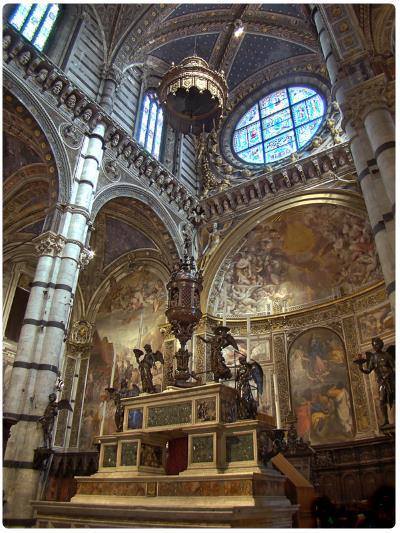 The
frescoes by Domenico Beccafumi that enliven the apse basin, due to
progressive deterioration, have unfortunately been extensively retouched and
repainted (Apostles of 1544; Trinity in Glory of 1812); below
is the Assumption of Mary by Bartolomeo Cesi in 1594, flanked
by two frescoes by Ventura Salimbeni (Ester and Assuerus on
the right and the Jews in the desert on the left), to whom we owe the
figures of the saints executed between 1608 and 1611. The glass window
of the apse, dedicated to the Glorification of the Madonna, is one of
the oldest painted in Italy: it gave the cartoons Duccio da Buoninsegna
and was made by Sienese masters in 1288 and resumed almost a century after
Giacomo di Castello. The apse is dominated by the maximum monument of
the apse and the wooden choir that occupies the whole lower part of
the apse basin. It comprises 51 stalls and consists of two joint parts: the
middle one, of Renaissance imprint, always designed by Riccio and executed
by Teseo of Bartolino and Benedetto di Giovanni three 1567
1570, and the side ones, the most beautiful, of Gothic taste, The work of
Francesco Giacomo del Tonghio between 1362 and 1397, later on inlaid
with fine masterpieces by Giovanni da Verona from 1503, coming from
the former Monastery of San Benedetto Fuori Porta. The
frescoes by Domenico Beccafumi that enliven the apse basin, due to
progressive deterioration, have unfortunately been extensively retouched and
repainted (Apostles of 1544; Trinity in Glory of 1812); below
is the Assumption of Mary by Bartolomeo Cesi in 1594, flanked
by two frescoes by Ventura Salimbeni (Ester and Assuerus on
the right and the Jews in the desert on the left), to whom we owe the
figures of the saints executed between 1608 and 1611. The glass window
of the apse, dedicated to the Glorification of the Madonna, is one of
the oldest painted in Italy: it gave the cartoons Duccio da Buoninsegna
and was made by Sienese masters in 1288 and resumed almost a century after
Giacomo di Castello. The apse is dominated by the maximum monument of
the apse and the wooden choir that occupies the whole lower part of
the apse basin. It comprises 51 stalls and consists of two joint parts: the
middle one, of Renaissance imprint, always designed by Riccio and executed
by Teseo of Bartolino and Benedetto di Giovanni three 1567
1570, and the side ones, the most beautiful, of Gothic taste, The work of
Francesco Giacomo del Tonghio between 1362 and 1397, later on inlaid
with fine masterpieces by Giovanni da Verona from 1503, coming from
the former Monastery of San Benedetto Fuori Porta.
Top
Sacristy
 To
the left of the entrance door is a small hanging stack in gilded bronze,
white marble and enamel, the prodigy of the goldsmith's art by Giovanni
di Turino in 1437. Among the many works of art you can admire: the
remains of frescoes by Domenico di Bartolo and others in the three
chapels, perhaps Nicola di Naldo (chapel on the right), Gualtiero
di Giovanni (central chapel) and probably Benedetto di Bindo
(left chapel), all of the early fifteenth century. From the left chapel you
pass to the vestibule (antechamber of the sacristy) where you will
find a bust of Alexander VII, Melchiorre Caffà, a valid
epigone of Lorenzo Bernini. In the next chapter room, some paintings
by Sano di Pietro that in the Preaching of San Bernardino in Piazza del
Campo, pleasantly characterizes vows, costumes and places of the time.
San Bernardino was a great communicator and preacher and it is no
coincidence that he was the patron saint of advertisers. As you can see, a
curious thing about time is the strict separation of men and women in public
places. To
the left of the entrance door is a small hanging stack in gilded bronze,
white marble and enamel, the prodigy of the goldsmith's art by Giovanni
di Turino in 1437. Among the many works of art you can admire: the
remains of frescoes by Domenico di Bartolo and others in the three
chapels, perhaps Nicola di Naldo (chapel on the right), Gualtiero
di Giovanni (central chapel) and probably Benedetto di Bindo
(left chapel), all of the early fifteenth century. From the left chapel you
pass to the vestibule (antechamber of the sacristy) where you will
find a bust of Alexander VII, Melchiorre Caffà, a valid
epigone of Lorenzo Bernini. In the next chapter room, some paintings
by Sano di Pietro that in the Preaching of San Bernardino in Piazza del
Campo, pleasantly characterizes vows, costumes and places of the time.
San Bernardino was a great communicator and preacher and it is no
coincidence that he was the patron saint of advertisers. As you can see, a
curious thing about time is the strict separation of men and women in public
places.
Top
Left
Transit
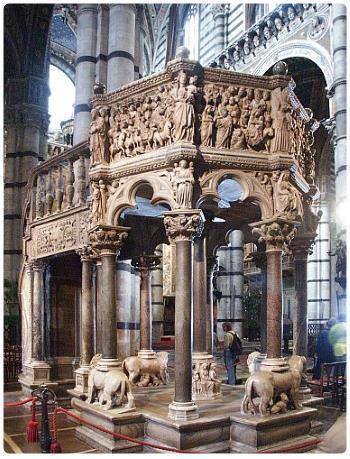 Next
to the pillars of the dome is offered to our admiration the famous Pulpit
by Nicola Pisano, in marble, octagonal in shape, with aid to the
realization of his son Giovanni Pisano and Arnolfo di Cambio,
Duccio di Donato and other Sienese masters, performed three 1266
1268. It is an absolute masterpiece of Romanesque Gothic sculpture or,
better, of all time. In it the serene and classic composure of Nicola
Pisano, still present in the first two panels, gives way to the
palpitating pathos of Giovanni Pisano. In the parapet panels of the
pulpit, events and evangelical stories are carved in bas-relief in the
following order: 1) Nativity and Visitation; 2) Arrival of the
Magi and adoration of the Magi; 3) Presentation of Jesus in the
Temple, Dream of Joseph and Escape to Egypt; 4) Slaughter of the
Innocents; 5) Crucifixion; 6) Final Judgement of the
Disobedient; 7) Final Judgement of the Elect. These stories are
separated by statues of Prophets and Angels. The eighth side of the octagon
is occupied by the access staircase, which has been remade on the design of
the Curly. The sides of the parapet rest on trilobi arches (in the plumes,
other Statues of Prophets) separated in turn by Statues of virtue. Under the
trilobi arches rise the marble columns supporting the Corinthian capitals.
The bases of the columns are, alternately, stilobate (the stilobate is the
plane on which the colonnade rests) and lions and lionesses crumbling
animals (ancient symbol, this one of the Church triumphant over paganism).
The base of the central column is replaced by a group of bas-reliefs with
allegories of the seven liberal highs and music. Next
to the pillars of the dome is offered to our admiration the famous Pulpit
by Nicola Pisano, in marble, octagonal in shape, with aid to the
realization of his son Giovanni Pisano and Arnolfo di Cambio,
Duccio di Donato and other Sienese masters, performed three 1266
1268. It is an absolute masterpiece of Romanesque Gothic sculpture or,
better, of all time. In it the serene and classic composure of Nicola
Pisano, still present in the first two panels, gives way to the
palpitating pathos of Giovanni Pisano. In the parapet panels of the
pulpit, events and evangelical stories are carved in bas-relief in the
following order: 1) Nativity and Visitation; 2) Arrival of the
Magi and adoration of the Magi; 3) Presentation of Jesus in the
Temple, Dream of Joseph and Escape to Egypt; 4) Slaughter of the
Innocents; 5) Crucifixion; 6) Final Judgement of the
Disobedient; 7) Final Judgement of the Elect. These stories are
separated by statues of Prophets and Angels. The eighth side of the octagon
is occupied by the access staircase, which has been remade on the design of
the Curly. The sides of the parapet rest on trilobi arches (in the plumes,
other Statues of Prophets) separated in turn by Statues of virtue. Under the
trilobi arches rise the marble columns supporting the Corinthian capitals.
The bases of the columns are, alternately, stilobate (the stilobate is the
plane on which the colonnade rests) and lions and lionesses crumbling
animals (ancient symbol, this one of the Church triumphant over paganism).
The base of the central column is replaced by a group of bas-reliefs with
allegories of the seven liberal highs and music.
Top
Chapel of Sant'Ansano
 The
side chapel of Sant'Ansano is located opposite the Sacramento chapel.
In the altar we find a painting by Francesco Vanni, Sant'Ansano, who
baptized the Sienese in 1596. On the left wall there is the Sepulchral
Monument of Cardinal Riccardo Petroni, executed in 1317 by Tino da
Caimaino, the greatest Sienese sculptor after Jacopo della Quercia.
Above the base supported by shelves, four caryatids support the sarcophagus
adorned with reliefs inspired by the Gospel. On the sarcophagus there is a
small catalogue with a statue of the bishop protected by a veil supported by
angels. The solemn monument ends with a cusped tabernacle containing statues
of the Madonna with Child and Saints Peter and Paul. Another famous bronze
tombstone slab is the one dedicated to Bishop Pecci, of Donatello and 1426,
embedded in the floor and usually covered. The
side chapel of Sant'Ansano is located opposite the Sacramento chapel.
In the altar we find a painting by Francesco Vanni, Sant'Ansano, who
baptized the Sienese in 1596. On the left wall there is the Sepulchral
Monument of Cardinal Riccardo Petroni, executed in 1317 by Tino da
Caimaino, the greatest Sienese sculptor after Jacopo della Quercia.
Above the base supported by shelves, four caryatids support the sarcophagus
adorned with reliefs inspired by the Gospel. On the sarcophagus there is a
small catalogue with a statue of the bishop protected by a veil supported by
angels. The solemn monument ends with a cusped tabernacle containing statues
of the Madonna with Child and Saints Peter and Paul. Another famous bronze
tombstone slab is the one dedicated to Bishop Pecci, of Donatello and 1426,
embedded in the floor and usually covered.
Once out of the Chapel, in a symmetrical
position with respect to the statues of the arm opposite the transept, there
are the statues of Pius II, Joseph Mazzuoli of 1698, and
Pius III of Pietro Balestra in 1706. On the floor, graffiti
tombstone of 1468. Two altars follow: in the second is a wooden crucifix
that is believed, only by tradition belonged to the Carroccio Senese.
Top
Chapel of St. John the Baptist
 Continuing
on, there is the Chapel of San Giovanni Battista, which is used as a
Baptistery, this chapel was built in 1482 to preserve the arm of
San Giovanni Battista, the relic that Pope Pius II gave to Siena. The
chapel is in a typical Renaissance style, with a circle plan and a dome
above it. Designed by Giovanni di Stefano in 1482, preceded by a
marble portal carved with the prodigious finesse of Lorenzo Marrina
and flanked by two orders of superimposed columns (the bases, once believed
to be of Roman age, are perhaps, instead of Antonio Federighi). The
wrought iron gate is by Sallustio di Francesco Barili. The chapel is
decorated with stuccoes by Alberto Caponeri and Cosimo Lucchi
in 1596 and has a baptismal font with reliefs in the centre, probably also
by Antonio Federighi. The lower ornamentation of the chapel is particularly
valuable. On the left is a beautiful Portrait of Alberto Aringhieri il
Giovane, rector of the Opera del Duomo, Pinturicchio;
Sant'Ansano, statue of Giovanni Di Stefano in 1487; The
Baptist of Donatello wonderful statue of the last way of the
artist; Take-off of the Baptist, of Pinturicchio, remade by Francesco
Rustici called Rustichino in 1608; Saint Catherine of Alexandria,
very delicate sculpture of Neroccio di Bartolomeo
in 1487; Portrait of Alberto Aringhieri elderly by Pinturicchio.
Outside the Chapel, on the right, in a niche, is the Statue of
Marcantonio Zonzadari, of Giuseppe and Bartolomeo Mazzuoli of
1725. Continuing
on, there is the Chapel of San Giovanni Battista, which is used as a
Baptistery, this chapel was built in 1482 to preserve the arm of
San Giovanni Battista, the relic that Pope Pius II gave to Siena. The
chapel is in a typical Renaissance style, with a circle plan and a dome
above it. Designed by Giovanni di Stefano in 1482, preceded by a
marble portal carved with the prodigious finesse of Lorenzo Marrina
and flanked by two orders of superimposed columns (the bases, once believed
to be of Roman age, are perhaps, instead of Antonio Federighi). The
wrought iron gate is by Sallustio di Francesco Barili. The chapel is
decorated with stuccoes by Alberto Caponeri and Cosimo Lucchi
in 1596 and has a baptismal font with reliefs in the centre, probably also
by Antonio Federighi. The lower ornamentation of the chapel is particularly
valuable. On the left is a beautiful Portrait of Alberto Aringhieri il
Giovane, rector of the Opera del Duomo, Pinturicchio;
Sant'Ansano, statue of Giovanni Di Stefano in 1487; The
Baptist of Donatello wonderful statue of the last way of the
artist; Take-off of the Baptist, of Pinturicchio, remade by Francesco
Rustici called Rustichino in 1608; Saint Catherine of Alexandria,
very delicate sculpture of Neroccio di Bartolomeo
in 1487; Portrait of Alberto Aringhieri elderly by Pinturicchio.
Outside the Chapel, on the right, in a niche, is the Statue of
Marcantonio Zonzadari, of Giuseppe and Bartolomeo Mazzuoli of
1725.
Top
Left nave and Piccolomini
Library
The left nave immediately shows the magnificent
elevation of the Piccolomini Library, consisting of two marble arches
elegantly worked by Lorenzo di Mariano Fucci called the Marrina
in 1497. In the right arch, there is an altar with a bas-relief
configuration of St. John the Evangelist by
Giovanni di Stefano. On the left, which is the entrance to the Library,
there is the double bronze gate by Antonio Ormanni, also dating back
to 1497. In the lunette above the entrance, we find the Coronation of
Pius III by Pinturicchio.
 The
Piccolomini Library was built at the behest of Cardinal Francesco
Todeschini Piccolomini, who later became Pope Pius III in 1495,
to house the precious library of his uncle Pope Pius II. To embellish
it, Pinturicchio was called to Siena, leading to the school of
Perugino,
Raphael,
who, according to the tradition of
Vasari, would give Pinturicchio
cartoons and sketches of various compositions. The
Piccolomini Library was built at the behest of Cardinal Francesco
Todeschini Piccolomini, who later became Pope Pius III in 1495,
to house the precious library of his uncle Pope Pius II. To embellish
it, Pinturicchio was called to Siena, leading to the school of
Perugino,
Raphael,
who, according to the tradition of
Vasari, would give Pinturicchio
cartoons and sketches of various compositions.
The work carried out between 1505 and 1507 by the master, now over fifty
years old (with many aids), confirms its peculiar qualities: richness and
vivacity of colors, taste for decorative elegance, pleasantness of narration.
In the rectangular room, paved in magnolia with the coat of arms of the
Piccolomini of 1507, the 10 frescoes by Pinturicchio, are divided by
pilasters decorated "grotesque" (The grotesques are a particular type of
wall painting decoration that has its roots in Roman painting of the
Augustan era and was rediscovered and popular since the late fifteenth
century.
In this case they are decoration that weaves disfigured patterns and many
geometers and that continues in the plumes) they represent, starting from
the window at the bottom right: 1) The young Aeneas Silvio Piccolomini
leaves for the Council of Basel; 2) He is ambassador of the Council
to the court of King James of Scotland; 3) He receives the laurel
crown of poet from the emperor of the Holy Roman Empire Frederick III;
4) He was sent as ambassador of Frederick III to Pope Eugene IV; 5)
As bishop of Siena present, at Porta Camogli a, Frederick III to his
girlfriend Eleonora of Portugal; 6) He was nominated cardinal of Pope
Callistus III; 7) He was elected pontiff with the name of Pius II;
8) In Mantua he exhorted the congress to undertake a crusade against the
Turks; 9) He decreed the canonization of Saint Catherine of Siena; 10)
In Ancona he exhorted the congress to hasten the departure for the
crusade (which was never to be done).
 Some
of Pinturicchio's collaborators have created the mythological and
allegorical paintings of the vault, in the centre of which is the coat of
arms of the Piccolomini. In the centre of the bookcase, on a marble pedestal
attributed to Federighi, the statues of the Three Graces, from
an original Hellenistic, wonderful for the soft elegance of the figures
harmoniously intertwined. On the carved benches under the frescoes are
precious choral finely illuminated by famous fifteenth-century artists such
as Liberale da Verona, Girolamo da Cremona, Sano di Pietro,
Guidoccio Cozzarelli, Benvenuto di Giovanni. Above the
entrance of the library, the Cacciata di Adamo and Eva dal Paradiso, an
excellent pair of reliefs from one of the Fonte Gaia. Among the
windows, bronze statues of the Risen Christ, by Fulvio Signorini in 1595. Some
of Pinturicchio's collaborators have created the mythological and
allegorical paintings of the vault, in the centre of which is the coat of
arms of the Piccolomini. In the centre of the bookcase, on a marble pedestal
attributed to Federighi, the statues of the Three Graces, from
an original Hellenistic, wonderful for the soft elegance of the figures
harmoniously intertwined. On the carved benches under the frescoes are
precious choral finely illuminated by famous fifteenth-century artists such
as Liberale da Verona, Girolamo da Cremona, Sano di Pietro,
Guidoccio Cozzarelli, Benvenuto di Giovanni. Above the
entrance of the library, the Cacciata di Adamo and Eva dal Paradiso, an
excellent pair of reliefs from one of the Fonte Gaia. Among the
windows, bronze statues of the Risen Christ, by Fulvio Signorini in 1595.
Leaving the library, we continue into the left
nave, where the monument to Bandino Bandini surmounted by a sculpture
(Jesus risen and two angels) of a master in the orbit of Michelangelo of
about 1570 and, further on, the altar Piccolomini, work of extreme
maturity of the master Andrea Bregno of 1580 of exquisite elegance:
was in the niche (Saints Gregory, Paul, Peter and Pius) are of the
debutant
Michelangelo executed
three 1501 to 1504, which perhaps also led to the completion of the St.
Francis begun by Pietro Torrigiani. The statue of the niche at
the top is attributed to the young Jacopo della Quercia; the table
framed by the marble ancona, the Madonna del Latte, is the work of Paolo
di Giovanni Fei from 1381. Three altars follow, with paintings by Pietro
Sorri from the late 16th century and Francesco Trevisani from the
late 17th century inside. Against the internal facade I know is the Statue
of Pope Marcello II by Domenico Cafaggi.
Copyright © Informagiovani-italia.com
Map
Top
Ostelli Siena
Ostelli Italia
Auberges de Jeunesse Italie
Hotel Siena
Carte de Sienne
Karte von Siena
Mapa Siena
Map of Siena
Carte de la Toscane
Karte von Toskana
Mapa Toscana Map of
Tuscany
Carte d'Italie
Karte von Italien
Mapa Italia
Map of Italy |