|
You are here:
Siena > What
to see in Siena >
Abbey of San
Galgano - Montesiepi Hermitage
|
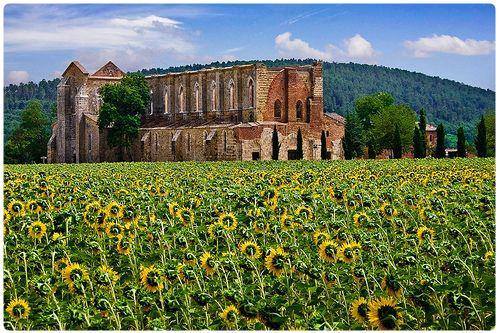
Colours and shapes strike the soul when you arrive
at the Abbey of San Galgano (Siena).
A unison of antiquities, medieval history and
mystery, immersed in a landscape as unique as the
Tuscan one. Perhaps not many people know the charm
of this place, about thirty kilometers from Siena.
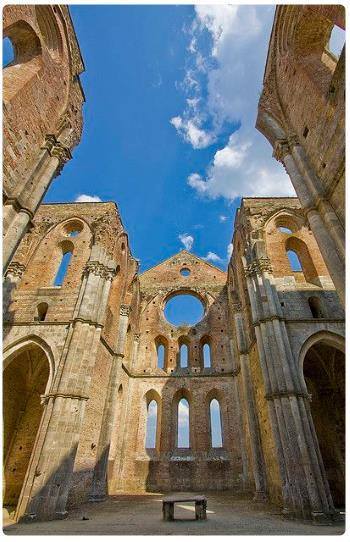
Here, the Cistercian monks began the construction of
an abbey church in Gothic style in 1218, which was
completed in 1288. What remains today is the stone
skeleton of the structure, without a roof. Still
there standing, rooted in the ground.
|
|
A little further on, we find
the chapel known as the Hermitage or the Round of Montesiepi (1185),
guardian of the tomb of San Galgano and of that sword in the rock
that marked the destiny of these places.
 The
Abbey is linked to the figure of San Galgano, who here in 1180 began
to live a period as a hermit. Galgano Guidotti di Chiusdino was a
Tuscan knight, who later became a hermit on this hill, which bears the name
of Montesiepi hill. The decision was induced by various dreams and
visions that led him to deny his previous life and to face a profound inner
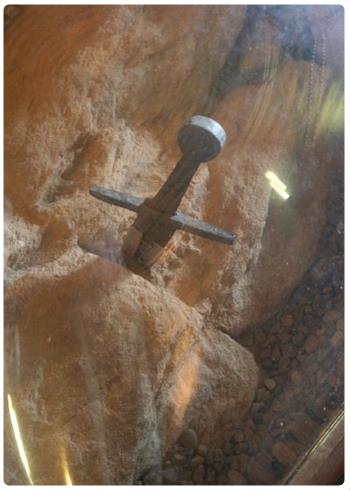
change. Legend has it that right here, Galgano put his sword into the rock
as a sign of detachment from previous life. It was Christmas Day of that
distant year, he inflicted his sword on the ground in order to turn the
weapon into a cross. The sword was stuck in the stone for long centuries up
to us... and today it is still there, exposed to curious and devoted.
Perhaps not a few, however, once visited these holy places, will ask
themselves if the popular tradition is true, which actually
recognizes the leader who later became a saint, in William X of Aquitaine,
father of Eleanor, and somehow linked to the events of the
Arthurians myths and the Holy Grail as described by Chrétien
de Troyes, French poet of medieval literature who lived in the 12th
century and is known as the Trouvère of novels dedicated to the Breton cycle
(author of Le Roman de Perceval ou le conte du Graal, a work in which the
Holy Grail is mentioned for the first time). Before you are caught by some
bold new King Arthur (the sword is protected by a glass case), you will be
amazed by the beautiful architecture that this place still retains. The
Abbey is linked to the figure of San Galgano, who here in 1180 began
to live a period as a hermit. Galgano Guidotti di Chiusdino was a
Tuscan knight, who later became a hermit on this hill, which bears the name
of Montesiepi hill. The decision was induced by various dreams and
visions that led him to deny his previous life and to face a profound inner
change. Legend has it that right here, Galgano put his sword into the rock
as a sign of detachment from previous life. It was Christmas Day of that
distant year, he inflicted his sword on the ground in order to turn the
weapon into a cross. The sword was stuck in the stone for long centuries up
to us... and today it is still there, exposed to curious and devoted.
Perhaps not a few, however, once visited these holy places, will ask
themselves if the popular tradition is true, which actually
recognizes the leader who later became a saint, in William X of Aquitaine,
father of Eleanor, and somehow linked to the events of the
Arthurians myths and the Holy Grail as described by Chrétien
de Troyes, French poet of medieval literature who lived in the 12th
century and is known as the Trouvère of novels dedicated to the Breton cycle
(author of Le Roman de Perceval ou le conte du Graal, a work in which the
Holy Grail is mentioned for the first time). Before you are caught by some
bold new King Arthur (the sword is protected by a glass case), you will be
amazed by the beautiful architecture that this place still retains.
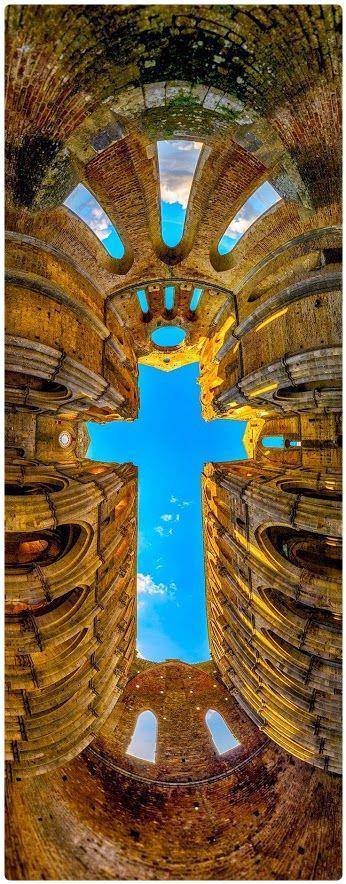
The sacred geometry of these
places is incomparable. The site itself is made up of the carcass of the
structure of the Abbey of San Galgano, reduced to the walls and
without the roof, and 6 minutes walk from the Rotonda (the Hermitage) still
well preserved. The construction of the abbey was completed in 1268, when it
was officially consecrated by the Bishop of Volterra (Alberto Solari). These
were the years of great prestige and financial wealth for the entire complex:
monks were taking on a decisive role in the economic and cultural life of
the Republic
 of
Siena; so important that they were assigned architectural responsibilities,
such as those of the construction of the
Siena
Cathedral (it is reported that friar Melano
of the Abbey of San Galgano, in 1266 took on Nicola Pisano for the
construction of the famous pulpit of the cathedral), and then reclamation
and construction of aqueducts, up to important financial roles, such as the
management of the Treasury of the Republic itself. The monastery's land was
so large that a dispute between the Republic of Siena and the Papacy was
triggered. The famine and plague that raged in the city in the first half of
the fourteenth century spared no one, not even the monks. In the 16th
century, the abbey order was still in vogue, but in the following century
the historical evidence documents part of the collapsed roof and the total
collapse of the same two centuries later due to lightning. In 1576 it was
reported that only one monk lived in the monastery. After the series of
misfortunes, in 1789, with the Rotonda di Montesiepi elevated to Pieve, the
great abbey was deconsecrated and left definitively to ruin. of
Siena; so important that they were assigned architectural responsibilities,
such as those of the construction of the
Siena
Cathedral (it is reported that friar Melano
of the Abbey of San Galgano, in 1266 took on Nicola Pisano for the
construction of the famous pulpit of the cathedral), and then reclamation
and construction of aqueducts, up to important financial roles, such as the
management of the Treasury of the Republic itself. The monastery's land was
so large that a dispute between the Republic of Siena and the Papacy was
triggered. The famine and plague that raged in the city in the first half of
the fourteenth century spared no one, not even the monks. In the 16th
century, the abbey order was still in vogue, but in the following century
the historical evidence documents part of the collapsed roof and the total
collapse of the same two centuries later due to lightning. In 1576 it was
reported that only one monk lived in the monastery. After the series of
misfortunes, in 1789, with the Rotonda di Montesiepi elevated to Pieve, the
great abbey was deconsecrated and left definitively to ruin.
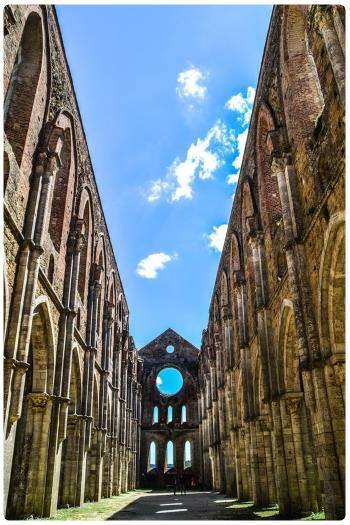
 The
ruined structure of the church has the apse facing east and has a double
sloping facade. Floor and roof are now non-existent. The building is 69
meters long by 21 meters wide and originally was a Latin cross plan, with
three naves and the main portal still decorated with a frieze in which are
carved figures. On the left side of the structure is remarkable the façade
of the transept, with architectural elements of great importance, so in
particular the apse, enclosed between two buttresses and with two orders of
openings of three single lancet windows with pointed arch. On the right
side, there was the cloister and today you can still see the signs of what
was the social life of the abbey. Among the various areas of the structure,
at the southern end of the ground floor was a vast environment, known as the
scriptorium, where monks copied the manuscripts. The
ruined structure of the church has the apse facing east and has a double
sloping facade. Floor and roof are now non-existent. The building is 69
meters long by 21 meters wide and originally was a Latin cross plan, with
three naves and the main portal still decorated with a frieze in which are
carved figures. On the left side of the structure is remarkable the façade
of the transept, with architectural elements of great importance, so in
particular the apse, enclosed between two buttresses and with two orders of
openings of three single lancet windows with pointed arch. On the right
side, there was the cloister and today you can still see the signs of what
was the social life of the abbey. Among the various areas of the structure,
at the southern end of the ground floor was a vast environment, known as the
scriptorium, where monks copied the manuscripts.
 A circa 800
metri, l'Eremo di Montesiepi si presenta nella sua singolare forma
cilindrica con architettura in travertino e mattoni, e decorazioni di
sculture simboliche e uno stemma mediceo. Questa struttura è più antica
della grande Abbazia. Fu edificata tra il 1182 ed il 1185, sulla collina
dove San Galgano visse il suo ultimo anno di vita e proprio nel punto in cui
infisse la sua spada nella roccia. Al suo interno è situata la tomba,
posizionata a nord della spada e verso la porta d'ingresso, in direzione
Chiusdino (il villaggio natale del santo). Cattura particolare
l'attenzione l'ambiente interno, decorato in stile romanico pisano-lucchese.
Al centro dell'abside è situata la pietra con inserita la spada di San
Galgano, mentre alla sinistra troviamo una cappella riccamente
affrescata nel Trecento da Ambrogio Lorenzetti, mastro pittore della
scuola senese tra i più rinomati (suoi sono i famosi Trittico di San
Procolo, 1332, conservato alla
Galleria degli Uffizi di
Firenze; la Presentazione al Tempio, 1342, oggi conservato
sempre agli Uffizi; Annunciazione, 1344, conservato alla Pinacoteca
Nazionale di Siena). A circa 800
metri, l'Eremo di Montesiepi si presenta nella sua singolare forma
cilindrica con architettura in travertino e mattoni, e decorazioni di
sculture simboliche e uno stemma mediceo. Questa struttura è più antica
della grande Abbazia. Fu edificata tra il 1182 ed il 1185, sulla collina
dove San Galgano visse il suo ultimo anno di vita e proprio nel punto in cui
infisse la sua spada nella roccia. Al suo interno è situata la tomba,
posizionata a nord della spada e verso la porta d'ingresso, in direzione
Chiusdino (il villaggio natale del santo). Cattura particolare
l'attenzione l'ambiente interno, decorato in stile romanico pisano-lucchese.
Al centro dell'abside è situata la pietra con inserita la spada di San
Galgano, mentre alla sinistra troviamo una cappella riccamente
affrescata nel Trecento da Ambrogio Lorenzetti, mastro pittore della
scuola senese tra i più rinomati (suoi sono i famosi Trittico di San
Procolo, 1332, conservato alla
Galleria degli Uffizi di
Firenze; la Presentazione al Tempio, 1342, oggi conservato
sempre agli Uffizi; Annunciazione, 1344, conservato alla Pinacoteca
Nazionale di Siena).
At
about 800 metres, the Hermitage of Montesiepi is in its unique
cylindrical shape with travertine and brick architecture, and decorations of
symbolic sculptures and a Medici coat of arms. This structure is older than
the great Abbey. It was built between 1182 and 1185, on the hill where San
Galgano lived his last year of life and right where he put his sword in the
rock. Inside is the tomb, located north of the sword and towards the front
door, in the direction of Chiusdino (the village where the saint was
born). Particular attention is paid to the interior environment, decorated
in the Pisan-Pisan-Luxe Romanesque style. In the centre of the apse is
situated the stone with the sword of San Galgano, while on the left there is
a chapel richly frescoed in the fourteenth century by Ambrogio Lorenzetti,
master painter of the Sienese school among the most famous (his are the
famous Triptych of San Procolo, 1332, preserved at the Uffizi
Gallery in
Florence; the
Presentation in the Temple, 1342, today also preserved in the Uffizi;
Annunciation, 1344, preserved in the Pinacoteca Nazionale di Siena).
Magic, art and medieval mystery
in a unique land like Tuscany.
How to get there:
The Abbey of San Galgano is
located about 20 km south of Siena.
Take the SS223 Siena -
Grosseto. At the junction for Monticiano (see distributor) follow the local
signs.
Top
Ostelli Siena
Ostelli Italia
Auberges de Jeunesse Italie
Hotel Siena
Carte de Sienne
Karte von Siena
Mapa Siena
Map of Siena
Carte de la Toscane Karte von Toskana Mapa Toscana Map of Tuscany
Carte d'Italie
Karte von Italien Mapa Italia Map of Italy |