|
Visit Versilia, information
|
Versilia
includes the territories of the coast of the province of
Lucca. The
area is famous for its large beaches and beautiful worldly life,
although compared to the past several towns, in particular
Pietrasanta,
have chosen to promote more and more cultural tourism. The
history of bathing was born here, in the second half of the
nineteenth century, with the construction of the first bathing
establishments. The pine forests behind the beaches, very
extensive and well-kept, are a historic place of shelter from
the summer heat. The most famous of these is the Versiliana
Park, in
Marina di Pietrasanta,
80 hectares of lush vegetation, which hosts high level cultural
events such as the festival of the same name. |
|
In Versilia there are many places to visit and we list some of the
following:
Pietrasanta and Marina di
Pietrasanta
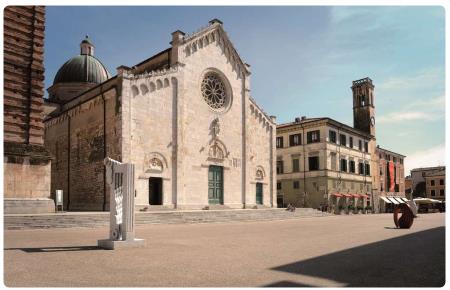 Pietrasanta
has about 25,000 inhabitants and is considered the historical capital of
Versilia. It rises on the slopes of the verdant hill of Sala and
has an ancient history, a splendid cathedral and a lively cultural life.
There are dozens of modern art galleries, trendy restaurants and many
interesting events, especially in the summer season. Cities with a
beautiful historical center very well maintained, Pietrasanta has
charming ancient streets, such as the characteristic Via del Riccetto,
with paving in river stones, or Via della Fontanella. Famous in
the world for the marble processing of nearby Apuane and bronze, it has
always welcomed sculptors and international artists who work and rest
here. Also thanks to these welcome guests, who often bought home here,
Pietrasanta has become a true city of art. Pietrasanta
has about 25,000 inhabitants and is considered the historical capital of
Versilia. It rises on the slopes of the verdant hill of Sala and
has an ancient history, a splendid cathedral and a lively cultural life.
There are dozens of modern art galleries, trendy restaurants and many
interesting events, especially in the summer season. Cities with a
beautiful historical center very well maintained, Pietrasanta has
charming ancient streets, such as the characteristic Via del Riccetto,
with paving in river stones, or Via della Fontanella. Famous in
the world for the marble processing of nearby Apuane and bronze, it has
always welcomed sculptors and international artists who work and rest
here. Also thanks to these welcome guests, who often bought home here,
Pietrasanta has become a true city of art.
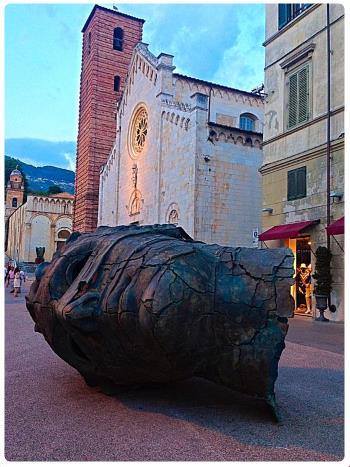
There are several places to visit in Pietrasanta, like the
Sketches Museum (Museo dei Bozzetti) with models of the
most important bronze sculptures from the local laboratories from the
mid-nineteenth century to the present day. Several sculptures by
important artists embellish the city, works by Franco Adami,
Fernando Botero, Pietro Cascella, Girolamo Ciulla,
Jean-Michel Folon, Igor Mitoraj, Kan Yasuda... There
are numerous art galleries, events and temporary exhibitions, also in
the open air, particularly in Piazza del Duomo and in the Church of
Sant' Agostino. Next to the cloister, in the cloister, there is the
local cultural centre.
In addition to the Duomo, there is also the Civic Tower,
the Arrighina Rocchetta, next to which there is the arch of
Porta a Pisa. The city also has a network of underground tunnels and
strategic defensive works, such as the walls of the city walls clearly
visible from the square, which can be reached by a path that ends at the
Rocca di Sala. Read more about the
Pietrasanta Guide.
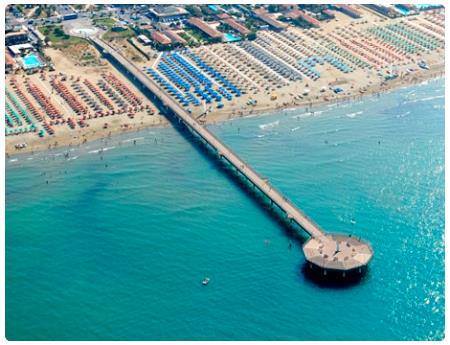 Once
you visit the beauties of Pietrasanta, you can only enjoy the sea. The
pleasant seaside resort of Marina di Pietrasanta, which is only a
few kilometres from the village, stretches for about five kilometres of
beautiful Tyrrhenian coast. Famous and sought after since the early
twentieth century, Marina di Pietrasanta is made up of four centres:
Fiumetto, Tonfano, Motrone and Focette. Read on
Marina di Pietrasanta. Once
you visit the beauties of Pietrasanta, you can only enjoy the sea. The
pleasant seaside resort of Marina di Pietrasanta, which is only a
few kilometres from the village, stretches for about five kilometres of
beautiful Tyrrhenian coast. Famous and sought after since the early
twentieth century, Marina di Pietrasanta is made up of four centres:
Fiumetto, Tonfano, Motrone and Focette. Read on
Marina di Pietrasanta.
Forte di Marmi
Famous resort resort with large fine sandy beaches, excellent bathing
establishments, a fantastic seafront promenade, trendy restaurants,
clubs, boutiques and discos, historically frequented by famous people.
Here you will find the famous Capannina discotheque by Franceschi.
The name of the town derives from the Fortino, fort Leopoldo I, or Forte
Lorenese, built by the Grand Duke Pietro Leopoldo in 1700, and
which is located right in the centre of the village, in Piazza G.
Garibaldi. It was built in defence of the landing place and of the
precious marble that from the Apuan Alps were brought here to take the
sea route. Inside the Fortress there is the Satira and Caricature
Museum, one of the most important museums of its kind. It collects
the legacy of the "Satira Politica" Prize created in 1973, and has
become the center of conservation, collection and study of all materials
concerning the history of satire and world caricature. On display are
original, contemporary and past drawings, a thematic library with over
1000 volumes, a video library and a multimedia archive.
Continuing towards the sea, you can admire the loading dock,
which was used to embark the large blocks of marble departing all over
the world. Today it is a tourist resort, where you can stroll and admire
the coast from three hundred meters away. The "Rome Imperial" district
is famous for the presence of many villas designed by famous architects
such as Giovanni Michelucci and Giò Ponti. Here you will
also find Villa Agnelli, once the family's summer residence of
the owners of the FIAT cars and now a hotel, with the underpass that
leads directly to the sea, inaugurated in 1929 and still open.
Camiore and its Lido
Camaiore is located 8 km from the coast and has over 30 thousand
inhabitants. It preserves within its ancient walls many artistic jewels
such as the famous Collegiata and the Benedictine Abbey. Lido di
Camaiore is a well-equipped and modern seaside resort with a large 4
km long beach and an elegant seafront promenade (Viale Europa) which is
a succession of bathing establishments, bars and cafes, shops and
restaurants. Very beautiful the modern Pontile Bellavista Vittoria,
where you can stroll and have an excellent aperitif with a look at the
sea and the Apuan Alps behind.
Viareggio
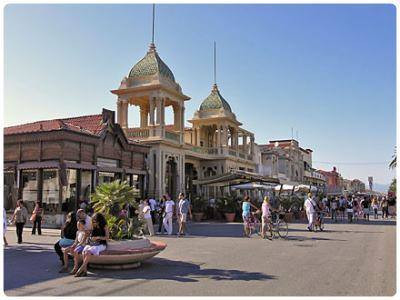 The
"capital" of Versilia is a city of about 60 thousand inhabitants. It
dates back to the first half of 1500, when it was the only one
overlooking the sea of the Republic of Lucca. The oldest city
building, the Matilde Tower, is a defensive fortification erected
by the inhabitants of Viareggio in 1541 to counter the incursions of the
pirates. Several interesting architectures in Art Nouveau style.
Beautiful is Piazza Percy Bysshe Shelley a square dedicated to
the famous English writer and philosopher who died in front of the
waters in front of the city's beaches in 1822. The town is famous not
only for the seaside tourism, but also for the international
Viareggio literary prize and for the ancient Carnival. The
latter, born in 1873, as you will know, is characterized by the enormous
floats of papier-maché that parade along the "Walk to the sea". A
character linked to Viareggio is
Giacomo Puccini who was at home here: he took his place
in the Margherita restaurant, near the window that from on the beach, he
met friends like D' Annunzio, Marconi and Toscanini. Read more about the
guide to Viareggio. The
"capital" of Versilia is a city of about 60 thousand inhabitants. It
dates back to the first half of 1500, when it was the only one
overlooking the sea of the Republic of Lucca. The oldest city
building, the Matilde Tower, is a defensive fortification erected
by the inhabitants of Viareggio in 1541 to counter the incursions of the
pirates. Several interesting architectures in Art Nouveau style.
Beautiful is Piazza Percy Bysshe Shelley a square dedicated to
the famous English writer and philosopher who died in front of the
waters in front of the city's beaches in 1822. The town is famous not
only for the seaside tourism, but also for the international
Viareggio literary prize and for the ancient Carnival. The
latter, born in 1873, as you will know, is characterized by the enormous
floats of papier-maché that parade along the "Walk to the sea". A
character linked to Viareggio is
Giacomo Puccini who was at home here: he took his place
in the Margherita restaurant, near the window that from on the beach, he
met friends like D' Annunzio, Marconi and Toscanini. Read more about the
guide to Viareggio.
Torre del Lago Puccini
6 km from Viareggio is located Torre del Lago, with its famous
marina and the beautiful beach of Lecciona, along with many
restaurants and clubs. The composer Giacomo Puccini lived here
from 1891 until his death (which took place in Brussels where he had
gone to seek treatment). In this place of peace and harmony, he composed
many of his most famous operas. After being rented, the composer bought
the house in Torre del Lago in 1898, on the viewpoint of Lake
Massaciuccoli. Villa Puccini, richly decorated inside, has a
rectangular shape and is now a museum that also houses, in the private
chapel, the remains of the musician, along with his wife, son and
daughter-in-law. In summer, the Puccini Festival is held in the
theatre on the lake shore, right in front of the composer's house. It is
the most important outdoor theatre in Tuscany. In the previous local
theatre, the Torre del Lago Festival was held in 1930 and, thanks
to the famous installations and the participation of the most
illustrious names of the world's lyricists, it became a highly
successful event. In the area to see also the Villa Borbone,
built by Lorenzo Nottolini for Maria Luisa di Borbone
along Viale dei Tigli (here are buried most of the Bourbon princes of
Parma) that from Viareggio leads to Torre del Lago and the Church of
San Giuseppe, of the eighteenth century.
Massaciuccoli
Lake Massaciuccoli is an ideal place for walking in nature and
birdwatching. Birds can be observed in a very large protected area,
including the Migliarino Park and the Tenuta San Rossore.
From the main pier, even the less experienced can admire many beautiful
birds in their habitat. Just don't make noise.... Canoe excursions are
also possible.
Seravezza
Municipality divided into several hamlets, the main one being Seravezza,
a pleasant village with a large square and many shops. To see the
Villa Medicea, summer residence of the de' Medici family, today a
place of culture with the Museo del Lavoro e delle Tradizioni Popolari
Locali, the library, the historical archive and exhibition spaces. Also
worth visiting are the Church of Saints Lorenzo and Barbara and
the Oratory of Santissima Annunziata.
Stazzema
Stazzema is also formed by small inhabited towns distant from each other
on the surrounding hills, a bit like in Garfagnana. Interesting in the
main village is the Clock Tower of 1700, the Carraia fountain
of 1500 and just outside the center, the parish church of Santa Maria
Assunta. A short distance away is the Sanctuary of Madonna del
Bell'Amore or Piastraio, immersed in the woods of Stazzema,
with a church today closed to the faithful, but once the destination of
many pilgrimages. You can reach it by using a short path near the Church
of Santa Maria delle Nevi in Stazzema or by using the mule track that
starts from the Mill. From a naturalistic point of view, from Stazzema
there are many paths for trekking lovers, which from here go up to the
Apuan Alps. The country is sadly known for the massacre that took
place here towards the end of the Second World War. The small hamlet of
Sant'Anna di Stazzema was the scene of a terrible crime against humanity
on August 12,1944. A German division of SS, killed 560 people and burned
their bodies; 130 of them were children. The massacre emerged in all its
cruelty in the eyes of international public opinion in 1994, when Judge
Antonino Intelisano, during his investigation of war crimes,
found in a palace in Rome, very important documents on what had happened,
which for decades had been kept silent. Since 2000, the National
Peace Park, a memorial and museum dedicated to the terrible event,
has been opened.
Copyright © Informagiovani-italia.com. La riproduzione totale o parziale, in qualunque forma, su qualsiasi supporto e con qualunque mezzo è proibita senza autorizzazione scritta.
Se questa pagina ti è piaciuta e ti è stata utile, per favore prenota con noi un hotel o un ostello ai link che trovi in questa pagina, è un servizio di Booking, non spenderai un euro in più, ma ci aiuterai ad andare avanti, per quanto possiamo e a scrivere e offrire la prossima guida gratuitamente. Oppure se vuoi puoi offrirci un caffè (ma non ci offendiamo se ci offri una pizza :) ) con una piccola donazione:.:
Paypal
☕
Dove si trova?
Ostelli Pietrasanta Ostelli Italia
Auberges de Jeunesse Italie
Hotel Pietrasanta
Carte de Pietrasanta
Karte von PietrasantaMapa Pietrasanta
Map of Pietrasanta Carte
de la Toscane
Karte von Toskana
Mapa Toscana Map of
Tuscany
Carte d'Italie
Karte von Italien
Mapa Italia
Map of Italy |