|
You are here:
Siena > What
to see in Siena >
Sala della
Pace (Peace Hall) - Siena
|
Next to the
Sala del
Mappamondo, in the
Palazzo
Pubblico of
Siena,
there is the equally beautiful Sala della Pace,
which was the historic public seat of the
Government of the Nine, to which we have already
mentioned in these pages of our guide of the city.
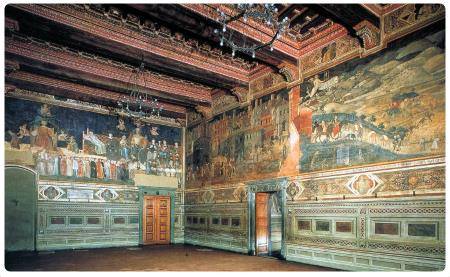
The walls of this room are entirely covered by the
most famous cycle of frescoes in the city, the
Allegoria del Buono and Mal Governo (Allegance
of the Good and Bad Government)) painted by
Ambrogio Lorenzetti between 1338 and 1340. A
universal masterpiece.
|
|
 The
"Government of the Nine" that lasted from 1892 to 1355, this
government in Siena marked the decline of the Ghibelline party
and the prevalence of the Guelph part. This scenario was
encouraged by a relative political stability serenely defended
by the Nine (representatives of the rich bourgeoisie and high
finance who, through an articulated body of judges, governed the
life of the Sienese republic. A succession of alternating
economic conditions gave rise to unquestionable cultural
progress (especially for the mission of the University) and an
incomparable flowering of the arts. The
"Government of the Nine" that lasted from 1892 to 1355, this
government in Siena marked the decline of the Ghibelline party
and the prevalence of the Guelph part. This scenario was
encouraged by a relative political stability serenely defended
by the Nine (representatives of the rich bourgeoisie and high
finance who, through an articulated body of judges, governed the
life of the Sienese republic. A succession of alternating
economic conditions gave rise to unquestionable cultural
progress (especially for the mission of the University) and an
incomparable flowering of the arts.
The great frescoes by Ambrogio Lorenzetti
of the period 1338-1340 are dedicated to the "Governo dei Nove",
which decorate the walls of the room and make up the largest complex of
medieval paintings dedicated to a profane subject. Lorenzetti addressed the
glorification of this government through a cycle of allegories in which
abstract concepts (government, virtue, vices, etc.) are clothed, as in
customary human features. It is believed probable that for the complex chain
of figurations commented by long explanatory captions in the vernacular
language, Ambrogio Lorenzetti had to deal with people of great culture and
philosophers, probably Aristotelian-school station
 On
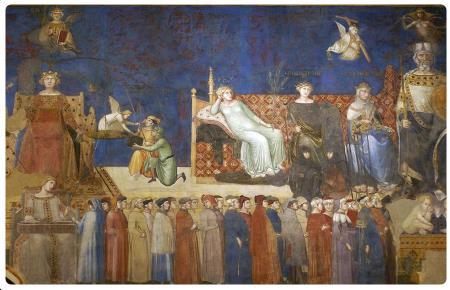
the wall opposite the window is the part of the fresco of Good Government.
The concept is that the Nove's government (symbolised by the king in
throne with the black and white garment, that is, with the colours of Siena,
also remembered by the two twins and the wolf) is good because it is based
on the observance of human and divine virtues. The human virtues are
personified by the six ladies who sit on the king's side: to his right,
peace, fortress, prudence; to his left, magnanimity,
temperance, justice. The divine virtues (faith, hope and charity) wander
over the king's head. The government's sum Virtue, however, is Justice,
represented a second time by the seated noblewoman, isolated, at the left
end of the scene, in turn inspired by the Wisdom that dominates it. On
the wall opposite the window is the part of the fresco of Good Government.
The concept is that the Nove's government (symbolised by the king in
throne with the black and white garment, that is, with the colours of Siena,
also remembered by the two twins and the wolf) is good because it is based
on the observance of human and divine virtues. The human virtues are
personified by the six ladies who sit on the king's side: to his right,
peace, fortress, prudence; to his left, magnanimity,
temperance, justice. The divine virtues (faith, hope and charity) wander
over the king's head. The government's sum Virtue, however, is Justice,
represented a second time by the seated noblewoman, isolated, at the left
end of the scene, in turn inspired by the Wisdom that dominates it.
In this way, all classes of citizens agree in paying homage to the
government: and are sold here represented by the 24 characters who hold two
strings (according to an etymology wrong, but figuratively more acceptable
than the right one, of the word "Concorde" which means with the heart
and not with the strings). These ropes descend from the two plates of the
scale of Justice on which watch over two angels (symbols of
commutative and distributive justice of Aristotelian memory), are collected
by Concordia (on her knees to the plane destined to humiliate the demands of
ambitious ones), and passed by her to the 24 characters who offer her to the
king. Finally, the military security of the government is exemplified, on
the right of the fresco, by the armed knights guarding a group of prisoners.
Ambrogio Lorenzetti came out of this
all-medieval crushy tablet, winning thanks to the accuracy of his gaze to
make the characters depicted in the fresco express the moral qualities and
feelings that they had to symbolize (although with sobriety of style in
keeping with the times and the austerity of the theme): For this reason we
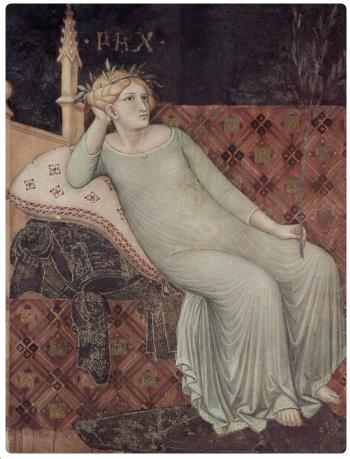
can see, in particular, the images of Peace (which gave the room its name),
Concordia, Prudence and the faces, now resigned, now
suffering, prisoners of war.
 In
the entrance wall there is the part of the fresco dedicated to The
effects of good governance in the city in the countryside. It tells us
how a well-governed city is also necessarily rich and happy, as can be seen
from the quantity and decorum of its buildings, the luxurious clothing of
its citizens, their festive optimism, the prosperity of its markets. In this
way Lorenzetti gives us a vision (not certainly completely arbitrary given
his constant attention to the truth) of Siena of his times, with its many
tower houses, its alleys, its squares, where girls beat the harpsichord and
dance, weddings are celebrated, fervent trade. This is undoubtedly the most
spectacular fresco of the cycle, the most famous for its evocative immediacy
and, at the same time, for so many different images that it does not allow
us to fix a single point of observation, for a party, finally, of colours,
which the "chemistry of the centuries" has unfortunately mortified but not
turned off. In
the entrance wall there is the part of the fresco dedicated to The
effects of good governance in the city in the countryside. It tells us
how a well-governed city is also necessarily rich and happy, as can be seen
from the quantity and decorum of its buildings, the luxurious clothing of
its citizens, their festive optimism, the prosperity of its markets. In this
way Lorenzetti gives us a vision (not certainly completely arbitrary given
his constant attention to the truth) of Siena of his times, with its many
tower houses, its alleys, its squares, where girls beat the harpsichord and
dance, weddings are celebrated, fervent trade. This is undoubtedly the most
spectacular fresco of the cycle, the most famous for its evocative immediacy
and, at the same time, for so many different images that it does not allow
us to fix a single point of observation, for a party, finally, of colours,
which the "chemistry of the centuries" has unfortunately mortified but not
turned off.
 If
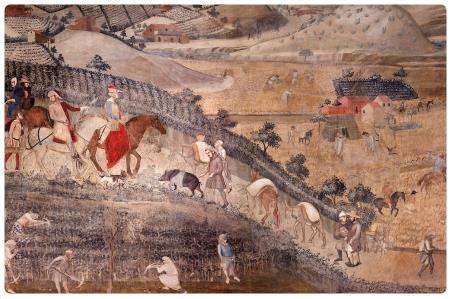
the government is good, its effects can also be seen in the countryside:
therefore Lorenzetti evokes us in the other large fresco of the wall, beyond
the crenellated walls of the city that form a dividing frame between the two
compositions, the hilly region that surrounds Siena, so meagre and yet so
tenaciously and geometrically ordered and cultivated (on the background, a
glimpse of Maremma: the port of Talamone). Also in this,
unfortunately spoilt, frescoes vary the anecdotes, delicious stories of
rural life: there are those who go hunting with the Falcone, pushes the
donkey with a stick or fat pork, who ara and beats wheat, who fishes, who
gets to the market, while the animals graze quietly and escape frightened in
front of the hunters. If
the government is good, its effects can also be seen in the countryside:
therefore Lorenzetti evokes us in the other large fresco of the wall, beyond
the crenellated walls of the city that form a dividing frame between the two
compositions, the hilly region that surrounds Siena, so meagre and yet so
tenaciously and geometrically ordered and cultivated (on the background, a
glimpse of Maremma: the port of Talamone). Also in this,
unfortunately spoilt, frescoes vary the anecdotes, delicious stories of
rural life: there are those who go hunting with the Falcone, pushes the
donkey with a stick or fat pork, who ara and beats wheat, who fishes, who
gets to the market, while the animals graze quietly and escape frightened in
front of the hunters.
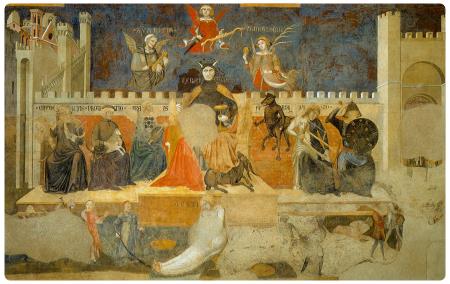 On
the opposite wall there is the fresco of the Malgovernment and its
effects in the country. These are the most faulty frescoes in the entire
room so that they are not easily readable. I am, of course, the allegorical
(and therefore figurative) reversal of the concepts expressed in the
previous frescoes: we pass, in summary, from good to evil. Thus, with the
sword of outrage, the Mal Governo dominates the chalice of greed by placing
its feet on a black goat (Belzebù?), with strabicidal eyes, two curved fangs
like the horns fleeing from the head. Above him there are the Tirannide,
the Avarice and Vanagloria, and on the sides sits the
Cruelty, the Deception, the Fraud, the Wrath, the
Discordia, the Perfidia; Justice is in chains laughed
and trampled on. As for the effects of bad governance, the few fragments let
us imagine if they are intact, the demise of a city reduced to ruins and
infested with brigands and a gloomy kingdom of violence and death. On
the opposite wall there is the fresco of the Malgovernment and its
effects in the country. These are the most faulty frescoes in the entire
room so that they are not easily readable. I am, of course, the allegorical
(and therefore figurative) reversal of the concepts expressed in the
previous frescoes: we pass, in summary, from good to evil. Thus, with the
sword of outrage, the Mal Governo dominates the chalice of greed by placing
its feet on a black goat (Belzebù?), with strabicidal eyes, two curved fangs
like the horns fleeing from the head. Above him there are the Tirannide,
the Avarice and Vanagloria, and on the sides sits the
Cruelty, the Deception, the Fraud, the Wrath, the
Discordia, the Perfidia; Justice is in chains laughed
and trampled on. As for the effects of bad governance, the few fragments let
us imagine if they are intact, the demise of a city reduced to ruins and
infested with brigands and a gloomy kingdom of violence and death.
Copyright © Informagiovani-italia.com
Where is it located?
Torna su
Ostelli Siena
Ostelli Italia
Auberges de Jeunesse Italie
Hotel Siena
Carte de Sienne
Karte von Siena
Mapa Siena
Map of Siena
Carte de
la Toscane Karte
von Toskana Mapa
Toscana Map of
Tuscany
Carte d'Italie
Karte von Italien
Mapa Italia
Map of Italy |