|
What
to see in Barga - Places to visit in Barga
|
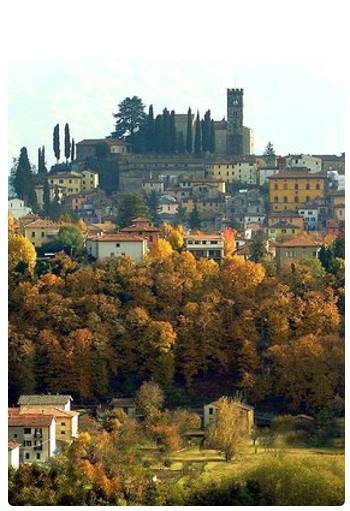
Barga
is a Tuscan town, located between
Lucca
and Castelnuovo Garfagnana, in the province of Lucca and
still manages to maintain its typical characteristics, which
make it become one of the most authentic villages in our
country, around the Cathedral, in fact, are intertwined many
small streets, which have maintained their typical
characteristics of the Middle Ages. |
|
The narrow streets are dotted
with alleys with steps, which are called "carraie". Even
today you can admire the ancient walls that protected the city
and the main entrance gates, such as the P Porta Reale (Royal
Gate) or "Marcianella". The area where today rises Barga was
inhabited already during the prehistoric age, as evidenced by
the numerous finds found in the territories around the inhabited
centre. During the Roman Empire passed to the empire and during
the age of the municipalities suffered clashes between Lucca and
Pisa, until 1341 when it came under the rule of Florence. For
Florence Barga was a real feather in the cap, becoming one of
the most active centres of commerce and textile production of
the time.
Barga has a population of about
10,000 people and has been a city since 1933. From here you can
admire the entire valley of Gargagnana, as the town stands on a
hill about 400 meters above sea level in the Media Valley of
Serchio. Barga is a small town and you can visit it on foot.
Walking through the typical streets it is impossible not to stop
at the arringo, it is a meadow that connects the
cathedral and the Praetorian palace. Once the people
gathered here to make the most important decisions, today you
can enjoy a splendid view and relax after a day of work. Barga
is also called "the most Scottish city in Italy" because
from here, during the 1900s, there was a strong migratory flow
to Scotland, as a consequence of which Italian emigrants had
summer residences built in Barga, which are very reminiscent of
the Scottish Art Nouveau style.
Historic Centre
As mentioned, the structure and
the various monuments of the centre of Barga date back to the
Middle Ages. It must be said immediately that the medieval face
of the town has been miraculously preserved despite the many
merciless war events to which Barga has been subjected over the
centuries. Among the main roads, Via di Mezzo (which
crosses the whole length), Via di Borgo (which measures
the width) and the Via del Pretorio, which together with
Via della Speranza follows the course of the old walls of
the castle, passing under what was the center of the fortress
and its last bulwark in case of extreme defense, ie the
Cathedral. Among these main arteries there is a dense network of
uphill and downhill roads and gently sloping steps: the
so-called "caravans", almost never touched by the sun and all in
suggestive dimness. And fabulous little squares with paved
sound, embellished with churches and palaces from different
periods, from the Middle Ages to the 17th century, yet
harmoniously coexisting within the ancient setting of the city.
Porta Manciana
The Porta Manciana or
Royal Gate, which is also the main one in the city, carries
the city coat of arms up high, which dates back to 1185 (when
Barga took away from the yoke of Lucca with the help of
Barbarossa) and carries as a wish the boat with the sail
deployed. To its right is the square of the Fosso, rectangular,
in front of which stood a hill in defense of the city walls.
These, raised and fortified at the beginning of 1500, were
partially demolished in the first decades of the last century,
when was dismantled also the tower that was in communication
with the Royal Door and near which was located the Rivellino
(type of independent fortification generally placed to protect a
door of a major fortification) famous for both the defense
opposite to Pisa in 1363 by the beautiful women of Barga, and
for the defeat suffered by the warlord Piccinino.
Porta
Macchiala
Porta Macchiala, located
on the other side of the Via di Mezzo and so called because it
led to the "spots", namely the beech forests of the Apennines.
It has remained almost intact since it was built (mid fifteenth
century): it is not missing that the drawbridge. The bridge,
moreover, has lost it also the Porta di Borgo, which was the
gateway to the same name. Via di Mezzo, via di Borgo and via
Pretoria are therefore the three cornerstones of the city, and
it is not surprising that there are prestigious buildings that
belonged to the most famous families who have lived in the city
over time. However, there are many people's houses here and in
the side streets that redeem their anonymity with an elegant
portal or with some other delicious detail.
Collegiate Church of
San Cristoforo
 On
top of the hill, in the highest part of the historic center
is the Collegiate Church of San Cristoforo. It is an
imposing building whose current facade corresponds to the left
side of a previous parish church. The Church dedicated to St.
Christopher is one of the symbols of the city of Barga,
its construction took place in different stages. The Duomo was
born in the same period of the birth of the city: it was built,
according to an ancient parchment, before the year 1000, as a
castle church dedicated to St. Jacopo ... Continue reading on
the
Collegiate Church of San
Cristoforo. On
top of the hill, in the highest part of the historic center
is the Collegiate Church of San Cristoforo. It is an
imposing building whose current facade corresponds to the left
side of a previous parish church. The Church dedicated to St.
Christopher is one of the symbols of the city of Barga,
its construction took place in different stages. The Duomo was
born in the same period of the birth of the city: it was built,
according to an ancient parchment, before the year 1000, as a
castle church dedicated to St. Jacopo ... Continue reading on
the
Collegiate Church of San
Cristoforo.
Arringo
Adjacent to the Duomo the lawn of
the Arringo, which evokes the life of the municipality
before the Florentine rule. Here the citizens met to decide on
war and peace; and here the magistrates were elected and the
life of the Castle was administered. In the 13th century, the
Praetorian Palace was built there, the seat of the Florentine
Commissioners and Podestà, who left their names in the coats of
arms under the loggia, on whose walls are marked the ancient
measures of the Barga. In an underground part of the Palace are
the prisons, which in past centuries have housed political
prisoners, who paid with their lives, on the lawn of the
Arringo, the attack on the freedom of Barga.
I
grandi palazzi di Barga
It is curious to see how in such
a small town (Barga has about 10,000 inhabitants) there are many
historical buildings. This is due to the prosperity that the
city once enjoyed, especially during the Renaissance, when it
was under the rule of Florence and the Medici family. It was
then that buildings such as Palazzo Balduini were built
overlooking Piazza Garibaldi. And also in the sixteenth
century was built the Palazzo dei Pancrazi in the
vicinity of which is a column of 1548 in honor of Cosimo I de
'Medici, in addition to the Loggia dei Mercanti,
which was the seat of the weekly market. Palazzo Pancrazi,
of refined elegance in the drafts that adorn the door and
windows also contains a rich archive (there are documents
preserved from the late fourteenth century) and the rich library.
Another loggia is very different, now that of the Podestà. An
original building of the XIV century where the mayor and the
commissioners who sent Florence to the city lived. That is, it
was the seat of power and also of justice, because it included
the court and the prison. All this can be visited in the
Barga Civic Museum.
Certainly, an unhurried stop
deserves the Palazzo Bertacchi, built on an ancient tower,
the residence of the Grand Dukes during their stay in Bargano.
And so it is of the severe Palazzo Pleracchi, in whose
courtyard is set a well of the twelfth century, and of the
Palazzo Nardini, now semi-dried, which housed the first
hospital of Barga ("Hospital of Santa Lucia") whose
considerable heritage passed at the time of its suppression at
the Hospital of Pisa. Facing each other, there are the ancient
Palazzo Borghesano (which belonged to a large family of
entrepreneurs, one of whom, Bolognino, in 1342
transplanted to Bologna the art of silk already flourishing in
Barga) and the Gothic Palazzo Tallinucci, which was not
spared by the war and where Dr. Piero, founder of today's
hospital, was born. And again, the sixteenth-century Palazzo
Nardi, patiently rebuilt after the destruction of 1944.
Finally, one cannot fail to mention the ancient Palazzo Angeli (from
whose family descended the poet and humanist Pietro, known as
the Bargeo), and the Renaissance palace with its façade in
pietra serena) which was the seat of a literary academy in 1700,
or Palazzo Mordini, whose rooms house a library and an
extremely rich archive. And next to the palaces, the famous
churches of Barga are all precious, from the smallest, as
miniature, to the monumental Duomo, up there on top of the
bastion that had the reputation of being impregnable. From its
parvis, which is accessed by a bold staircase, you can enjoy an
unforgettable view, but we will talk about it later.
Museum House of Giovanni
Pascoli
Giovanni Pascoli, one of
the most important Italian poet and classical scholar, loved
Barga, he loved sitting in these countryside and admiring the
landscape and it is here that the great poet died. The House
Museum dedicated to Giovanni Pascoli is located on the Caprona
Hill and was the house where the poet lived from 1895 to
1912. The building, however, was built a century earlier by
the Cardosi Carrara family who chose it as their country
residence. During the visit to the house museum you can see that
everything has remained intact, the rooms, furniture, books,
everything is stopped on April 06, 1912, the date on which
the poet died. Inside the museum house you can also admire the
manuscripts of Giovanni Pascoli and some frames that depict him
in Messina, shortly before the earthquake of 1908 that
devastated the city. Next to the villa there is the Chapel
where the poet is buried.
Buying only one ticket you can
visit both the Civic Museum and the Museum House of Pascoli, to
book guided tours you can call the following number 0583 72471.
Chiesa del Santissimo
Crocifisso (Church of the Most Holy Crucifix)
The Church of Santa Croce or
of the Santissimo Crocifisso is one of the oldest in the
city, it dates back to 1200, (the oldest after the
Cathedral) when work began on its construction, although very
little has remained of the original construction today, because
over the years the building has been significantly modified. The
building has a façade that dates back to 1500, where there is
the large portal and two statues, one is certainly dedicated to
St. John, the other depicts a woman, but the identity of this
woman remain, still today, many doubts. Inside there is a
beautiful wooden choir, of the mid-seventeenth century, which
borders with the presbytery, and in the same period also belongs
to the wooden altar carved and gilded, by Francesco Santini,
from Borgo a Mozzano.
Church
of the Santissima Annunziata
The Church of Santissima
Annunziata is a religious building of the XVII century,
inside which are the statues of the Annunciation and
frescoes of the period and paintings like a Madonna with
Child and Saints by the local artist Baccio Ciarpi.
It took this name when the image of the Annunciation of the
Virgin Mary found its seat here. It is a simple Latin cross
building with a large longitudinal nave and false columns
resting on the walls. The facade has two overlapping orders of
which the upper is crowned by a tympanum and decorated in
elevation by two stone vases. In the choir, which is slightly
raised, the large frescoes on the wall narrate the Marriage
of the Virgin and the Presentation in the Temple of Jesus.
Church
of Santa Elisabetta
The Church of Santa Elisabetta,
is located in the city center, within the historic center
attached to the convent of the Poor Clares, has, among other
things, a beautiful Assumption Della Robbia and a remarkable
wooden Crucifix of 1400. The convent was founded in the
mid fifteenth century by Blessed Michele da Barga, from
the convent of San Bernardino near Mologno, in order to welcome
the children of the countryside who were destined by families to
the cloister (not to marry them, conveniently equipped, thus
avoiding the fragmentation of family wealth). At the end of
1700, with the leopoldine reform of religious orders, the
cloister was removed and the convent was destined to the
Conservatory, that is to female educandate, so the nuns, already
silk weavers and embroiderers of sacred furnishings, took on the
new role of pedagogues of the girls from Barga. After the
unification of Italy, the Conservatory became a primary and
complementary school, and therefore normal, "forge" - so
said Giovanni Pascoli - "of the mountain women."
The building in question is certainly worth a visit, if only for
the cloister, the choir of the fifteenth century and the
seventeenth-century paintings that are collected there.
Church
of San Francesco
The Church of San Francesco,
which is located just outside the medieval village of Barga, is
from the same period as that of the Poor Clares and is also
annexed to a convent, founded by Blessed Michele da Barga
(Michele Turignoli). The church building, built between 1471 and
1490, consists of a simple rectangular plan with cross vaults,
preceded by a small cloister. The latter leads into the church
where there are four other Della Robbia terracottas,
representing the Nativity of Jesus, the Stigmata of St.
Francis and St. Andrew and St. Anthony Abbot, all
attributable to Giovanni della Robbia, while the
Assumption is from his school.
Loggia del Podestà
This palace dates back to 1300
and was once inhabited by the Podestà and the Commissioners who
had the task of governing and maintaining order in the city.
Barga was a city under the direct control of the Medici,
therefore the Lords of Florence, sent here their officials to
ensure political stability. In the basement of the Loggia there
were prisons and you can also admire the beautiful
hearing room. Very particular, on the external walls, are the
units of measure that were used in Barga, it is the staio, the
half staio and the arm barghigiano. Inside the palace, today,
there is the Civic Museum, which allows you to know and
relive the history of Barga. Inside the Museo Civico del
Territorio di Barga it is possible to study the history of this
city, starting from prehistoric times. A detailed section is
dedicated to the Middle Ages and the Renaissance. Buying only
one ticket you can visit both the Civic Museum and the Museum
House of Pascoli, to book guided tours you can call the
following number 0583 72471.
Theatre of Diffenti
The theatre of the Different
represents one of Barga's historical and artistic paths. Here,
in fact, on April 23, 1688, was born the Academy of
Differenti, an art academy, which had the main task of
staging shows of high culture. The academy was strongly desired
and supported by the Medici of Florence, who made culture a
strong point. In order to continue their mission, these
academics decided to build the theatre, which was
inaugurated on 25 July 1795. It was from this stage that
Pascoli recited an oration in 1911 to promote the war in Libya.
Even today, this museum hosts numerous theatrical performances
throughout the year.
Territory museum Antonio
Mordini
If you are curious about the
various aspects of Barga's life, don't miss a visit to the
Antonio Mordini Museum, opened in 1993, which documents with
an educational exhibition, the paleontological aspects of the
Serchio Valley, the archaeological aspects of the Barga area (Ligurian
tombs and Etruscan bronzes) and the artistic aspects of the
Middle Ages and Renaissance. The first two rooms display the
paleontological and archaeological fossil finds. Three other
rooms are dedicated to the Middle Ages and the early
Renaissance, themes of great importance for the important
artistic implications of this period such as the Duomo, itself a
large museum near the museum itself, the parish church of Loppia,
the sacred furnishings. Going down to the old prison, recent
studies have allowed to reconstruct the furnishing of a secret
and torture room. Through a predetermined path, one can
understand a past in which the way of conceiving and exercising
justice was very different from the way it is today.
Via della Speranza, 6, 55051 Barga LU
Tel: 0583 72471
Opening hours:
1 June - 30 September: 10.00 - 12.30 and 14.30 - 17.00.
Open during the other months of the year by reservation.
Ostelli Barga Ostelli Italia
Auberges de Jeunesse Italie
Hotel Barga
Carte de Barga
Karte von Barga Mapa Barga
Map of Barga Carte
de la Toscane
Karte von Toskana
Mapa Toscana Map of
Tuscany
Carte d'Italie
Karte von Italien
Mapa Italia
Map of Italy |