|
You are here:
Siena > What
to see in Siena >
Piazza del Campo
in Siena
|
Vsiting Siena, a must-see stop is
the visit to Piazza del Campo; this square, in fact, both by tourists
and inhabitants, is considered one of the symbolic places of Tuscany. What
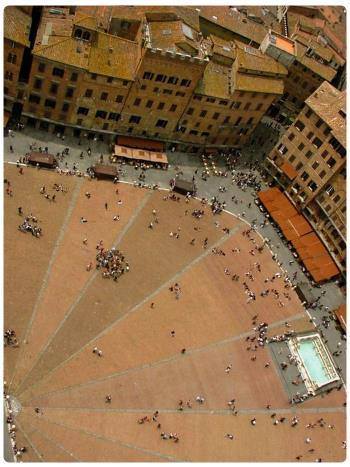
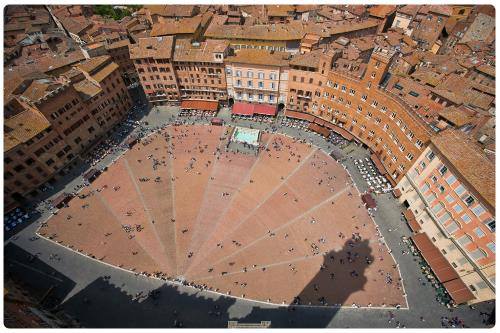
is most striking about this square is its particular shape, in fact
it resembles a shell with nine segments, slightly sloping. The number
of these segments is not random, but brings back the memory to the
government of the Nine, a government that has remained in the history of
the city.
|
|
This shape is clearly visible on the top of the
Mangia Tower (Torre del Mangia). This place has represented and represents
the fulcrum of city life: here, in fact, the market was held,
politics was discussed, danced during the feasts, today there are events,
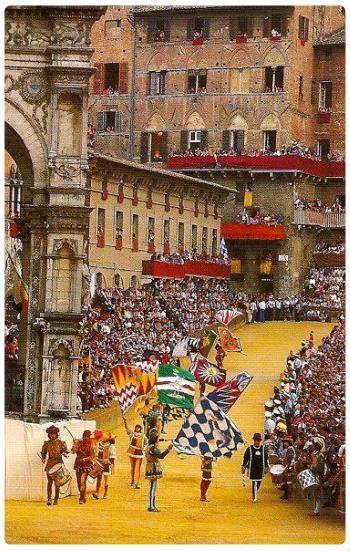
celebrations and the famous Palio
 We
do not know exactly when this square was born, but it is mentioned in some
documents dating back to 1193. During one of his visits to Siena in 1581,
the great philosopher and writer of
Bordeaux Michel de
Montaigne (who we have already met in our guide of
Bagni di Lucca) noted
in his Travel Journal:"The square (of the Campo) of Siena is the most
beautiful that can be seen in no other city of Italy". Like him, many
other foreign and Italian visitors were enchanted by the unmistakable
scenery of this square, simply called "il Campo". We
do not know exactly when this square was born, but it is mentioned in some
documents dating back to 1193. During one of his visits to Siena in 1581,
the great philosopher and writer of
Bordeaux Michel de
Montaigne (who we have already met in our guide of
Bagni di Lucca) noted
in his Travel Journal:"The square (of the Campo) of Siena is the most
beautiful that can be seen in no other city of Italy". Like him, many
other foreign and Italian visitors were enchanted by the unmistakable
scenery of this square, simply called "il Campo".
 For
all these centuries the camp was the centre of public life in Siena: Here
the people gathered together in the sad and joyful hours of republican life,
here the avid factions of hegemony were confronted, here the famous
preachers warned the people and powerful (the Celebrities among all were
St. Bernardine) here, Finally, the distressing times that preceded the
surrender of the troops of the infamous Milanese leader Medeghino,
sent by Emperor Charles V of Spain, were experienced. We have already
met the figure of the Medeghino when we talked about its mausoleum built by
Leone Leoni in the
Duomo of Milan. For
all these centuries the camp was the centre of public life in Siena: Here
the people gathered together in the sad and joyful hours of republican life,
here the avid factions of hegemony were confronted, here the famous
preachers warned the people and powerful (the Celebrities among all were
St. Bernardine) here, Finally, the distressing times that preceded the
surrender of the troops of the infamous Milanese leader Medeghino,
sent by Emperor Charles V of Spain, were experienced. We have already
met the figure of the Medeghino when we talked about its mausoleum built by
Leone Leoni in the
Duomo of Milan.
 Perhaps
the most evocative medieval urban environment in Italy, Piazza del Campo is
born on a natural slope, which from the end of the twelfth century seems to
have been used as the market. The final settlement of the area, however,
began between the thirteenth and fifteenth century, the era of maximum
splendour and artistic fervour of Siena, now a free commune: the city, in
fact, felt the political need to organize a public space of representation
for civil power, establishing an organic relationship between the seat of
the judiciary and citizenship. Perhaps
the most evocative medieval urban environment in Italy, Piazza del Campo is
born on a natural slope, which from the end of the twelfth century seems to
have been used as the market. The final settlement of the area, however,
began between the thirteenth and fifteenth century, the era of maximum
splendour and artistic fervour of Siena, now a free commune: the city, in
fact, felt the political need to organize a public space of representation
for civil power, establishing an organic relationship between the seat of
the judiciary and citizenship.
The very particular spatial configuration of the square, which adapts
without altering it to the slope of the ground, creating a shell, was
determined at the end of the twelfth century the construction of a wall
separating the area of the current Piazza del Campo and the one adjacent to
today's Piazza del Mercato (Market Square), probably to curb soil
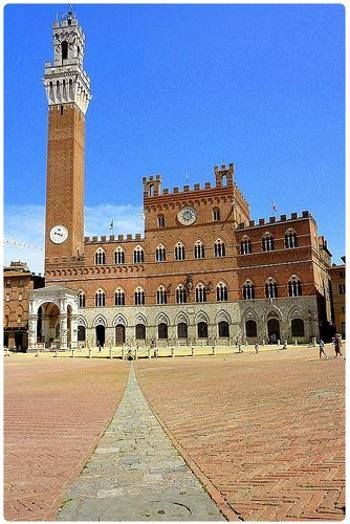
erosion. Behind the wall is Palazzo Pubblico (Public Palace) which,
with its horizontal mass, closes downstream the hemicycle and, thanks to the
difference in height and the compact building curtain of the surrounding
buildings, becomes the fulcrum of the various visual directions.
 The
Palazzo Pubblico was the first to be built, starting from the end of
the XIII century, then it was progressively surrounded by private residences
belonging to the most important families of Siena, such as Palazzo Chigi
Zondadari, Palazzo Sansedoni and Casino dei Nobili, all
renovated in the eighteenth century. The central flooring, completed in
1349, is made up of bricks arranged in a herringbone pattern, interspersed
with nine strips of travertine arranged in rays that recall the government
of the nine, a period of maximum prosperity of the Municipality of Siena. The
Palazzo Pubblico was the first to be built, starting from the end of
the XIII century, then it was progressively surrounded by private residences
belonging to the most important families of Siena, such as Palazzo Chigi
Zondadari, Palazzo Sansedoni and Casino dei Nobili, all
renovated in the eighteenth century. The central flooring, completed in
1349, is made up of bricks arranged in a herringbone pattern, interspersed
with nine strips of travertine arranged in rays that recall the government
of the nine, a period of maximum prosperity of the Municipality of Siena.
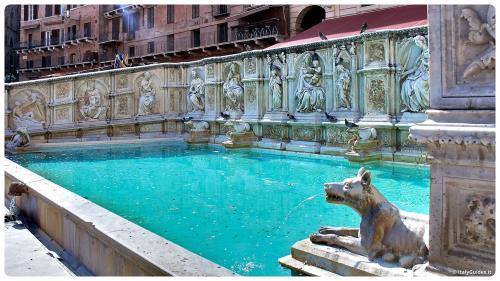
 In
1409
Jacopo della Quercia was commissioned to execute the marble
basin of Fonte Gaia, which ended ten years later, in 1419, the last
major public work destined for the urban furnishing of the square, located
on the opposite side of the field in front of the public palace (now
replaced by a nineteenth-century copy). The fountain was named after this
fountain for the festivities that took place in the 1400's, it flows into
Piazza del Campo del Campo water coming from an aqueduct about 25 km long.
The bas-reliefs represent, from left to right: The Creation of Adam,
Wisdom, Hope, Power, Prudence, The Blessed
Mother with Child between two angels, Justice, Charity,
Temperance, Faith, The expulsion of Adam and Eve from Earthly
Paradise. The water in the basin is fed by the jets of two Sienese
wolves. In
1409
Jacopo della Quercia was commissioned to execute the marble
basin of Fonte Gaia, which ended ten years later, in 1419, the last
major public work destined for the urban furnishing of the square, located
on the opposite side of the field in front of the public palace (now
replaced by a nineteenth-century copy). The fountain was named after this
fountain for the festivities that took place in the 1400's, it flows into
Piazza del Campo del Campo water coming from an aqueduct about 25 km long.
The bas-reliefs represent, from left to right: The Creation of Adam,
Wisdom, Hope, Power, Prudence, The Blessed
Mother with Child between two angels, Justice, Charity,
Temperance, Faith, The expulsion of Adam and Eve from Earthly
Paradise. The water in the basin is fed by the jets of two Sienese
wolves.
 The
desire to make the Piazza del Campo environment as coherent and homogeneous
as possible from an architectural point of view has been evident since the
beginning of its construction. In the municipal statutes of 1262, in fact,
there are provisions aimed at making the 12 openings to the square easily
accessible and in 1297 it is mandatory that the façades of private buildings
that overlook it have only double window windows and are without balconies,
for stylistic consistency with the shapes of the Palazzo Comunale. The
desire to make the Piazza del Campo environment as coherent and homogeneous
as possible from an architectural point of view has been evident since the
beginning of its construction. In the municipal statutes of 1262, in fact,
there are provisions aimed at making the 12 openings to the square easily
accessible and in 1297 it is mandatory that the façades of private buildings
that overlook it have only double window windows and are without balconies,
for stylistic consistency with the shapes of the Palazzo Comunale.
E proprio l'armonia l'equilibrio dell'insieme,
i suoi calibratissimi rapporti tra spazio vuoto e volumi architettonici,
rendere Piazza del campo uno dei più alti esempi dell'urbanistica medievale
italiana ed europea. Simbolo di un'intera città e anche sede del Palio più
famoso del mondo.
The shell shape is clearly visible on the top of the
Torre del
Mangia. This square represented and represents the fulcrum
of the city's life in the city of Siena, where the market was held, where
politics was debated, where people danced during the festivities. On this
square are the main buildings of the city and as for many squares in the
world, for tourists there is an almost "mandatory" ritual to do, that is to
sit or lie down on the ground and admire the sky.
Copyright © Informagiovani-italia.com
Where is it located?
Top
Ostelli Siena
Ostelli Italia
Auberges de Jeunesse Italie
Hotel Siena
Carte de Sienne
Karte von Siena
Mapa Siena
Map of Siena
Carte de
la Toscane Karte
von Toskana Mapa
Toscana Map of
Tuscany
Carte d'Italie
Karte von Italien
Mapa Italia
Map of Italy |