|
Delicious
Verona! With its beautiful ancient palaces and the
enchanting countryside seen from a distance from
practicable paths and solid galleries with
balustrades..., this is how
Charles
Dickens,
the famous British author of Oliver Twist,
wrote in the 19th century, when during his visit to
Verona he thought he could hear the "ancient
and quiet streets in which the cries of the
Montecchi and Capuleti echoed...? The marble
churches, the high towers, the rich architecture
remind us that Verona is one of the most beautiful
and historically charged Italian cities.
|
|
 Many
of us know it as the city of lovers, the place where
Shakespeare set the most famous romantic drama of all
time, Romeo and Juliet. But this is also a city that
offers itself to the visitor for many other interesting and
suggestive facets. Verona is a busy and lively city, a place
where past and future are the constant thought of a daily
life full of enthusiasm. A place known since ancient times,
chosen by the Romans for its fertile plain, for its
being halfway between the lakes and the Alps, the north and
central Italy, a crossroads of peoples and travelers.
Gothic memories and medieval legends are lost in the
maze of narrow streets and seventeenth-century palaces in
the center, flanked by the city's landmarks, the Roman
Amphitheater and Juliet's Balcony.
Many
of us know it as the city of lovers, the place where
Shakespeare set the most famous romantic drama of all
time, Romeo and Juliet. But this is also a city that
offers itself to the visitor for many other interesting and
suggestive facets. Verona is a busy and lively city, a place
where past and future are the constant thought of a daily
life full of enthusiasm. A place known since ancient times,
chosen by the Romans for its fertile plain, for its
being halfway between the lakes and the Alps, the north and
central Italy, a crossroads of peoples and travelers.
Gothic memories and medieval legends are lost in the
maze of narrow streets and seventeenth-century palaces in
the center, flanked by the city's landmarks, the Roman
Amphitheater and Juliet's Balcony.
 The
ancient Romans chose the fertile outlet of the Adige
river as their settlement place, and settled here, in a
place that stood on the main road of communication of Europe
that was forming with their conquests. It was the first
century of a new era and the city was born between Lake
Garda on the one hand and the Pre-Alps on the
other. To say that Verona was born with the Romans is not
entirely correct, however, in earlier times the territory
was in fact already inhabited by several indigenous peoples
such as the Euganeans, the Cenomani Gauls or
the ancient Venetians (also called Paleoveneti).
The
ancient Romans chose the fertile outlet of the Adige
river as their settlement place, and settled here, in a
place that stood on the main road of communication of Europe
that was forming with their conquests. It was the first
century of a new era and the city was born between Lake
Garda on the one hand and the Pre-Alps on the
other. To say that Verona was born with the Romans is not
entirely correct, however, in earlier times the territory
was in fact already inhabited by several indigenous peoples
such as the Euganeans, the Cenomani Gauls or
the ancient Venetians (also called Paleoveneti).
 Fu tuttavia grazie alla Roma di Cesare che il piccolo nucleo
urbano che andava sviluppandosi attorno ad un 'castrum' (castello)
fortificato poté ottenere il rango di 'municipium' e
da lì svilupparsi rapidamente. La Verona odierna grazie
ai suoi antichi monumenti, romani e medievali, rinascimentali
e scaligeri, è oggi patrimonio dell'Umanità UNESCO.
"Verona, con le sue vecchie mura che l'attorniano, i suoi
ponti dai parapetti merlati, le sue lunghe e larghe vie, i suoi
ricordi del medioevo, ha una grande aria che incute rispetto".
(Paul Valéry)
Fu tuttavia grazie alla Roma di Cesare che il piccolo nucleo
urbano che andava sviluppandosi attorno ad un 'castrum' (castello)
fortificato poté ottenere il rango di 'municipium' e
da lì svilupparsi rapidamente. La Verona odierna grazie
ai suoi antichi monumenti, romani e medievali, rinascimentali
e scaligeri, è oggi patrimonio dell'Umanità UNESCO.
"Verona, con le sue vecchie mura che l'attorniano, i suoi
ponti dai parapetti merlati, le sue lunghe e larghe vie, i suoi
ricordi del medioevo, ha una grande aria che incute rispetto".
(Paul Valéry)
However,
it was thanks to Caesar's Rome that the small urban centre
that was developing around a fortified 'castrum' (castle)
was able to obtain the rank of 'municipium' and from there
develop rapidly. Today's Verona, thanks to its
ancient monuments, Roman and medieval, Renaissance and
Scaliger, is now a UNESCO World Heritage Site.
"Verona, with its old walls that surround it, its bridges
with crenellated parapets, its long and wide streets, its
memories of the Middle Ages, has a great air that inspires
respect." (Paul Valéry)
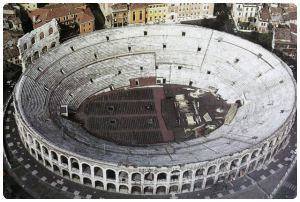 Let's
close our eyes on a summer night... imagine the notes in the
air that come from the shows of the
Arena of Verona,
one of the most important places of music in Italy and a
monument known throughout the world. The Roman Arena can be
easily reached from Piazza Bra, a very lively meeting
point in the city center and recognizable for the high
Civic Tower of the Lamberti and the seventeenth-century
architecture of the Palace of the Grand Guard
(Palazzo della Gran Guardia - keep an eye on the art
exhibitions inside). The Arena di Verona is the best
preserved Roman Amphitheatre in the world and the
best known along with the
Colosseum
of
Rome, one of those places that a foreign
tourist can not help but visit once in Italy, one of those
places that every Italian wants to see at least once in his
life. Despite its 2000 years, the barbarian incursions, the
earthquake of the twelfth century, wars and more recent
battles, still continues to testify to the greatness of the
Romans and the welfare of the Veronese.
Let's
close our eyes on a summer night... imagine the notes in the
air that come from the shows of the
Arena of Verona,
one of the most important places of music in Italy and a
monument known throughout the world. The Roman Arena can be
easily reached from Piazza Bra, a very lively meeting
point in the city center and recognizable for the high
Civic Tower of the Lamberti and the seventeenth-century
architecture of the Palace of the Grand Guard
(Palazzo della Gran Guardia - keep an eye on the art
exhibitions inside). The Arena di Verona is the best
preserved Roman Amphitheatre in the world and the
best known along with the
Colosseum
of
Rome, one of those places that a foreign
tourist can not help but visit once in Italy, one of those
places that every Italian wants to see at least once in his
life. Despite its 2000 years, the barbarian incursions, the
earthquake of the twelfth century, wars and more recent
battles, still continues to testify to the greatness of the
Romans and the welfare of the Veronese.
 In
Verona, the power struggles in the Middle Ages led to
a series of rivalries that ended, at the end of 1200, with
the rise of the family of della Scala (also known as
Scaligeri). The family became the lady of Verona in 1262,
with Mastino della Scala, of Ghibelline tradition. He
with his strange name "Mastino", was not the only one to
testify a certain sympathy with the 'canine' theme of the
wealthy family; among his successors there was also
Cangrande, with whom the city lived its most flourishing
period, and to whom Dante dedicated a whole song of
his Divine Comedy, and also Cansignorio, to
whom we owe the construction of important city monuments.
The power of the Scaligeri family was such that their rule
extended to nearby cities such as Belluno, Padua,
Treviso and Vincenza.
In
Verona, the power struggles in the Middle Ages led to
a series of rivalries that ended, at the end of 1200, with
the rise of the family of della Scala (also known as
Scaligeri). The family became the lady of Verona in 1262,
with Mastino della Scala, of Ghibelline tradition. He
with his strange name "Mastino", was not the only one to
testify a certain sympathy with the 'canine' theme of the
wealthy family; among his successors there was also
Cangrande, with whom the city lived its most flourishing
period, and to whom Dante dedicated a whole song of
his Divine Comedy, and also Cansignorio, to
whom we owe the construction of important city monuments.
The power of the Scaligeri family was such that their rule
extended to nearby cities such as Belluno, Padua,
Treviso and Vincenza.
Al penultimo
dei signori della città (Cansignorio, come accennavamo prima)
si devono strutture monumentali come la Torre del Gardello
(la prima torre orologio in Italia), il ponte sull'Adige, e
la commissione delle cosiddette "Arche Scaligere", le
famose tombe monumentali della famiglia della Scala,
situate nella piazza esterna alla chiesa di Santa Maria Antica.
Le tombe, come diceva lo scrittore francese Paul de Musset,
sono "un'opera rara, che segna il passaggio dal Medioevo
al Rinascimento", un'architettura ed un'arte scultorea unica
in Italia. La più elaborata delle tombe è quella di Cangrande
I: un sarcofago sostenuto da dei cani (il tema 'canino'
continua), accompagnato da una Pietà, dall'Annunciata e dall'Angelo
Annunciante e riccamente decorato da bassorilievi. Il tutto
custodito all'interno di un baldacchino ad arco, con in cima
la statua del valoroso condottiero a cavallo in battaglia. Le
tombe scaligere sono in totale cinque e ancora oggi rappresentano
uno degli esempi più belli d'arte gotica in Europa; accanto
a quella di Cangrande I troviamo anche quelle, più semplici,
di Mastino II, Cansignorio, Alberto II della Scala
e Giovanni della Scala.
The penultimate of the city's lords (Cansignorio, as we
mentioned before) was responsible for monumental structures
such as the Tower of Gardello (the first clock tower
in Italy), the bridge over the Adige, and the commission of
the so-called "Arche Scaligere", the famous
monumental tombs of the Scala family, located in the
square outside the Church of Santa Maria Antica. The
tombs, as the French writer Paul de Musset said, are
"a rare work, marking the transition from the Middle Ages
to the Renaissance", an architecture and sculptural art
unique in Italy. The most elaborate of the tombs is that of
Cangrande I: a sarcophagus supported by dogs (the
'canine' theme continues), accompanied by a Pietà, the
Annunciata and the Angelo Annunciante and richly decorated
with bas-reliefs. All this is kept inside an arched canopy,
with the statue of the valiant leader on horseback in battle
at the top. There are a total of five Scaliger tombs and
they still represent one of the most beautiful examples of
Gothic art in Europe; next to Cangrande I there are also the
simplest tombs of Mastino II, Cansignorio,
Alberto II della Scala and Giovanni della Scala.
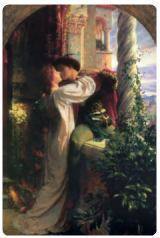 Gli
Scaligeri appartenevano alla Verona delle Signorie, ma
non c'è dubbio che la Verona storica più nota sia quella del
periodo dei Comuni e cioè del periodo delle lotte
per le investiture tra Guelfi e Ghibellini, questi ultimi
ben rappresentati dalla famiglia dei Montecchi, probabilmente
una delle famiglie medievali più conosciute al mondo. Pensate
che il turismo a Verona riguarda ancora oggi la famiglia
dei Montecchi, con quelli che possiamo definire i pellegrini
'shakespeariani', coloro che arrivano in città esplorando
le strade un tempo testimoni delle lotte tra la famiglia dei
Capuleti e la famiglia dei Montecchi, famiglie
di appartenenza di Romeo e Giulietta. Malgrado la storia verosimile,
i personaggi della tragedia di Shakespeare in realtà non sono
mai esistiti, e allora che dire della Casa di
Giulietta
in via Capello a Verona?
Gli
Scaligeri appartenevano alla Verona delle Signorie, ma
non c'è dubbio che la Verona storica più nota sia quella del
periodo dei Comuni e cioè del periodo delle lotte
per le investiture tra Guelfi e Ghibellini, questi ultimi
ben rappresentati dalla famiglia dei Montecchi, probabilmente
una delle famiglie medievali più conosciute al mondo. Pensate
che il turismo a Verona riguarda ancora oggi la famiglia
dei Montecchi, con quelli che possiamo definire i pellegrini
'shakespeariani', coloro che arrivano in città esplorando
le strade un tempo testimoni delle lotte tra la famiglia dei
Capuleti e la famiglia dei Montecchi, famiglie
di appartenenza di Romeo e Giulietta. Malgrado la storia verosimile,
i personaggi della tragedia di Shakespeare in realtà non sono
mai esistiti, e allora che dire della Casa di
Giulietta
in via Capello a Verona?
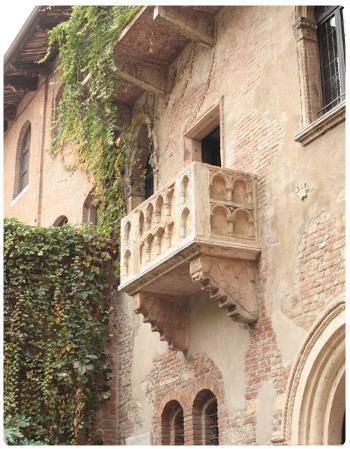
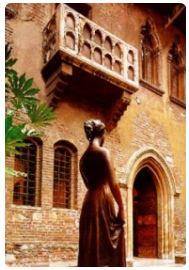 And
that romantic balcony from which the beautiful Juliet looked
out? The balcony is a beautiful fake, added to the original
building in 1935, but the suggestion remains and it is
difficult to go to Verona and not imagine the two lovers
fighting for their love. What is true is only the story of
the two powerful families of the city, two rival noble
families in the Italy of the Municipalities. As is well
known, the story of Romeo and Juliet in Verona is
based on an ancient legend that inspired the great English
novelist Shakespeare told in two novels, a Sienese novel of
1476 and a Venetian novel by Luigi da Porto, of 1524,
entitled 'Historia novellamente ritrovata di due nobili
amanti'. Luigi da Porto was the first to set the story
in the Verona of the Scaligers, telling the story of the two
protagonists, Romeus and Juliet, a young couple. A few years
later, Shakespeare reworked the original novel, transforming
it into a work of art that everyone knows.
And
that romantic balcony from which the beautiful Juliet looked
out? The balcony is a beautiful fake, added to the original
building in 1935, but the suggestion remains and it is
difficult to go to Verona and not imagine the two lovers
fighting for their love. What is true is only the story of
the two powerful families of the city, two rival noble
families in the Italy of the Municipalities. As is well
known, the story of Romeo and Juliet in Verona is
based on an ancient legend that inspired the great English
novelist Shakespeare told in two novels, a Sienese novel of
1476 and a Venetian novel by Luigi da Porto, of 1524,
entitled 'Historia novellamente ritrovata di due nobili
amanti'. Luigi da Porto was the first to set the story
in the Verona of the Scaligers, telling the story of the two
protagonists, Romeus and Juliet, a young couple. A few years
later, Shakespeare reworked the original novel, transforming
it into a work of art that everyone knows.
"Juliet's sarcophagus, simple, open, with withered leaves
around, in the vast and desolate garden of a convent, is as
sad as her love was sad. I took away some pieces to give to
my daughter and grandchildren". So wrote Byron
when he visited Verona. In this case it is clear that the
power of the literary myth has imposed itself on what is
inferred from the real historical documentation. But Verona
is a city for dreamers, you know, and even today the
tourists who come to be photographed under the legendary
balcony are well over a million each year. The small, simple
courtyard of Via Cappello is filled with young and
old, many leave behind a photo, a memory of a day of lost
love. Someone is involved in the tradition of touching the
right breast of the beautiful bronze statue in the courtyard
(the Juliet by Nero Costantini). From here, if
you want to get close to the river bank, in Via delle
Pontiere, a few minutes walk, you will also find the tomb
of Juliet and then see the pretty cloister of the
Capuchin convent of San Francesco al Corso, the place
where he traced the tragic fate of the two lovers.
 "During
the evening you feel the joy of living and the aristocracy
goes out for the walk. Those who go to church to recite the
Ave Maria, those who stop in Piazza Bei Cavalleri approach
the carriages to entertain themselves with the beautiful
ladies. The population here comes and goes among the
greatest entertainment and especially in some streets. In
the days of the market the squares are full of people, you
laugh, you joke throughout the day. The people are all
beautiful and good and look after the events of others with
a keen eye, the rich and noble are locked up in their homes."
"During
the evening you feel the joy of living and the aristocracy
goes out for the walk. Those who go to church to recite the
Ave Maria, those who stop in Piazza Bei Cavalleri approach
the carriages to entertain themselves with the beautiful
ladies. The population here comes and goes among the
greatest entertainment and especially in some streets. In
the days of the market the squares are full of people, you
laugh, you joke throughout the day. The people are all
beautiful and good and look after the events of others with
a keen eye, the rich and noble are locked up in their homes."
 Johann
Wolfgang von Goethe. Thanks to this Goethe pass, you can
easily get carried away with your imagination to the places
described and to the joyful and noisy atmosphere of the
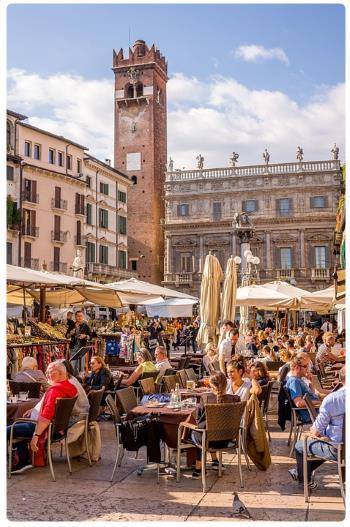
market. Imagine the Piazza delle Erbe as it was then,
admire the patrician palaces that surround it. The herbs,
spices, coffee beans and light silks that once arrived in
the city, through Venice, from the distant Catai
visited and told by Marco Polo, still seem to echo
with their scents and flavors in the frame of this small
square. The Maffei Palace, the Merchants' House,
the Mazzanti Houses, all recall the historical eras
experienced by the city over time. Of particular interest, a
little further on, is the Loggia del Consiglio, built
during the Venetian rule in Verona. From here you can easily
reach the beautiful Church of Santa Maria Antica and
its Arche Scaligere.
Johann
Wolfgang von Goethe. Thanks to this Goethe pass, you can
easily get carried away with your imagination to the places
described and to the joyful and noisy atmosphere of the
market. Imagine the Piazza delle Erbe as it was then,
admire the patrician palaces that surround it. The herbs,
spices, coffee beans and light silks that once arrived in
the city, through Venice, from the distant Catai
visited and told by Marco Polo, still seem to echo
with their scents and flavors in the frame of this small
square. The Maffei Palace, the Merchants' House,
the Mazzanti Houses, all recall the historical eras
experienced by the city over time. Of particular interest, a
little further on, is the Loggia del Consiglio, built
during the Venetian rule in Verona. From here you can easily
reach the beautiful Church of Santa Maria Antica and
its Arche Scaligere.
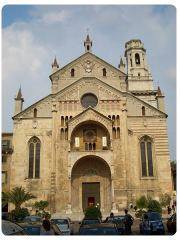 Not
far away, we find the Church of Sant'Anastasia in Verona,
which is appreciated for its Dominican Gothic architecture
of the late thirteenth century (note in particular the
fresco of St. George del Pisanello). The churches of
Verona find a particular space in the artistic and
architectural context of the city. First of all, the
Cathedral of Verona (Cathedral of Santa Maria Matricolare),
with the main portal embellished with bas-reliefs in Lombard
Romanesque style and the white and pink marble attributed to
Maestro Niccolò (XII century), whose work can also be
seen at the Basilica of San Zeno Maggiore. This last
church is indicated by art critics as a masterpiece of
Romanesque in Italy, a building originally built in the
eighth century on the foundations of the tomb of St. Zeno,
patron saint of Verona.
Not
far away, we find the Church of Sant'Anastasia in Verona,
which is appreciated for its Dominican Gothic architecture
of the late thirteenth century (note in particular the
fresco of St. George del Pisanello). The churches of
Verona find a particular space in the artistic and
architectural context of the city. First of all, the
Cathedral of Verona (Cathedral of Santa Maria Matricolare),
with the main portal embellished with bas-reliefs in Lombard
Romanesque style and the white and pink marble attributed to
Maestro Niccolò (XII century), whose work can also be
seen at the Basilica of San Zeno Maggiore. This last
church is indicated by art critics as a masterpiece of
Romanesque in Italy, a building originally built in the
eighth century on the foundations of the tomb of St. Zeno,
patron saint of Verona.
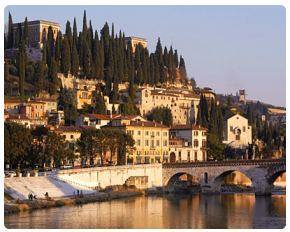 The
church, although located a little outside the usual tourist
route, for its beauty and harmony, is still the most visited
in the city. On the sober external façade, admire the great
12th century rose window, called the Wheel of Fortune,
which says: "Behold, only I, Fortune, govern mortals; I
raise, lay, give to all goods and evils; I dress who is
naked, I strip who is dressed. If anyone trusts me, they
will mock them." Note also the main portal, surmounted
by two pillars with marble lions. Inside the religious
building there is an important painting by Andrea
Mantegna.
The
church, although located a little outside the usual tourist
route, for its beauty and harmony, is still the most visited
in the city. On the sober external façade, admire the great
12th century rose window, called the Wheel of Fortune,
which says: "Behold, only I, Fortune, govern mortals; I
raise, lay, give to all goods and evils; I dress who is
naked, I strip who is dressed. If anyone trusts me, they
will mock them." Note also the main portal, surmounted
by two pillars with marble lions. Inside the religious
building there is an important painting by Andrea
Mantegna.
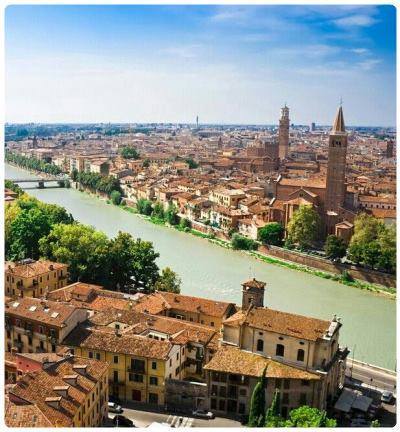
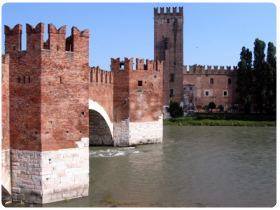 Going
up the Adige, towards the city centre, you reach
Castelvecchio, the Castle of San Martino in Aquaro, a
fairytale fortress, embattled with towers and brick turrets.
It was commissioned in 1354 by Cangrande II to serve
as a residential palace and military fortress; it survived
centuries of occupation by the Visconti family, the
Serenissima Republic of Venice and Napoleon, before being
destroyed in World War II. After a long restoration in the
50s, by Carlo Scarpa, it was opened to the public in
1964. Inside the structure there is now the Civic Museum
of Castelvecchio, one of the most important museums in
Verona.
Going
up the Adige, towards the city centre, you reach
Castelvecchio, the Castle of San Martino in Aquaro, a
fairytale fortress, embattled with towers and brick turrets.
It was commissioned in 1354 by Cangrande II to serve
as a residential palace and military fortress; it survived
centuries of occupation by the Visconti family, the
Serenissima Republic of Venice and Napoleon, before being
destroyed in World War II. After a long restoration in the
50s, by Carlo Scarpa, it was opened to the public in
1964. Inside the structure there is now the Civic Museum
of Castelvecchio, one of the most important museums in
Verona.
 Verona
is a pleasant city and full of opportunities for fun and
cultural events. Above all, important events and
exhibitions are not to be missed throughout the year,
such as the Arena Opera Festival, which since 1913 has
delighted the evenings of opera lovers, the Veronese
Summer Theatre and the various representations of the
Shakespearean Festival.
Verona
is a pleasant city and full of opportunities for fun and
cultural events. Above all, important events and
exhibitions are not to be missed throughout the year,
such as the Arena Opera Festival, which since 1913 has
delighted the evenings of opera lovers, the Veronese
Summer Theatre and the various representations of the
Shakespearean Festival.
For the curious, you should know that, among the many famous
people who were born in Verona, there are:
The poet Valerio Catullo, born in 84 BC.
The painter Paolo Caliari (known as il Veronese),
born in 1528
The architect Michele Sammicheli, born in 1484
The erudite Scipione Maffei, born in 1675
The musician Antonio Salieri, born in 1750
The writer Ippolito Pindemonte, born in 1753
The poet Aleardo Aleardi, born in 1812
The statesman Angelo Messedaglia, born in 1820
The criminologist Cesare Lombroso born in 1835
The inventor Enrico Bernardi, born in 1841
The writer Emilio Salgari, born in 1863
Copyright
© Informagiovani-italia.com.
If you liked
this guide and want to help Informagiovani-italia.com help
us to spread it.
Where are wu?
Top
OSTELLI Verona
OSTELLI Italia
Auberges de Jeunesse Italie
Hotel Verona
Carte
de Verone
Karte von Verona
Mapa
Verona
Map
of Verona
Carte
de Venetie
Karte von Venetien
Mapa
Veneto
Map
of Veneto
Carte
d'Italie
Karte von Italien
Mapa
Italia
Map
of Italy