|
Curiosities about
Barcelona
Did
you know that...
 Imagine
how many curiosities and misteries a city like Barcelona
can hide. Even before the city was revealed in "
Sombra del
Viento" (Shadow of the wind) by Carlos Ruiz Zafon,
Barcelona was characterized by a tangible mistery that could be
just partially visible for the occasional visitor. Rambla
Santa Monica, Raval, Plaça Reial, Calle de
Escudellers … Are you curious? Let's start exploring the
city! Imagine
how many curiosities and misteries a city like Barcelona
can hide. Even before the city was revealed in "
Sombra del
Viento" (Shadow of the wind) by Carlos Ruiz Zafon,
Barcelona was characterized by a tangible mistery that could be
just partially visible for the occasional visitor. Rambla
Santa Monica, Raval, Plaça Reial, Calle de
Escudellers … Are you curious? Let's start exploring the
city!
did
you know that...
…the
Rambla, the most famous avenue in Barcelona, used to be a
river formed by the waters descending from the mountains behind
the city. The word Rambla means sand, torrent or stream.
...
the Rambla del Centro (downtown rambla, probably one of
the most trafficked streets in Europe), has a name which
originates from an ancient convent of Capuchin friars.
…
Barcelona has a great reputation because of its sewers and it
was one of the first modern cities to have a sewer system;
many European cities took Barcelona as an example for this.
 …
the
Oriental Hotel, built in 1842, il the oldest in town.
Inside, you can find Café de l'Opera, opened in 1929, one
of the most ancient and well preserved cafès in Barcelona. …
the
Oriental Hotel, built in 1842, il the oldest in town.
Inside, you can find Café de l'Opera, opened in 1929, one
of the most ancient and well preserved cafès in Barcelona.
…
Teatro Principal
is the most ancient theatre in Barcelona and one of the
oldest in Spain. The original name was different (the present
was given in 1868),and in the very same place in 1667 there used
to be a small thatre that could contain up to 800 people.
…
near the center of the
Plaça Reial
square, you can find the Source of the Three Graces.
Some say that the lamps of the square may have been designed by
Antoni Gaudì in 1878.
… Rambla
de Santa Monica
is
considered the access door to the port area, where you can find
the ancient Convent of Discalced Augustinians (1626), that
nowadays is an Art centre which hosts intesresting
temporary exhibitions.
…
the
name of the road Calle Escudellers (the southern part of
the Ramblas, south of Plaça Reial) indicates the people who once
sold plates and other objects made of clay. This is the street
where potters have settled during medieval times. Plus, its
historical interest derives from the fact that it's located in
the middle of Picasso's old quarter. It was here that the great
artist lived, worked and had fun.
… Picasso
and
his family lived in Calle La Merce, which is just a few
minutes' walk from Calle Escudellers. Picasso owned a study in
Calle Escudellers Blancs, a small side street of Calle
Escudellers. Here, he created some of his paintings of the so
called blue period.
…
the
shipyard, built in 1378, was the biggest in the whole world. It
hosts the Maritime Museum, which was built during the
civil war (1936-1939) and opened in 1941.
 …
the
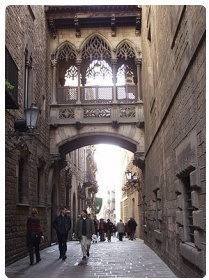
Gothic quarter (Barri Gotic) is the ancient Roman colony
which developed century after century, testifying the splendor
of the County of Barcelona and Catalonia from the 8th
to the 12th century. The gothic name was given at the
beginning of the 20th century. El Call, the …
the
Gothic quarter (Barri Gotic) is the ancient Roman colony
which developed century after century, testifying the splendor
of the County of Barcelona and Catalonia from the 8th
to the 12th century. The gothic name was given at the
beginning of the 20th century. El Call, the
 medieval
Jewish quarter, as well as Plaça Reial, are both located
inside this area. medieval
Jewish quarter, as well as Plaça Reial, are both located
inside this area.
…
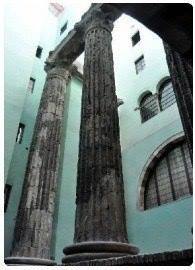
the Roman Barcelona, the ancient City of Barcino, has
been discovered at the beginning of the 20th
century. The Roman walls of Barcino are the strongest,
the most modern and technically the most developed of the Roman
times. Those walls defended the city of almost 1000 years.
…
in
Plaça Reial you can still see the bell tower of Saint
Agata, which has the shape of a crown because it used to be
a royal chapel. It used to include a secret tunnel which
connected the chapel with the Royal Palace.
...
the Royal Palace was originally built as a
residence for the liutenant or viceroy, even if this last one
has never lived there. Throughout his history, it has been used
as a prison and as the headquarters of the Archive of the
Crown of Aragona.
…
the
Jewish quarter of Barcelona was the most important
cultural centre of Catalonia in the 11th, 12th
and 13th century, with five synagogues. In Calle
Marlet n° 1, it's still possible to see a hebraic headstone,
found in 1820 thanks to a few works by rabbi Samuel Hassardi.
…
the house of Calle San Domenico (number
6) is the most ancient house in Barcelona, inhabited since the
12th century. Some say that in the postwar period it
was a famous brothel. You can still see the walls of the front,
which are oblique because of the earthquake in 1428.
...Saint
Philip Neri's Church was visited every day by Antoni Gaudí,
even if he wasn't interested in listening to the mass at all.
…
in
the same square you can find the
Museum of shoes
which still hosts the mold (1,22 metres long) that was used to
create the shoes of the Columbus Statue.
…
for
many centuries, the new square was used for public executions.
According to tradition, the bandit Giovanni Serrallonga
has been killed here.
…
in
the cloister of the gothic cathedral you can see 13 white
geese, which do not only serve as guards, but they also stand
for the age of
Saint Eulalia
when she died: thirteen years old.
…
in
the cloister of the cathedral you can visit the grave of
Manuel Girona, the financer for the contruction of the
front of the building. He actually wanted to be buried inside
the cathedral, but only kings and bishops were intitled to that
honor.
...
the buildings of the department stores of Portal de l'Angel
have been built in the second decade of the 20th
century and are among the oldest in town. You can still see
Els Quatre Gats (c. Montsió 3a), a modernist building
designed by Josep Puig, inaugurated on June 12th 1897.
Nowadays it hosts a Catalan cuisine restaurant. Avant-garde
artists such as Picasso and Casas Rusiñol Nonell
used to stop by: rumours say they loved to exaggerate with
drinking because that helped them to find inspiration for their
works. The cafè hosted the first exhibition ever made by Pablo
Picasso.
... Plaza Catalunya was built in the first part of the 19th
century to merge the old part of the city. Its surface is 50.000
square metres, comparable to other huge squares such as Saint
Peter in Rome.
...
during Roman times, the Roman Forum was already in the
Plaça Saint Jaume area: it is over 2000 years old.
…
inside the town hall in Plaza de San Miguel, rests of a
Roman bath have been found.
…
in
Calle Ferran it's possible to visit the house where
painter Joan Miró was born.
…
Giovanni
Fiveller Lledo, the first mayor of Barcelona, used to live
at number 4 in the same street.
…
In
Calle Leon there used to be one of the first zoo in Europe,
which was built thanks to Peter III, called the Ceremonious.
You can still see Sant Jaume's Church: it originally was
an Hebraic synagogue, later transformed in Christian church, in
1394.
…
so, did you know that Barcelona is a unique town in the world?
We're
waiting for you!
Top
Hostels
Barcelona
Hostels
Spain
Hotels in Barcelona
Carte d'Espagne
Karte von Spanien
Mapa
de España
Map of Spain
Carte de Barcelone
Karte von Barcelona
Mapa Barcelona
Map of Barcelona
|