|
Barcelona's famous personalities
The history book of Barcelona includes a long list
of famous personalities, men and women who linked for ever their name to the
capital of Catalonia: Picasso, Dalì, Mirò, Carreras,
Montaner, Gamper, Montserrat Caballé, Pedrosa, Valdéz, Hernandez, Rivel, Bacardi
and, last but not least, Gaudì, just to name a few of the ones we'd
like to remember about.
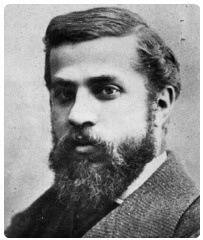 Antoni
Gaudì was a famous Catalan architect, the main exponent of
Spanish modernism, although he's gone beyond the artistic canons of his
time. Undoubtedly, nowadays he's the most famous personality of Spanish
architecture, the one who contributed more than anyone else to create
Barcelona. Born in 1852 in a small village called Reus in the
province of Tarragona, he graduated in 1877 at Barcelona's Escola
Técnica Superior d'Arquitectura. Since then, the city became the center
of his artistic activities and his life. Antoni
Gaudì was a famous Catalan architect, the main exponent of
Spanish modernism, although he's gone beyond the artistic canons of his
time. Undoubtedly, nowadays he's the most famous personality of Spanish
architecture, the one who contributed more than anyone else to create
Barcelona. Born in 1852 in a small village called Reus in the
province of Tarragona, he graduated in 1877 at Barcelona's Escola
Técnica Superior d'Arquitectura. Since then, the city became the center
of his artistic activities and his life.
Since he was a kid, he was fascinated by nature,
which he incorporated in many elements included in his drawings and he
developed a unique style. This led him to create, by collaborating with some
of the top craftsmen of his times, the elements that form his
architectural portfolio – by working wrought iron, furnitures, glass
windows, sculptures, mosaics, tiles and so on – for a concept of decoration
which integrated these elements in the architectural construction process.
The sea landscape was one of his favourite inspirations. The artist became
popular thanks to the endorsement of the rich Count Eusebi de Güell,
remembered in the famous Parc Güell (one of the most famous and
audacious of Gaudì's projects)
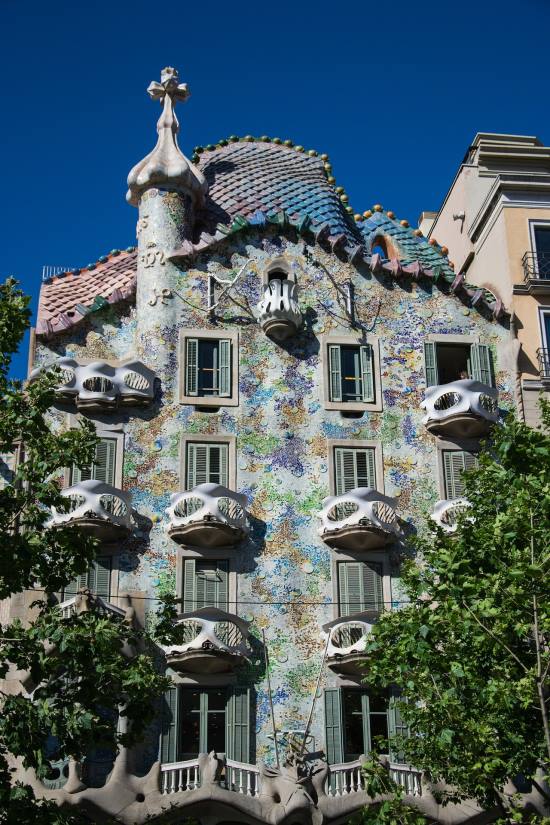
The most significant works are Casa Milà (La
Pedrera), Casa Batlló and the Crypt of Güell Colony's Church.
His massive masterpiece, left unfinished after he dedicated 40 years of his
activity to it, is the famous Sagrada Familia, Barcelona's most
important Catholic Church, together with the cathedral.
On June 7th 1926 Gaudí got accidentally
run over by a tram. He wasn't recognized and exchanged for a poor beggar, so
he was sheltered in a hospice for beggars. He was recognized only after 2
days, the day before his death, which happened June 10th. Since
then, his body rests in his Sagrada Familia.
During his times, Gaudì was admired and criticized
for the audacity an the peculiarity of his innovative art. World wide fame
is now undisputed, both among experts and public in general. Seven of his
masterpieces of architecture are included in Unesco World Heritage.
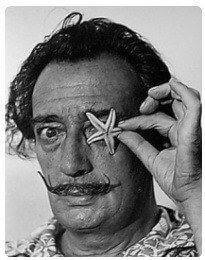 Salvador
Dalì is considered the most important surrealist and one of the
most famous artists in the 20th century. His father was a
prestigious notary; Dalì was born in 1904 in the small Catalan town of
Figueras, in Northern Spain. His early artistic talent was already
recognized during the drawing lessons he took as a kid. One of his teachers
was a famous Spanish impressionist, Ramon Pichot, who taught at the
public drawing school. Dali's art varies among paintings, sculptures,
drawings for books, jewels' design and even theatre and cinema (he
collaborated with Luis Bunuel and also with Alfred Hitchcock's
dream sequence in the film 'I will save you', 1945). He also wrote a
pretentious autobiography, 'Salvador Dalì's secret life" (1942) and a novel
in 1944. Salvador
Dalì is considered the most important surrealist and one of the
most famous artists in the 20th century. His father was a
prestigious notary; Dalì was born in 1904 in the small Catalan town of
Figueras, in Northern Spain. His early artistic talent was already
recognized during the drawing lessons he took as a kid. One of his teachers
was a famous Spanish impressionist, Ramon Pichot, who taught at the
public drawing school. Dali's art varies among paintings, sculptures,
drawings for books, jewels' design and even theatre and cinema (he
collaborated with Luis Bunuel and also with Alfred Hitchcock's
dream sequence in the film 'I will save you', 1945). He also wrote a
pretentious autobiography, 'Salvador Dalì's secret life" (1942) and a novel
in 1944.
Dalì had a talent for self presenting and
exhibitionism, grown until reaching eccentricity. One of his most famous
acts was showing up in a diving suit for the grand opening of the surrealist
art exhibition in London in 1936; he stated that this kind of behaviours was
the source of his creative energy. He adopted the surrealist theory of
automatism, although transformed in a more positive method which he
defined critical paranoia.
His iconic works include The enigma of desire
(1929), The great masturbator (1929), The persistence of
memory (1931), The birth of liquid desires (1931-32), Soft
construction with boiled beans (1936), Narciso's Metamorphosys
(1937), Sleep (1937), giraffe in flames (1937), Apparition
of face and fruit dish on the beach (1938).
Montserrat
Caballé
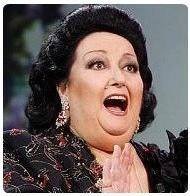 Maria
de
Montserrat Viviana Concepcin Caballe i Folc,
better known as Montserrat Caballé (born April 12th 1933), is a
famous Spanish lyric singer (soprano), renowned for her technique of
"
bel canto" and her interpretations in operas by Rossini, Bellini
and Donizetti. Maria
de
Montserrat Viviana Concepcin Caballe i Folc,
better known as Montserrat Caballé (born April 12th 1933), is a
famous Spanish lyric singer (soprano), renowned for her technique of
"
bel canto" and her interpretations in operas by Rossini, Bellini
and Donizetti.
Montserrat Caballé was born during the Spanish civil war in the city of
Barcelona, growing in a family which had a passion for classical music.
The girl wanted to study music, but her parents couldn't afford to send her
to school, so they made a deal with the rich Bertrand family in
Barcelona, who contributed to financing her studies. In exchange for this,
the girl accepted to appear in the Opera Theatre of Barcelona each
concerts season. So, she joined the Lyceum Conservatory at the age of
13, although the mother had to register her as a 15 years old girl.
After studying music and singing
technique, with Eugenia Kemmeny as a
teacher, Montserrat joined the Opera of Basel in 1956, where she
debuted in 1957. The following season she joined the Opera of Bremen,
where she developed the basis of her wide repertoire. Between 1950 and 1960,
Montserrat Caballé had already played more than 40 roles. She debuted at
Alla Scala Theatre of Milan in 1960 in the opera Parsifal by Wagner.
The following year she went back to Spain, debuting at the Liceu. During her
comeback home, she met her future husband Bernabe Marti.
In 1965, Montserrat Caballé kept gaining
international fame. In April 1965, she went to the United States and
received great praise and recognition. The same year she debuted at the
Metropolitan Opera of New York, playing the role of Marguerite in
Gounod's Faust.
In 1992, Hollywood Records released "
Barcelona", a
duet album with the soprano and Queen's singer Freddie Mercury.
Recorded in 1987, the album was published only after Mercury's death. The
single became the opening hymn of Barcelona's Olympic games in 1992.
Despite her fame and her great career, Caballè
never forgot her humble origins. Her and her husband created a charity
foundation by taking in custody 500-600 orphans in a village at the foot
of the Pyrenees, among many other charity actions they did. By living a life
with grace and dedication to her art, Montserrat Caballé revealed herself as
one of the greatest sopranos of the 20th century.
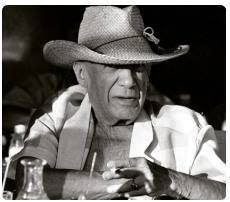
Pablo
Picasso
Among the most famous personalities of
Barcelona, Pablo Picasso (October 25th 1881 – April 8th 1973) is one of
the greatest Spanish painters and is famous world wide. The artist was born
in Malaga but he spent his childhood and his first manhood in Barcelona,
where he formed his art. Picasso is considered as the most interesting and
well known artist of the 20th century; his works are mainly
abstract faces, figures and landscapes. Besides being a painter, he also
explored sculpture, ceramic and incision and he created 20.000 works overall
in a wide variety of styles. No painter before him had such a passionate
public. Great painters such as Tiziano in the 16th century
or Velazquez in the 17th probably gathered a few thousands
people, mostly nobles and intellectuals who belonged to the European courts.
Picasso's public counted maybe hundreds of thousands of people: maybe he was
the first artist of all who received a huge attention by the mass media.
Picasso's artistic production was enormous
and left permanent signs on every artistic and social discipline: they say
that if he died before 1906, his sign in the art of the 20th
century would have been lighter.
Female nudity is the obsessive subject
always chosen by the artist. Everything in his painting universe seems
connected to women's naked body. He painted in a sort of metamorphosys,
recomposing the female body: "
moving", as Picasso described this process,
"
putting the eyes between the legs, or sexual organs on the face.
Contradict. Nature does many things, like I do, be she hides them!".
Undoubtedly, Picasso's greatest works arrived in a
30 years period between "
Les Demoiselles d’Avignon"(1907) and "
Guernica"
(1937). Also in the years of the war, the 50s, 60s and 70s, the artist
produced very powerful prints and paintings. In his late years, his
production has a manic and obsessive quality, as the creative act (even if
repetitive) could prevent death. His death, happened in 1973, left the
public with the nostalgia for a genius that no talent in painter today is
able to satisfy.
Top
Hostels
Barcelona
Hostels
Spain
Hotels in Barcelona
Carte d'Espagne
Karte von Spanien
Mapa
de España
Map of Spain
Carte de Barcelone
Karte von Barcelona
Mapa Barcelona
Map of Barcelona
|