|
Arts and
Culture in Barcelona
|
Barcelona
is a city of art, one of the most important in Europe. From the
livelyness of his well known beaches to the medieval atmosphere of the
Barri Gòtic and the modernist
buildings of
Eixample. Lots of treasures
are kept in museums and architectural wonders are everywhere: authentic
jewels that give uniqueness to its art and culture. Each
quarter or districts hosts its own annual festival with music and crowds of
people who keep inhabitants awake all night. |
|
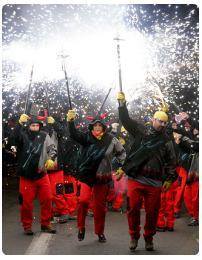 In the Fiesta Mayor Gracia
for example, for a whole week in August, the quarter of Gràcia
is filled with music, parades with masks and elaborated costumes: everyone
is dressed as a devil with torches in their hands. The dancing devils of
Barcelona are formed by groups of people dressed up with costumes who
dance along the streets with percussionists and with small fireworks coming
out of their pitchforks. Barcelona is rich of traditional festivals:
this festivity is also well know, apart for its nice devils, also for the
human towers called 'castellers'. These towers are composed of 8
levels, with a number of persons forming each level and each one of them
climbing over the people who form the levels below to form a tower. The
historical reference came from the country area around Tarragona in 1890,
from where farmers were forced to move to Barcelona, in the quarter of
Gràcia, because of the wine crisis caused by the phyllozera parasite. In the Fiesta Mayor Gracia
for example, for a whole week in August, the quarter of Gràcia
is filled with music, parades with masks and elaborated costumes: everyone
is dressed as a devil with torches in their hands. The dancing devils of
Barcelona are formed by groups of people dressed up with costumes who
dance along the streets with percussionists and with small fireworks coming
out of their pitchforks. Barcelona is rich of traditional festivals:
this festivity is also well know, apart for its nice devils, also for the
human towers called 'castellers'. These towers are composed of 8
levels, with a number of persons forming each level and each one of them
climbing over the people who form the levels below to form a tower. The
historical reference came from the country area around Tarragona in 1890,
from where farmers were forced to move to Barcelona, in the quarter of
Gràcia, because of the wine crisis caused by the phyllozera parasite.
 There
are so many events, shows and festivals in Barcelona, all throughout the
year: not only in August, but also in June and in December, with the
characteristic
Christmas of Barcelona, or in
April for the Sant Jordi of Catalunya Festival, celebrated with the
traditional book fair and many roses for lovers. We've dedicated a separated
section to
Festivals and shows in Barcelona,
don't miss it! Culture in Barcelona is rich in history and tradition:
2000 years of life that enriched one of the most beautiful and interesting
European cities. With the transition in Spain, from Franco's
dictatorship to democracy, Catalan culture found its place of honor in
the country and in the continent, recovering very valuable traditions and
works of art. There
are so many events, shows and festivals in Barcelona, all throughout the
year: not only in August, but also in June and in December, with the
characteristic
Christmas of Barcelona, or in
April for the Sant Jordi of Catalunya Festival, celebrated with the
traditional book fair and many roses for lovers. We've dedicated a separated
section to
Festivals and shows in Barcelona,
don't miss it! Culture in Barcelona is rich in history and tradition:
2000 years of life that enriched one of the most beautiful and interesting
European cities. With the transition in Spain, from Franco's
dictatorship to democracy, Catalan culture found its place of honor in
the country and in the continent, recovering very valuable traditions and
works of art.
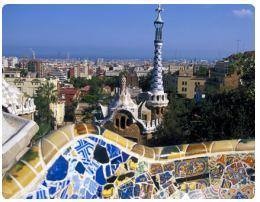
 Art in Barcelona is connected especially with Modernism (called
Liberty in Italy, Art Nouveau in France or Jugendstil in
Germany), which in Barcelona is unique thanks to figures such as
Antoni Gaudi, Lluís
Domènech i Montaner, Josep Puig i Cadafalch, Josep Maria Jujol
i Gibert, Francesc d'Assís Berenguer i Mestres and many more. Art in Barcelona is connected especially with Modernism (called
Liberty in Italy, Art Nouveau in France or Jugendstil in
Germany), which in Barcelona is unique thanks to figures such as
Antoni Gaudi, Lluís
Domènech i Montaner, Josep Puig i Cadafalch, Josep Maria Jujol
i Gibert, Francesc d'Assís Berenguer i Mestres and many more.
We've
told about Gaudí in a section dedicated to him (see
Gaudì's Barcelona) and to his
great architectures
Sagrada Familia, Casa
Batlló (along the Passeig de Gracia) or
Pedrera-Casa Milà.
Montaner, one of the precursors of the Catalan style, left a unique and
personal track in his Barcelona, between a style which uses French elements
and an arab/hispanic architecture. Visit the Palace of Catalan Music:
listed in the Unesco World Heritage, it's one of the most beautiful
buildings in Spain and one of the most striking in town. It was meant to be
the 'garden of music' in Catalonia and nowadays it's the headquarters
of the Catalan choral society (Orfeó Català).
Cadafalch is the author if the spectacular Casa Amatler, Casa
Serra, Casa Martí and many more. Gibert, who was one of
the closest collaborators of Antoni Gaudí, designed the Fountain of Plaça
Espanya and the elaborated Sanctuary of the Mother of God in
Montserrat (in the area of Montferri).
 Among
the architectures of Modernist art in Barcelona listed by Unesco you
can also find the Hospital de Sant Pau en Barcelona (Montaner) and
Gaudì's Park Güell, Palau Güell, Casa Milá, Casa
Vicens and the Colònia Güell in Santa Coloma de Cervelló. Even
today, modernist architecture characterizes the city, by giving it a very
particular charm. Among
the architectures of Modernist art in Barcelona listed by Unesco you
can also find the Hospital de Sant Pau en Barcelona (Montaner) and
Gaudì's Park Güell, Palau Güell, Casa Milá, Casa
Vicens and the Colònia Güell in Santa Coloma de Cervelló. Even
today, modernist architecture characterizes the city, by giving it a very
particular charm.
Modernism in Spain, and above all in Barcelona, influenced all
forms of art and left its footprint in the smallest details of everyday
life. It guided the cultural renaissance of a group of intellectuals who
didn't promote only the architecture, but also literature and the social
world in general.
From
the 12th to the 20th century, Catalan literary culture began with Ramon
Llull in the medieval times and reached its peak with Ausiàs March's
poetry, with his 'Tirant lo Blanc'. With the Ranaixença, the
Catalan Renaissance, literature of this part of Spain recovered its power
and faced the future with a stronger impact, expressed by the modernist
cultural movement.
The
beginning of the 20th century is when the 'Noucentisme' movement was
born: it was linked to the bourgeoisie and inspired by
Catalan political nationalism. The aesthetic ideal of this
movement, created by Eugeni d'Ors, promotes a more classical art. Its
most emblematic author was Josep Carner ('Frutti Els saborosos', 'El
cor tranquilla' and 'Nabi'). After the First World War, the Avant-Garde
movement gains visibility in Catalan culture, with artists such
as Salvador Dalí and Joan Miró and authors like Joan
Salvat-Papasseit ('L'irradiador del porto i les Gavines'), influenced by
Cubism and Futurism, and Josep Vicenç Foix ('Sol i de dol').
Do not forget authors like Carles Riba ('Elegie de Bierville'), Josep
Maria de Sagarra ('Vida privada', 'El cafè de la Marina'), Josep Pla i
Casadevall ('El Quadern gris'), maybe the most important narrator of
contemporary Catalan literature, because of his simplicity, irony and
clarity.
The
Spanish civil war limited the regional literary production, with very few
authors who were able to resist to the strong repression: Ferran de Pol, Bartra, Calders.
Later, the new wave of writers who actively promoted the Catalan literature
were Llorenç Villalonga ('Bearn') e Mercè Rodoreda ('La Plaça
del diamant', 'Mirall Trencat'). Salvador Espriu deserves a mention
for his contribution to the literary of the time, with works like
'Antigona', 'Cementeri de Sinera' and 'La pell de brau'.
From
the second half of the past century new generations of authors
started to appear, thanks to an intense literary and intellectual activity.
These ones deserve a special mention: Josep Palau Fabre, Joan
Brossa, Vicent Andrés Estellés, Gabriel Ferrater, Joan
Margarit, Pere Gimferrer, Maria Mercè Marçal, Baltasar
Porcel,Jaume Cabré, Carme Riera e Sergi Belbel.
Among
folklore, culture and tradition, myths and legends of Catalonia seem
to excite curiosity the most. Some of the most peculiar ones are those which
deal with Barcelona's witches. Witchcraft and witches (called
'bruixes' in Catalan) aren't part of an occult power, with potions, bad
omens and curses. They come from the manifestation of fear of a people that
had to live hard moments of poverty and hunger. In the 17th century,
religion played a very important role in Catalonia as in the rest of Europe,
influencing believers' superstitions. Many women were accused of witchcraft
(in Catalonia, between 1616 and 1622, approximately 400 women have been
burnt alive). Nowadays, various traveling routes deal with Barcelona's
witches.
Museums in Barcelona which
deal with the history and the evolution of the city are widespread. They are
also immersed in the traditions of their population: ancient, modern,
contemporary, avant garde, they form a scenery as various as very few other
European town. The Civic Museum of History, located where the Royal
Residence used to be, the Museum of Catalonia's History, the National Museum
of Catalan art, the MACBA (Museum of Contemporary Art in Barcelona), the
well known Museum
Picasso, the Foundation Joan Miró and Centre
d'Estudis d'Art Contemporani, the CosmoCaixa (Science Museum),
are just few of the most important museums in town. You can check the
section dedicated to museums for further information.
Barcelona isn't just beaches and fun: art, folklore and culture are its
biggest passions. Ernest Hemingway knew it very well: he used to
spend hours in the tiny bar, hidden from the crowd of the Ramblas. Smoky and
noisy, authentic, this bar was opened by Miguel Boadas in 1933.
Everything is culture in Barcelona.
Copyright © Informagiovani-italia.com
Top
Hostels
Barcelona
Hostels
Spain
Hotels in Barcelona
Carte d'Espagne
Karte von Spanien
Mapa
de España
Map of Spain
Carte de Barcelone
Karte von Barcelona
Mapa Barcelona
Map of Barcelona
|