|
You are here:
What to see in Barcelona
>
Sagrada
Familia
|
The
Sagrada Familia, the unfinished masterpiece
of
Antoni Gaudì (but it will be lent), is
one of Barcelona's most popular tourist
attractions, probably the only one that alone,
even if dear, is worth a visit to the city. His
Spanish-language name is Templo Expiatorio de la
Sagrada Familia. Main characteristic, in
addition to the aesthetic, is that of being still
under construction: incredible but true, but the
works seem to continue at least until 2026... and
think that they began in 1882! Like the great
churches of the past, this one follows its path, in
an architecture that has now become synonymous with
the same soul of the city
|
|
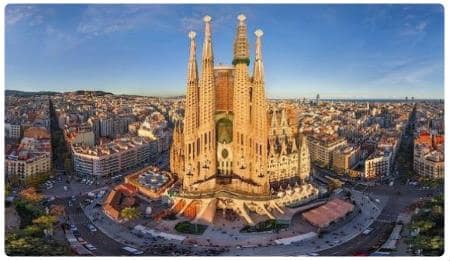 The
Expiatory Temple of the Holy Family was consecrated by Pope
Benedict XVI in 2010 and since then it has been called the
Basilica of the Holy Family. Since Gaudì's death in
1926, several architects have been given the task of
continuing to build the Basilica of the Sagrada Familia, but
not without criticism of different sectors due to the wide
and curious interpretation, in some cases, of the work
designed by Gaudí. The
Expiatory Temple of the Holy Family was consecrated by Pope
Benedict XVI in 2010 and since then it has been called the
Basilica of the Holy Family. Since Gaudì's death in
1926, several architects have been given the task of
continuing to build the Basilica of the Sagrada Familia, but
not without criticism of different sectors due to the wide
and curious interpretation, in some cases, of the work
designed by Gaudí.
Detto questo, la magnifica chiesa, nata per servire il credo
cattolico, è già diventata forse il maggiore punto di
riferimento di Barcellona ed è stata consacrata
dall'arcivescovo della città il 3 marzo 2010, 127
anni dopo l'inizio dei lavori per la sua costruzione.
Nel corso dello stesso anno, il 7 novembre, venne consacrata
anche da papa Benedetto XVI, nel corso della sua visita a
Santiago di Compostela e Barcellona.
 Today
the Basilica of the Sagrada Familia is one of the most
famous monumental churches in the world and, while still
under construction, it resists every year the most visited
place in Barcelona. The church should be completed (the
conditional is obligatory), in 2026, when the eight current
towers will be 18, and 12 of which will be dedicated to each
of the apostles, 4 to the evangelists, one to the Virgin
Mary and the other to Jesus. Today
the Basilica of the Sagrada Familia is one of the most
famous monumental churches in the world and, while still
under construction, it resists every year the most visited
place in Barcelona. The church should be completed (the
conditional is obligatory), in 2026, when the eight current
towers will be 18, and 12 of which will be dedicated to each
of the apostles, 4 to the evangelists, one to the Virgin
Mary and the other to Jesus.
The idea for the construction of a new church was launched
by a secular organization (headed by Josep Maria
Bocabella, a rich publisher) devoted to the Catholic
Church and whose aim was to put an end to the de-Christianisation
of Barcelona, which began with the increasing
industrialization and the accumulation of wealth. The
organization purchased a plot of land in the new Eixample
district in 1877. The architect Francisco de Paula
del Villar was initially called upon to design it, in
neo-Gothic style, working on it until 1883. One year later,
modernist Antoni Gaudí took up his position as an
architect at the age of 31.
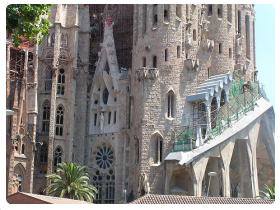 From
that moment on, Gaudí devoted much of his life to building
the church, but instead of keeping to the original planes,
he drastically changed the design of the structure. The
neo-Gothic style made its way to Gaudì's modernist style,
which was based on forms present in the world of nature.
When he died, in 1926 only a façade (the facade of the
Nativity), a tower, the apse and the crypt were finished.
Gaudí was constantly in a following of improvisations and
changes during the construction works; upon his death he
left some drawings and models, but most of them were
destroyed during the Civil War in 1936. From
that moment on, Gaudí devoted much of his life to building
the church, but instead of keeping to the original planes,
he drastically changed the design of the structure. The
neo-Gothic style made its way to Gaudì's modernist style,
which was based on forms present in the world of nature.
When he died, in 1926 only a façade (the facade of the
Nativity), a tower, the apse and the crypt were finished.
Gaudí was constantly in a following of improvisations and
changes during the construction works; upon his death he
left some drawings and models, but most of them were
destroyed during the Civil War in 1936.
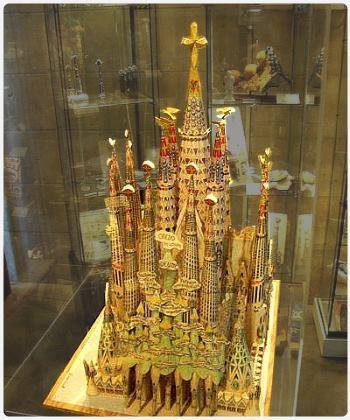
 Despite
this, the architects who followed him had a clear idea of
what Gaudì wanted to achieve. Before the war, the
direction of the works was taken over by Domenech
Sugranyes. The latest version of the great master's
design required a 95-metre long and 60-metre wide structure,
capable of accommodating 13,000 people and with an
incredible total of 18 towers. Four towers on each of the
three facades represent the 12 apostles and reach a height
of 90 to 120 metres. Four other four towers represent the 4
evangelists. All of them surround the largest 170-metre
tower dedicated to Jesus Christ. The tower dedicated to the
Virgin Mary will be built above the apse. Despite
this, the architects who followed him had a clear idea of
what Gaudì wanted to achieve. Before the war, the
direction of the works was taken over by Domenech
Sugranyes. The latest version of the great master's
design required a 95-metre long and 60-metre wide structure,
capable of accommodating 13,000 people and with an
incredible total of 18 towers. Four towers on each of the
three facades represent the 12 apostles and reach a height
of 90 to 120 metres. Four other four towers represent the 4
evangelists. All of them surround the largest 170-metre
tower dedicated to Jesus Christ. The tower dedicated to the
Virgin Mary will be built above the apse.
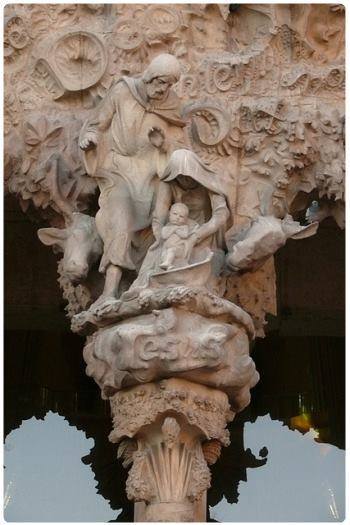
Construction began to resume in 1950 with the completion of
two facades and eight towers. The main nave
was covered in 2000. The building is now mainly focused on
the nave and the main façade to the south. The facade facing
east, known as the facade of the Nativity, was finished by
Gaudí himself and is decorated in Baroque style with motifs
of animals and plants. In 1987 the sculptures representing
the crucifix of Jesus were added.
 The
project currently being carried out is based on the
reconstructed versions of Gaudì's lost plans and modern
adaptations. Since 1940, the architects Francesc Quintana,
Puig Boada Isidre, Lluís Bonet i Gari and
Francesc Cardoner have continued their work. Carles
Buigas is responsible for the task of its lighting. The
current works manager (son of Lluís Bonet) is Jordi
Boneti Armengol. You can't help but add the names of
Mark Burry, J. Busquets, Etsuro Sotoo and the
controversial Josep Subirachs. The
project currently being carried out is based on the
reconstructed versions of Gaudì's lost plans and modern
adaptations. Since 1940, the architects Francesc Quintana,
Puig Boada Isidre, Lluís Bonet i Gari and
Francesc Cardoner have continued their work. Carles
Buigas is responsible for the task of its lighting. The
current works manager (son of Lluís Bonet) is Jordi
Boneti Armengol. You can't help but add the names of
Mark Burry, J. Busquets, Etsuro Sotoo and the
controversial Josep Subirachs.
Approximately 2.26 million visitors to the church were
estimated until 2004, which is doubled in the following
years and closer to us, making it one of the most popular
attractions in Spain
 Even
though the Sagrada Familia is far from complete, the
remarkable church is definitely worth a visit. You can visit
the crypt itself where Gaudí is buried. A museum tells the
story of this great architect and the history of the church.
You can also visit the towers. The Crypt, located in
the subsoil of the Temple, was completed in 1891, although
the religious services here have been held since 1885. The
Crypt is one of the hidden jewels of the Holy Family.
Although it is free, it only opens for the celebration of
masses and only parishioners who want to participate can
enter, which means that many tourists and visitors end up
not being able to enter. Even so, its doors open a few
minutes before the beginning of the ceremony, when you can
enter to visit it, so if you can profit from it. Even
though the Sagrada Familia is far from complete, the
remarkable church is definitely worth a visit. You can visit
the crypt itself where Gaudí is buried. A museum tells the
story of this great architect and the history of the church.
You can also visit the towers. The Crypt, located in
the subsoil of the Temple, was completed in 1891, although
the religious services here have been held since 1885. The
Crypt is one of the hidden jewels of the Holy Family.
Although it is free, it only opens for the celebration of
masses and only parishioners who want to participate can
enter, which means that many tourists and visitors end up
not being able to enter. Even so, its doors open a few
minutes before the beginning of the ceremony, when you can
enter to visit it, so if you can profit from it.
Cript Mass Hours
Weekdays: 9:00 and 20:15.
Sunday: 19:30.
Holidays: 9:00,10:30,11:45,13:00,18:30 and 20:15.
An elevator (cost of about €4.5) will take you to the
top of a tower of the basilica, from which you can enjoy a
magnificent view of Barcelona. The ascent is not recommended
for those suffering from dizziness or claustrophobia! Stairs
can only be used to descend.
One of the most exciting things is to visit the Sagrada
Familia in the evening, with all its lights on, then you
understand why people go around telling that it is built of
bone sun. During rush hours, it is advisable to have snacks,
refreshments and maybe even a personal music player, or
rather, a nice book! to spend time queuing.
Given the importance of the place it is recommended to
choose to take an audioguide available in 9 languages
(Catalan, Spanish, English, French, Italian, German,
Portuguese, Russian and Chinese). The guided tours are
currently in Spanish, Catalan and English and last 50
minutes.
If you want to buy a gift, you can do it in the two souvenir
shops at the foot of the facades of the Nativity and
Passion, where you will find all kinds of items, from the
simplest, typical and cheapest to the most elaborate,
original and at a higher price.
Sagrada Família
C/Mallorca 401
Quartiere:
Eixample
Metro: Sagrada Família
Opening hours
from October to March: 9.00-18.00
from April to September: 9.00-20.00am
25 and 26 December, 25 and 26 December
1 and 6 January: 9.00-14.00
Sometimes there are long queues in the checkout.
Ticket price
Entrance fee: € 15
Children up to 10 years old: free admission
Audio Guide: € 5.00
Lift Tour: 4.50
Handicap bearers (65%): 5.80 € (+1 companion) Please use the
West entrance,.
With the ticket you can see Gaudí's workshop next to the
Sagrada Familia Museum building.
Advice
The Sagrada Familia is the most visited monument in Spain.
Therefore, there may be long queues in front of the entrance
gates and elevators. Late in the morning, queues are the
longest. So, if you don't want to stay in the queue, use the
time to look at the Duomo from a distance, perhaps from the
two points on the right and left of the Sagrada Familia.
Ticket counters usually have long lines to buy tickets,
being longer during peak hours of the day and during the
summer months and during holidays such as Christmas or
Easter. To avoid these queues, we suggest that you purchase
your tickets online in advance. This will allow you to
choose the day and time of access and enter directly into
the Basilica showing the printed receipt.
Where is it located?
Top
Ostelli Barcellona
Ostelli Spagna
Hotel Barcellona
Hotel Spagna
Carte
d'Espagne
Karte von Spanien
Mapa de España
Map of Spain
Carte de
Barcelone
Karte von Barcelona
Mapa Barcelona
Map of Barcelona
|