|
You are here:
What to see in Barcelona
>
Ajuntament
- City Hall of Barcelona
|
The
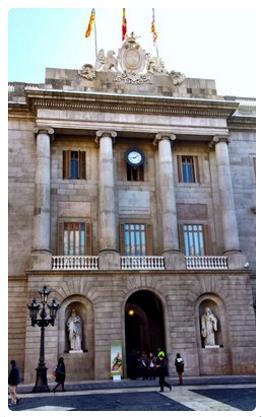
City Hall of Barcelona (Ajuntament) is an elegant building with a
beautiful 18th century façade and an ancient Gothic-Catalan entrance hall dating
back to the 15th century. Inside you can admire several works of art by the
great Catalan masters and in particular the famous Saló de Cent, where
the Council of the Hundred (Consell de Cent) used to meet during the
government of the city, from 1372 to 1714. The building of the Municipality of
Barcelona, also called Casa de la Ciutat is located in the Plaza de
Sant Jaume, one of the most central places in the city and therefore used by
tourists and citizens of Barcelona. Opposite there is another very significant
institutional building, the Palau de la Generalitat de Catalunya.
|
|
History and highlights of the
town hall
From the beginning of the 1st century BC. The highest representatives of the
community of the time, known as Barcino, already gathered in this same area
to resolve various issues related to the future of the town. The current
building of the Municipal Council of Barcelona began to be built in the
middle of the fourteenth century with the construction, among other things,
of the Salone dei Cento. Shortly afterwards, the existing side façade was
also built. Over the centuries the building expanded further. Without
considering the most modern (and somewhat ugly) annexe completed in 1970.
The Gothic facade
The Gothic facade of the town hall is on one side of the building, in
Calle de la Ciutat. Its construction dates back to 1399, when the famous
builder Arnau Bargués commissioned the city "the Council of the
Hundred" (Consell de Cent) to build it". Here you can still see the
Gothic windows and stained-glass windows as well as the coats of arms of the
city and King Peter the Ceremonious (Pere el Cerimoniós).
The neoclassical façade
Taking advantage of the extensive redesign of Plaza de Sant Jaume,
the neoclassical façade was built, today the main facade of the Town Hall
and very similar (as you will see) to that of the Palau de la Generalitat,
located in front of it. On both sides of the entrance there are two
sculptures, one by King James I of Aragon and the other by Councillor
Joan Fiveller. Looking closely, you'll see a plaque on the facade
where you'll read "Plaza de la Costitution", in memory of the square's
previous name.
The courtyard
The courtyard of the Town Hall is decorated with several sculptures by
artists, born in Barcelona or who have had a close relationship with the
city. These include works by Antoni Miró, Josep Llimona,
Pablo Gargallo, Manolo Hugué and Josep Maria Subirachs. On the right
side, entering through the main entrance of Plaza de Sant Jaume, you can see
part of the old Lonja del Trentenari (Loggia del Consiglio dei Trenta).
The black scale
This staircase owes its name to the black marble with which it was built. It
goes from the patio to the first floor, where there is a sculpture by
Josep Viladomat and an imposing mural by the artist Miquel Valdrich.
The staircase of honour
The other staircase connects the patio with the first floor, in particular
the Gothic Gallery. Worth mentioning is the arrangement of two
tapestries and a stone shield, once located in the Portal of Sant'Antoni,
which connected the current district of Sants with the walled city.
The Gothic Gallery
Located on the first floor, the Gothic Gallery is visible from the
courtyard when entering the building. The gallery, crowned by several
sixteenth-century showers, has a series of arches supported and one of the
columns shows the date engraved in Roman numerals.
The Chronicle Hall
This space was renovated in 1929, its decoration includes paintings on the
walls and ceiling by Catalan artist Josep Maria Sert. In them the
painter wanted to represent an allegory of Catalonia, using the deeds of the
Almogàver (the soldiers of the Aragon Coron who fought during the Reconquest,
also used as mercenaries) who fought under Roger de Flor.
The Queen regent salon
Currently used as a room of the Municipality of Barcelona, this is probably
the most curious part of the building, as it was built so that Queen
Maria Cristina could have a space where to take tea with her friends who
stayed at the nearby Hotel de La Rambla. In it stands out the
painting of a ceiling, completely original and in which are represented in
allegorical form Virtu, Industry and Energy. Other original elements are the
candelabra, commissioned from
Versailles by the
Queen herself, and the braziers. The arch and sculptures of Santa Eulalia
and Sant Jordi on the sides were added later, as well as wooden
chairs used by councillors during plenary sessions.
The One Hundred Hall
Originally smaller, later enlarged, was intended for meetings of the
so-called Council of the Hundred. Currently, due to its beauty, its
use is reserved for weddings and other specific events within the
municipality. Of the original salon of 1639 and the work of Pere Llobet,
few elements remain, as many renovations have taken place over the course of
its 7 centuries of history. Much of the current image of the exhibition is
due to the extensive renovation and extension by Lluís Domènech i
Montaner and Josep Puig i Cadafalch, both of which are prominent
exponents of Catalan modernism. As a curious fact,
Antoni Gaudí also
took part in the competition to restructure this one, but his project was
not chosen.
When can I visit the city of
Barcelona (Ajuntament)?
The Municipality of Barcelona can be visited every Sunday of the year,
except in cases where Sunday falls on a holiday of great importance, such as
25 December, 1 or 6 January. For this reason, and although it is not
necessary to book in advance, in these cases we recommend that you contact
the Town Hall directly.
You can choose to visit the building yourself, with the help of an
information leaflet, or you can do it through the guided tours that are
organized, something that we recommend you do not miss any architectural
details of the building and we will inform you about the different
historical data and anecdotes of it. Admission, which is free in all cases.
Plaça Sant Jaume
Quartiere: Barri Gòtic
Metro: Jaume I o Liceu
Where is it located?
Ostelli Barcellona
Ostelli Spagna
Hotel Barcellona
Hotel Spagna
Carte d'Espagne
Karte von Spanien
Mapa de España
Map of Spain
Carte de Barcelone
Karte von Barcelona
Mapa Barcelona
Map of Barcelona
|