|
You are here:
What to see in Barcelona
>
Casa Batlló
in Barcelona
|
In the early 1900s,
Antoni Gaudì, the most famous
Barcelona architect and his collaborator
Josep Maria
Jujol, took charge of designing an ordinary block of apartments
belonging to the textile manufacturers magnate Josep Batlló. The
result was to create one of the greatest masterpieces in the
history of architecture. With its sensual wrought-iron curves
and the shimmering "trencadis" (collage of broken tiles and
ceramics) on the façade, it would seem that Casa Batlló
represents the legend of St. George (patron saint of Catalonia)
and his dragon.
|
|
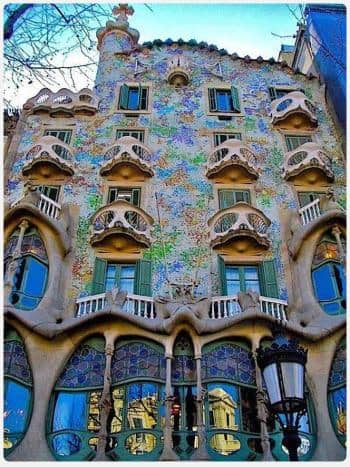
The balconies are protected by imposing formations similar
to skulls, supported by columns as similar to vertebrae (which
one thinks represent the victims of the dragon). Everything
wonderful and to see at least once in a lifetime, so much so
that it entered the UNESCO World Heritage List in
2005. The
only problem is the very expensive entrance
price, with the minimum discounts for older than 6 years,
which is almost prohibitive for families, considering that
only two floors are visited. The current owners of the
Battlò house allow you to visit only the first floor of the
building and the attic and the rooms of these rooms are
completely without furniture. In any case, thanks to a very
efficient tourist marketing, Casa Batllò is always full,
despite the price and long rows of people are formed to buy
tickets at the exit (which is always better to buy first
online).
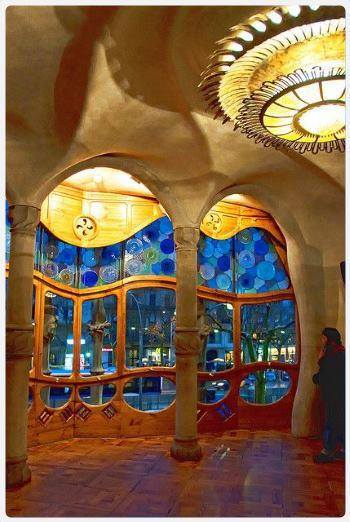
Visits to the interiors at 20.50 euro are a must for art and design
enthusiasts. See the smallest details designed and created by the master (from
door handles to ingenious ventilation and natural lighting reflected in the
inner courtyard). The extravagant spectacularity of the interiors remains,
in our opinion, one of the greatest architectural expressions of Barcelona,
especially for the sinuous staircases and the glass window of the gallery.
Barcelona has linked its name to the extravagance of
Antoni Gaudì, to his colourful and bold architectural forms,
genuine and natural. The Batlló House, a restored 19th
century building, is one of its most popular masterpieces,
located in Passeig de Gràcia, in the Eixample
district. The rooms affectionately call it Casa dels ossos
(home of bones), and in fact the vision of this strange building
figure possesses a visceral quality, similar to an organic
skeleton. Visiting its interiors is like entering into the very
soul of the artist, an experience that is incredible even for
those who are far from the world of architecture.
Between 1898 and 1906, three adjacent houses on Barcelona's most
fashionable boulevard Paseo de Gracia were renovated by
some of the most important modernist architects of the time:
Casa Amatller (designed by Puig i Cadafalch), Casa
Lleo Morera (designed by Domènech i Montaner) and
Casa Batlló in Gaudí.
|
The original building of Casa Batllò was built in 1875 by
Emilio Sala Cortés (1841-1920), an architect of several
buildings in Barcelona and the province, such as Casa
Elizalde (1885), Palazzo Tolrà in Castellar del
Vallès (1890), the Dukes Hotel in Bergara
(1898), Casa Emilia Carles (1898), Scuole Ribas in
Rubino (1912-1915) or the Pantheon of the family. Emilio
Sala Cortés was also professor at the School of Architecture in
Barcelona, and was one of the teachers of Gaudí, who used
occasionally as a designer.
|
|
 In
1903 the original building was purchased by the industrialist
Josep Batlló i Casanovas, a wealthy businessman who owned
several textile factories in Barcelona. He was married to
Amalia i Belaunzarán, Godo, of the family of the Counts of
Godo, publishers of the newspaper La Vanguardia, (still
existing) with whom he had five children. Husband and wife lived
the rest of their life on the main floor of the house (Josep
Batlló died in 1934, his wife 1940 his wife 1940). The building
was then sold in 1954 by their children, who lived there. Batllo
bought the building for 51000000 pesetas, with the main
intention of demolishing it and building it from scratch. Then,
as we know, it was renovated by Gaudì as we know it today. In
1903 the original building was purchased by the industrialist
Josep Batlló i Casanovas, a wealthy businessman who owned
several textile factories in Barcelona. He was married to
Amalia i Belaunzarán, Godo, of the family of the Counts of
Godo, publishers of the newspaper La Vanguardia, (still
existing) with whom he had five children. Husband and wife lived
the rest of their life on the main floor of the house (Josep
Batlló died in 1934, his wife 1940 his wife 1940). The building
was then sold in 1954 by their children, who lived there. Batllo
bought the building for 51000000 pesetas, with the main
intention of demolishing it and building it from scratch. Then,
as we know, it was renovated by Gaudì as we know it today.
The building was located in the Eixample district, which with
its main avenue Paseo de Gracia had become one of the main
arteries of the city, chosen by the rising Catalan bourgeoisie.
All three of the main dwellings of thies street Casa Amatller,
Casa Lleo Morera and Casa Batlló were designed in
a different interpretation of the Catalan modernist style,
in what seemed to be a competition between architects. A
competition that led to call the works 'Mançana de la
Discordia', that is to say the apple of discord, referring
to Greek mythology. The word Mançana also means' palace,
building structure', so the expression' Mançana de la Discordia'
can also be translated as' palace of discord'. Of the three,
Casa Batlló remains the most expressive, the most imaginative
and, without a doubt, the most envied.
Per il rifacimento della casa Batlló commissionò il progetto a
Gaudí, che era già un famoso e ricercato architetto e, in quel
momento lavorava su diversi progetti contemporaneamente: la
Sagrada
Familia (1883-1926), la Torre Bellesguard (1900 -1909),
il
Parc Guëll
(1900-1914) e il restauro della Cattedrale di Santa María
a Palma di Mallorca (1903-1914). L'industriale era così
impressionato dal lavoro di Gaudì che lo consigliò fortemente al
suo amico, Pere Mila i Camps , per la quale Gaudí
costruito la
Casa Milà
(conosciuta come la Pedrera ) tra il 1906 e il 1912.
For the refurbishment of the house Batlló commissioned Gaudí,
who was already a famous and sought after architect, and at that
time worked on several projects simultaneously: the
Sagrada Familia
(1883-1926), the Bellesguard Tower (1900 -1909), the
Parc Guëll (1900-1914) and the restoration of the
Cathedral of Santa María in
Palma de Mallorca
(1903-1914). The industrialist was so impressed by the work of
Gaudì that he strongly advised his friend, Pere Mila i Camps,
for whom Gaudí built the Casa Milà (known as the Pedrera)
between 1906 and 1912.
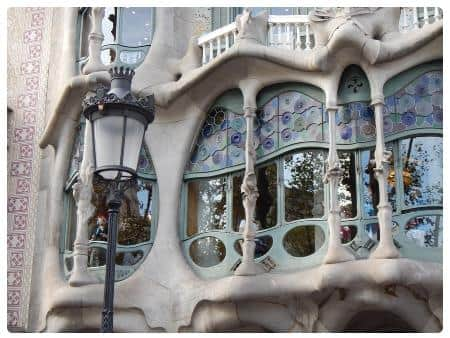 After
the work began, between 1904 and 1906 the façade and roof were
redesigned, other floors added and the interior completely
renovated. The façade at first visual impact is of
incredible aesthetic sense, the material used is sandstone,
covered by the ever-present coloured trencadis (a type of
Catalan mosaic). Typical of Gaudí, straight lines have been
avoided when possible. Gothic and Art Nouveau (Style Liberty)
seem to find here mutual influence of style. The lower-floor
balconies are similar to pillars made of bones, while the
upper-floor balconies look like pieces of skulls. Not
surprisingly, the local nickname of the building, while the
windows, which were enlarged in a sort of decoration on the
first floor, led to another nickname, 'House of yawning'. After
the work began, between 1904 and 1906 the façade and roof were
redesigned, other floors added and the interior completely
renovated. The façade at first visual impact is of
incredible aesthetic sense, the material used is sandstone,
covered by the ever-present coloured trencadis (a type of
Catalan mosaic). Typical of Gaudí, straight lines have been
avoided when possible. Gothic and Art Nouveau (Style Liberty)
seem to find here mutual influence of style. The lower-floor
balconies are similar to pillars made of bones, while the
upper-floor balconies look like pieces of skulls. Not
surprisingly, the local nickname of the building, while the
windows, which were enlarged in a sort of decoration on the
first floor, led to another nickname, 'House of yawning'.
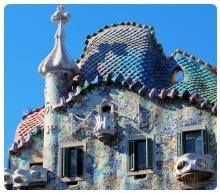
The roof is decorated with multicoloured ceramics in
brilliant colours, crowned by a tower with the typical Gaudí
look. According to the experts, who gave a key reading to the
Gaudian symbolism, the coloured staircase resembles a
reptile skin, going to represent the grotesque figure of the
dragon, while the small cross turret symbolizes the sword of St.
George. The bones and skulls on the façade represent all the
victims of the dragon.
 Inside
the building, the spaces have been completely reorganised so as to
obtain a more natural light (the courtyard is covered in blue ceramic,
progressively illuminated to guarantee the same or similar light on the
upper part and on the ground), even the ventilation has been studied in the
smallest details. Various decorative elements such as furniture,
glass, forged iron elements, fireplaces, etc. are shown, all of which have
been refined in detail according to the modernist taste of the master, who
loved to pause with the passion that only an artist can understand in the
care of the smallest details: doors, handles, bells.... Inside
the building, the spaces have been completely reorganised so as to
obtain a more natural light (the courtyard is covered in blue ceramic,
progressively illuminated to guarantee the same or similar light on the
upper part and on the ground), even the ventilation has been studied in the
smallest details. Various decorative elements such as furniture,
glass, forged iron elements, fireplaces, etc. are shown, all of which have
been refined in detail according to the modernist taste of the master, who
loved to pause with the passion that only an artist can understand in the
care of the smallest details: doors, handles, bells....
The creation of the building was also attended by other
prestigious names who worked under the instructions of Gaudí, in
particular: the architects Josep Maria Jujol and Joan
Rubió the Bellve on the facade, the Badia brothers
for ironworking, the carpenter Casas i Bardes,
Sebastià Ribo for ceramics and Tallers Pelegrí for
decorated glass.
Nel 2005 la Casa Batllo venne insignita dall'UNESCO come
patrimonio dell'Umanità e nel 2007 come una delle sette
meraviglie di Barcellona, ma sono tanti i premi ricevuti nel
tempo sin dal 1906. La ristrutturazione effettuata da Gaudí ha prodotto una delle
composizioni più poetiche e artistiche dell'artista. La visita
all'edificio include un itinerario di due piani dell'edeficio, il piano Noble (dove viveva la famiglia Batllo) che da accesso al cortile in
stile modernista di 230 m²,
l'attico, il tetto, l'intera sala, le scale... preparatevi ad
immergervi in un mondo di colore, mistero e arte decorativa
espressa alla massima potenza.
In 2005 the Casa Batllo was awarded by UNESCO as a World
Heritage Site and in 2007 as one of the seven wonders of
Barcelona, but there have been many awards received in time
since 1906. The renovation carried out by Gaudí has produced one
of the artist's most poetic and artistic compositions. The visit
to the building includes a two-storey itinerary of the factory,
the Noble floor (where the Batllo family lived) which
gives access to the modernist courtyard of 230 m², the penthouse,
the roof, the entire room, the stairs.... get ready to immerse
yourself in a world of colour, mystery and decorative art
expressed at maximum power.
Casa Batlló
Address: Passeig de Gràcia 43
Phone: +34 932 160 306
Neighborhood: Eixample
Metro: Passeig de Gràcia
Access: to pagination
Transportation
Metro: Passeig de Gràcia (L2, L3, L4) Tourist Bus: Casa Batlló - Fundació
Antoni Tàpies
Opening hours
Daily 9-21,00
Ticket price
Normal: 20.50 €, reduced: € 18.50
Children 0-6: free
Barcelona Card: 3 € discount
Where is it located?
Ostelli Barcellona
Ostelli Spagna
Hotel Barcellona
Hotel Spagna
Carte d'Espagne
Karte von Spanien
Mapa de España
Map of Spain
Carte de Barcelone
Karte von Barcelona
Mapa Barcelona
Map of Barcelona
|