|
The Danube
|
Napoleon
called the Danube "Le Roi des fleuves d' Europe".
We all learned at school during one of the geography lessons
that the three most important rivers in Europe are the
Rhine, Rhone and Danube. But the latter is
not only the longest river on the continent - more than
double the length of the Rhine and almost three times the
length of the Rhone - but also flows (and forms the border)
in eight countries different from the slopes of the Black
Forest on the banks of the Black Sea, where it flows
with a large delta into Romanian territory after a route of
2872 km. |
|
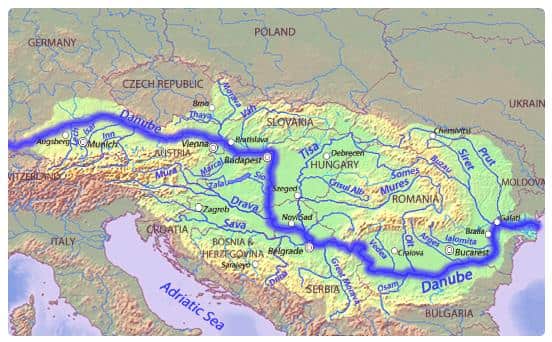
The Danube rises up in the German
Black Forest,
crosses Germany, the heart of Austria, forms the border between
the latter and Slovakia, then between Slovakia and Hungary,
before crossing it, then passing through Croatia and Serbia, and
then forming the border between Serbia and Romania itself, then
between Romania and Bulgaria, where it finally empties into the
Black Sea.
The Danube is conventionally born from the confluence of the two
streams Brigach and Breg to the east of
Donaueschingen, a German town of about 21,000 inhabitants in
the Black Forest in the south-west of the federal state of
Baden-Württemberg, famous for its beer production. The
source of the Donaubach in Donaueschingen itself is known as the
source of the Danube River (Donauquelle). Hydrologically,
the true source of the Danube is the source of the Breg, being
the largest of the two formative streams, which rises near
Furtwangen.
 Once
upon a time there was a bitter active rivalry between the
municipalities of Furtwangen and Donaueschingen
for the title of the city where the Danube was born. In 1981,
the state government granted Donaueschingen the fact that the
source of Furtwangen was no longer named Donauquelle
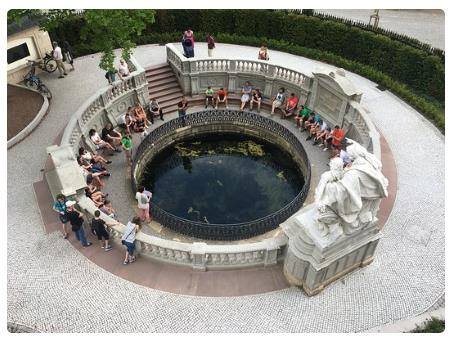
(source of the Danube) in the official maps. In Donaueschingen,
the "official" source is located on one side of the castle of
the Furstenberg princes. On the edge of the circular bathtub,
from the bottom of which there is a tender tumult of small
gorges with which spirals of bubbles intertwine, there is a
balustrade dominated by a group of statues depicting the
surrounding Baar region holding the young Danube in its arms.
2872 km separate that statue from the sea, a path along which
the West slowly and majestically vanishes. Once
upon a time there was a bitter active rivalry between the
municipalities of Furtwangen and Donaueschingen
for the title of the city where the Danube was born. In 1981,
the state government granted Donaueschingen the fact that the
source of Furtwangen was no longer named Donauquelle
(source of the Danube) in the official maps. In Donaueschingen,
the "official" source is located on one side of the castle of
the Furstenberg princes. On the edge of the circular bathtub,
from the bottom of which there is a tender tumult of small
gorges with which spirals of bubbles intertwine, there is a
balustrade dominated by a group of statues depicting the
surrounding Baar region holding the young Danube in its arms.
2872 km separate that statue from the sea, a path along which
the West slowly and majestically vanishes.
We are in fact about six hours by car from the main cities of
northern Italy. If you come from
Turin or
Milan,
you should base yourself in
Freiburg
(of Brisgovia, not to be confused with the nearby, homonymous
Swiss city), and leave here for a tour that will touch another
delicious city, home of ancient university:
Tübingen.
 The
Danube basin contains traces of early human cultures, such
as the Vucedol culture of the third millennium BC. Famous
for its ceramics and the Vin?a culture. From the first
millennium BC, the ancient Greeks explored and traded along
the lower Danube to the Iron Gate (where the Danube
marks the border between Serbia and Romania). Under Julius
Caesar, Rome expanded its influence along the Danube (Davinius);
Roman ships patrolled its waters while at the same time
creating the first military settlements: Aquincum (Budapest),
Singidunum (Belgrade),
Sexantaprista (Ruse, northern Bulgarian city) and
Vindobona (Vienna). The
Danube basin contains traces of early human cultures, such
as the Vucedol culture of the third millennium BC. Famous
for its ceramics and the Vin?a culture. From the first
millennium BC, the ancient Greeks explored and traded along
the lower Danube to the Iron Gate (where the Danube
marks the border between Serbia and Romania). Under Julius
Caesar, Rome expanded its influence along the Danube (Davinius);
Roman ships patrolled its waters while at the same time
creating the first military settlements: Aquincum (Budapest),
Singidunum (Belgrade),
Sexantaprista (Ruse, northern Bulgarian city) and
Vindobona (Vienna).
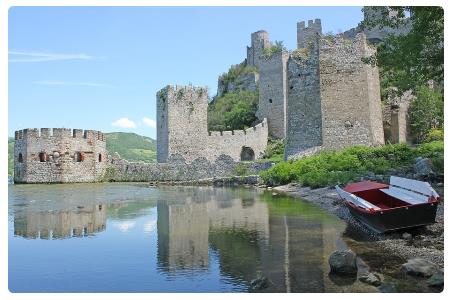
After the fall of the Roman Empire, Charlemagne
built castles and fortresses along the banks of the
river (such as Werfenstein Castle, built in the
century). Between the 14th and 19th centuries, the Ottoman
Turks fought over the Danube from the Hungarian and then
Austrian (asburgic) empires. For centuries, the river formed
the northern boundary of the Ottoman Empire. With the
Ottoman and Hapsburg disintegration after the First World
War, and the upheaval of the Second World War, the Cold War,
the Balkan wars and the formation of the European Union, the
Danube region has seen many changes in the last century.
Today, with its generally established borders, the Danube is
an important transport route throughout Europe and is
designated as "Corridor VII" of the European Union. Since
the opening of the Rhine-Main-Danube Canal and the
Danube-Black Sea Canal, the great river connects the North
Sea and Western Europe with the Black Sea ports.
 Over
the centuries, the Danube has been less important as an
economic corridor than the Rhone and Rhine, but it has
nevertheless been one of the most significant cultural and
historical boundaries in the history of the European
continent. During the Roman era, the river was the
northernmost border of the Roman Empire and until 454 A. D.
the whole length of the river formed the border a Roman
world that was collapsing and the barbaric invaders of the
steppes of Ukraine and Central Asia. Over
the centuries, the Danube has been less important as an
economic corridor than the Rhone and Rhine, but it has
nevertheless been one of the most significant cultural and
historical boundaries in the history of the European
continent. During the Roman era, the river was the
northernmost border of the Roman Empire and until 454 A. D.
the whole length of the river formed the border a Roman
world that was collapsing and the barbaric invaders of the
steppes of Ukraine and Central Asia.
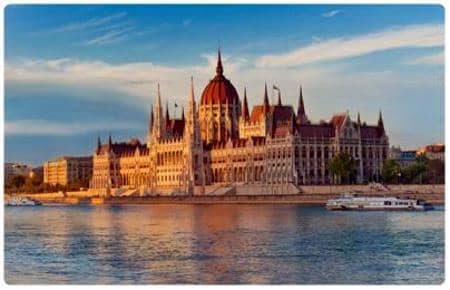 The
Roman heritage has given the river its importance as a
medieval trade route, both for navigation and along its
banks. This role has created important shopping and
political centres, including
Regensburg
and
Ulm
in Germany,
Linz
and
Vienna
in Austria,
Bratislava,
the Slovak capital,
Budapest,
the capital of Hungary and
Belgrade,
the former capital of Yugoslavia and now the capital of
Serbia. Bucharest, the capital of Romania, is not far from
the great river, being located between its banks and the
southern part of the Carpathian mountains. Many
cities along the Danube began their history as Roman
military outposts. Beyond Belgrade, the Danube enters the "Iron
Gates", a large corridor through the Carpathian chain and
the Balkan mountains and then flows into the plains of the
ancient Roman province of Wallachia. The flooding of the
Danube Delta has been a problem since Roman times (and still
is). Because of the floods, no major city has ever developed
on the Danube downstream of Belgrade. The
Roman heritage has given the river its importance as a
medieval trade route, both for navigation and along its
banks. This role has created important shopping and
political centres, including
Regensburg
and
Ulm
in Germany,
Linz
and
Vienna
in Austria,
Bratislava,
the Slovak capital,
Budapest,
the capital of Hungary and
Belgrade,
the former capital of Yugoslavia and now the capital of
Serbia. Bucharest, the capital of Romania, is not far from
the great river, being located between its banks and the
southern part of the Carpathian mountains. Many
cities along the Danube began their history as Roman
military outposts. Beyond Belgrade, the Danube enters the "Iron
Gates", a large corridor through the Carpathian chain and
the Balkan mountains and then flows into the plains of the
ancient Roman province of Wallachia. The flooding of the
Danube Delta has been a problem since Roman times (and still
is). Because of the floods, no major city has ever developed
on the Danube downstream of Belgrade.
The trade corridor along the Danube gave rise to two major
kingdoms, Austria and Hungary, which merged under the
Habsburgs
in the early 19th century and became the Austro-Hungarian
Empire in 1867. Further downstream, the plains included in
the Wallachia floods formed a significant boundary between
modern Romania and Bulgaria, allowing a significant cultural
border between these two regions. In fact, the Lower Danube
has become a critical cultural frontier region between
Austria and the Ottoman Empire. Romania and Bulgaria still
today reflect their respective and separate stories with
Romania, which has a neolatine language, and Bulgaria, which
have fundamental historical affinities in architecture and
traditions with the Ottoman Empire.
The
Danube in European culture
 Over
the centuries, civilisations along the Danube have contributed
predominantly to some of the most important artistic movements
in European history, and the Danube itself has inspired a wide
range of works across the entire artistic spectrum. The Danube
region has generated many works and artistic movements over the
centuries, ranging from religious art in the Middle Ages to
painting and sculpture from the Renaissance period. The most
notable are the painters of the so-called "Danube school"
of landscape painting, which emerged in the first three decades
of the 16th century, especially in the Danube valley in Austria
and Bavaria, including Albrecht Altdorfer (Regensburg),
Jörg Breu the Elder (Augusta)
and Wolf Huber (Passau). They were among the first
to engage in pure landscape painting and employed a highly
expressive style. Over
the centuries, civilisations along the Danube have contributed
predominantly to some of the most important artistic movements
in European history, and the Danube itself has inspired a wide
range of works across the entire artistic spectrum. The Danube
region has generated many works and artistic movements over the
centuries, ranging from religious art in the Middle Ages to
painting and sculpture from the Renaissance period. The most
notable are the painters of the so-called "Danube school"
of landscape painting, which emerged in the first three decades
of the 16th century, especially in the Danube valley in Austria
and Bavaria, including Albrecht Altdorfer (Regensburg),
Jörg Breu the Elder (Augusta)
and Wolf Huber (Passau). They were among the first
to engage in pure landscape painting and employed a highly
expressive style.
Many cities along the Danube or its basin have seen the birth or
living many of the world's greatest composers of the last three
centuries. The great river has inspired poets and writers like
Jules Verne (Le Pilote du Danube). A wide range of
universities, monasteries, libraries, art and history museums,
orchestras, opera and theatre companies and other cultural
institutions have thrived - many of them for centuries - along
the Danube River... both in major cities such as Prague, Vienna,
Bratislava and Budapest, as well as in less populated areas
along the river, such as Melk Abbey in the Austrian
Wachau Valley.
Some
national foods from the Danube region
Germany: Together with its beers, breads and cheeses,
Germany - in particular Bavaria - is renowned for its
bratwurst, a sausage typical of German cuisine, generally
made from veal, pork or beef. In a tavern in Regensburg, this
sausage has been served in the same way for 500 years - grilled
on charcoal, served with sauerkraut and mustard.
Austria: In Austria, schnitzel wiener - the
traditional Austrian dish with boned meat, beaten with a bunch,
then fried in an egg coating and breadcrumbs.
Slovakia: A national speciality characterised by
traditional Slovak restaurants is Bryndzové halušky, a
plentiful meal that effectively combines two dishes - halušky
(drinks dumplings gnocchi potatoes) and bryndza (a soft
sheep's cheese).
Hungary: with roots from the 9th century A. D.,
goulash - a dense broth with stew of meat, vegetables and
tagliatelle and flavored with paprika and other spices - is the
Hungarian national dish, but almost all countries along the
Danube have their own national version.
Wine
The Danube River Valley is home to many world-class wines and
viticulture dates back almost 2,000 years. The first
wine-growing areas in the valley include Wachau,
Kremstal, Traisental, Kamptal and Wagram.
The wine varieties in the region include Grüner Veltliner,
Roter Veltliner, Riesling, Zweigelt and
Blauphränkisch.
Copyright © Informagiovani-italia. com. Reproduction in whole
or in part, in any form, on any medium and by any means is prohibited
without written permission.
If you liked this guide and would like to help Informagiovani-italia. com
help us spread it.
Back up
Ostelli Vienna
Ostelli Austria Carte de la Autriche Karte von
Österreich Mapa Austria Map of Austria
Carte de Vienne Karte von Wien Mapa Viena Map of Vienna
|